I am forced to get off the comfy king sized bed – the urge to write overrides the laziness I feel when faced with the chore of getting on my wheelchair to go to my bag and dig out the moleskin notebook. I momentarily chide myself for not being forward-thinking enough before I got onto the bed in the first place. Being in a wheelchair teaches one the economy of transfers. But laziness and the desire to write are strong competitors, and the urge to put pen to paper wins, almost every time. This is how I know I am a writer. I do it compulsively. I don’t just want to think this stuff – I want to capture it for later when I want to recall the weekend. I want to revisit the Lego-like image of plane after plane taking off and landing across the water of Botany Bay – as I view them from my balcony window in the Novotel Sydney Brighton.
The planes are thunderously loud. They boom across the sky. At night it seems they are louder than during the day, as if the day-air somehow absorbs and blankets the sound. Chunky Sydney air – thick with moisture always – so different from Perth’s air – gauze thin. On a still Sydney night the jets crack the sky. Some dogs must hate this; living beneath the flight path. Others must habituate to the noise and become the seriously bomb-proof hounds.
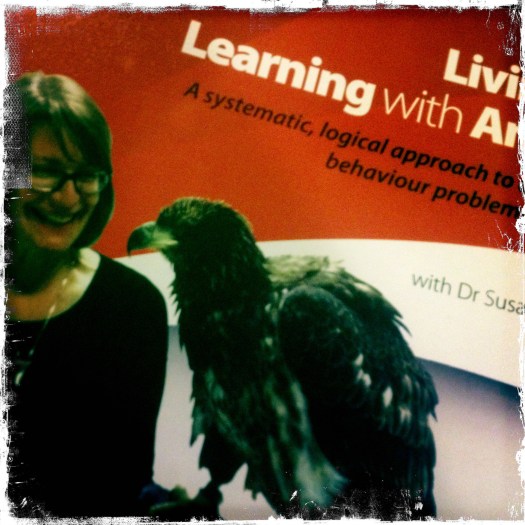
Susan Friedman is an Applied Behaviourist and specialises in teaching people how to assess behaviour across all species. She has a penchant for work with captive birds. She has talked for two days solid. A true New Yorker, despite living and teaching these days in Utah. Some heavy reinforcement must have been declared, since she has turned a normally 8-week long course into a two-day seminar. “Strap yourselves in,” she tells us; peppers us with “Good Job”.
She is not speaking to the uninitiated in behaviour. It is an audience of veterinarians who are interested in behaviour or have done further study, of animal trainers, of zoological keepers and behaviour practitioners. I guess we could be considered a weird bunch; heavily analytical and deciphering. Even making her morning coffee with a new machine, Friedman, sees behaviour in everything she does.
And why wouldn’t you? It is one of those areas. The more you learn about how animals learn the more you see the world through a behaviourist’s eye. From a gnat to a blue whale – we all learn the same. Through motivation. Through being reinforced. Through wanting to move towards something or escape something else. The more we study behaviour across species the more we see the similarities, especially when it comes to learning and behaviour. There was a time, sadly not that long ago, when we concentrated on the difference between us and animals, even believing animals felt less pain than we do and hence operating on them without adequate pain relief following. That seems ludicrous now.
Susan Friedman has a simple message for all. Behaviour is what animals do – all of us – on Earth. To change behaviour is simpler than you think. What comes before the behaviour is called the antecedents – the environmental circumstances that the behaviour happens in. And what comes after the behaviour are the consequences of the behaviour itself. So, if a dog bites a hand, the bite is the behaviour, and the hand being near the dog is the antecedent and the consequence is that the hand goes away. To successfully change the behaviour we can work both with the antecedents and the consequences. We can change the way the dog thinks about an approaching hand by positively reinforcing the approach of the hand. Much behaviour can be managed by changing both the consequence and the antecedent before addressing the behaviour itself. Looking closely at the consequence of an animal’s behaviour can tell us what it was doing the behaviour for in the first place.
Having worked with delinquent children she sees the need for working ethically and changing behaviour by trying the least intrusive method first. This means we should not be reaching for shock collars when we deal with a barking dog as a first port of call. (I would say there is always another way.) Ethics demands we explore the least punitive measures first and so therefore, with our barking dog, as an example again, we should ask at what and when does the dog bark? Can we first manage the environment to stop the dog barking?
It was one of those conferences that sees you delving into the behaviour of your child and spouse and unpicking their behaviour in the behavioural assessment kind of way. And holding the mirror up too. Perhaps it is as simple as reinforcing the behaviour you want. She told the delightful story of a group of psychology students who successfully manipulated their professor to only teach from one corner of the lecture room. Whenever he moved towards that corner they became more attentive, listening and nodding, smiling as he spoke. When he moved away from that corner they looked down and uninterested, fiddled and feigned disinterest. By the end of the term he was indeed corralled exactly as they had planned – all with the use of positive and negative reinforcement.
A mantra she taught us to ask when looking at behaviour is, “What is the Function?” Use this when studying behaviour and you can see how useful it is. Perhaps when people believe they are unable to change a behaviour then it is because they are invested in the behaviour continuing unaltered.
She also talked to us to be wary of the investment in“story”. As behaviourists let us not get too caught up in how the behaviour developed in the first place. It is common for people to want to tell you stories of how a dog’s jealousy, anger or fear arose, but as behaviourists, we should concentrate more on teaching animals what to do and be less concerned on what NOT to BE. This too carries over to children who, for example, have been shown to do less well at school once a label; such as having a “learning disorder” is attached to them.
Most clients will want the tool to “stop” a behaviour that is causing them problems, when really they would be better served asking themselves what would they like the animal to do instead – and then teach it. It sounds simple and is – but this is not the same as easy – since people live in a “cultural fog” of misinformation regarding animal behaviour – from thinking animals should just do it because you have asked it of them, to believing that animals are incapable of learning anything at all.
At the end of the two days, as the organisers were getting ready to thank Susan for her talks, the fire alarm went off. Loud.Persistent. The conference could not continue over the siren. Intermittently a recorded voice came on and asked us to stay where we were and await further instructions. I thought of 9/11 and the people who died because they heeded that advice. I thought we should leave the building. Isn’t that what you do when a fire alarm goes off? After several minutes the alarms had been switched off and another announcement told us the source of the problem had been located. Susan was presented with a sculptured galah, which she sincerely claimed to love. A behaviourist till the end, she left us saying she hoped she wouldn’t be paired forever more with the piercing sound of a fire alarm. The lectures were over.
I ascended the building in the lift and could smell the smoke as I entered the sixth floor. I could see no smoke. In the corridor two heavily clad firemen stood by the entrance to the laundry. They had tracked the smoke to the laundry room where someone had set a meal aflame in the microwave. The perpetrator had fled with the burning meal and the smoke had made the alarms go off. Now there was just unmistakable taint of smoke and burnt food lingering.
I spoke to the firemen because. Because they are in yellow, with bulky suits and because they are firemen. FIREMEN. Since our own house fire, years ago, I have the conditioned response to firemen (the conditioned stimulus) of going weak at the knees and running off at the mouth. I hovered about them as they measured the smoke with their machinery. I asked them about the rule of not using a lift in a fire. They said I could use it. The lift was for them and me. They said the person who had set the meal on fire could be charged with a criminal offence if caught. I thought of the learning we had been doing moments before downstairs. Of how punishment is entrenched in the way we humans do stuff. Despite there being no injury or damage caused, the punishment inflicted could be severe. Deterrent enough to being caught. If the world could become the tiniest bit like the world offered up by Susan Friedman we could see more harmony between our species too.


 the chook house