Talus

When G moved in many years ago, the wooden shelf above the old Metters cooker held a handful of my special objects. I am not sentimental and I don’t keep stuff. He took over the shelf and it became his place for his eclectic array of old toys and figures.


One of my special objects is the talus bone from the hock of a horse. It is sculptural. It is smooth and hard. It has a groove, so that when the bone is held in your hand like a ball, your finger lies snugly there. It has no smell. It is inert and unchanging. No hint of rock or wood. It is heavy and yellowed like aged parchment.


I am lying in hospital, only weeks since car collided with tree and my own spine snapped like a mere twig.


A bearded man comes to visit. Like many before him he brings a gift. Others have brought flowers and food. He is not like others. He still wears tweed jackets with leather patches at the elbows. He walks with a swagger like his trousers are too big, his feet unknown to him.


I am not able to sit up. I lie alternatively on one side and then the other and finally flat on my back. The bed has a special name. Every two hours it swings into action, operated by a single nurse. It is a spinal bed, designed to prevent pressure sores while the patient is immobilized. When finally I move to the spinal ward the bed will be replaced with three men whose job it is to turn people without twisting their spines. They are called the turning team. I grow to love them. To drink I use a sipper cup like a baby and am fed spoonfuls of mush as I lie on my side. I give up eating.


He enters the ward and stands looking at me. Everyone does this. Inspects me. I am a prisoner to their gaze, strapped into my bed. In his hand, held down by his side, is the bone. Perhaps he thinks twice before parting with it. He holds it like a bowler walking to his mark. Before he gives it to me he makes me name it. Talus? The most beautiful of bones. The man is an anatomist. Structure and function is his thing. He is giving me a treasure.


He pulls up a chair. Even someone as clunky as he can sit, can walk, can move. It irks me. He hands me the bone and my finger finds the groove too. Something to hold, he says.


I will never work with horses. I will never work with cattle. But I can admire the design of nature and together we talk about the magnificence of the horse. My fingers can feel the bone. They can find its curves, its waves, its hollows.


We talk of the stay apparatus of tendons in a horse’s legs that allow it to stand for hours without becoming tired, the chordae tendineae in the valves of the heart, the cleverness and delicateness of any spine. You are still a vet, he says to me.


My eyeballs are aching. Tears amass behind the globes. How many tears can you cry before you can make no more? Did you know the tears of sadness are not the same as those when you have grit in your eye? But I don’t really know the bearded man. He is a lecturer. He is kind. He understood that vet students were not always intrigued by the curves of the liver and the way the diaphragm shouldered it. He stood at the front of the lecture theatre and performed, all the while hitching up his trousers. He tried hard to get us to love anatomy as much as he did.


Seated at stainless steel tables we worked on the formaldehyde cadavers of greyhounds not fast enough to run the track. The smell attacked your nose and made your eyes sting. Tears of the unsad kind. We rushed through our labs to get away from the fumes. We didn’t draw neatly enough. We didn’t take enough care. We failed to see the beauty in the talus when it was shown to us.


Now I see it. I cherish it.


Empty Nest


The Robinia is still recovering from the storm. The edges of its fragile leaves are brown and bruised. It is not how it usually looks in summer. It is autumnal, bedraggled.

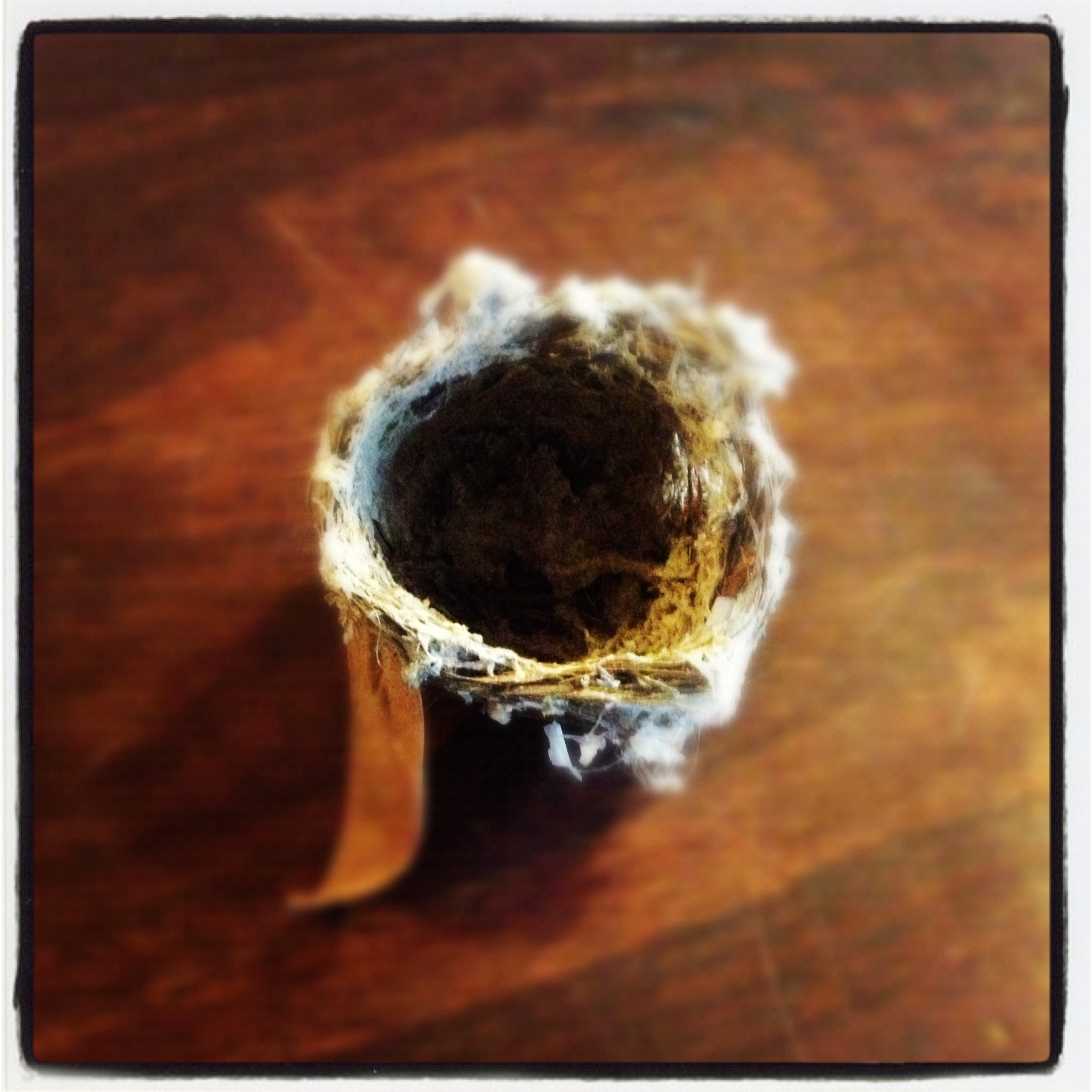
The Willy Wag tail nest is still there. Stoic and strongly harnessed to its branch. But it is empty. No longer do the busy little black and white birds make their way, back and forth, with bounty from the grass.

Where do Willy Wag tails go to grieve?

***

Mrs. W is in her seventies. She wears a polycotton blue and white floral print dress for her visit to the vet. It is a happy dress. Benny is her Jack Russell terrier with a long history of heart disease. We have battled his belly, which grows rigid and tight with oedemtaous fluid, but the belly has won. The skin is drawn tight over the gourd-like abdomen. She keeps a measure on the size of his belly with her dressmaking tape. Today it measures 60cm. I think of Elizabeth Taylor playing Scarlett O’Hara and her less than 20-inch waist.

I can tell by the quiver in her voice. The way she holds him into her chest, that she has come to say goodbye. The medication is no longer working. His heart sounds like a working washing machine. She tells me he is not eating and he looks at her as if to say, help me, I’ve had enough.

Is she anthropomorphising? Yes. No doubt. So what. He is her only close companion these days. He is human to her.

We decide that, yes, Benny has had enough and together we will be saying goodbye to him today.

I imagine her at home, before the visit, before she has rung for the appointment. She has had to build up to this. She has tried all the foods she is not supposed to feed him, to see if he will eat. Streaky bacon. She has doubled his diuretics. She has decided to ring and then waited another day. She has sat and watched him through the night. She has dialed the number and then hung up before the phone has answered. She has driven past with him in the car and even into the car park, but turned about again and gone home. He follows her around the house, into the bathroom. She sleeps with her hand on his chest, feeling it madly vibrate beneath her palm. She has prayed that he will drift off in his sleep. She wonders how big his abdomen can get. How much can one little dog belly hold? Can it pop like a overinflated balloon?

I sedate him, and while the medication takes effect, Mrs W tells me about her old mum who recently passed away. Her mum was in a coma for days, being given morphine and not able to communicate, but, before she died she opened her eyes and looked around. She saw her daughter there and then turned her head towards the window and in the light that beamed through her daughter was convinced that her mother saw someone waiting for her. She had a wonderful, not-often-seen, smile on her face. The daughter believed it was her brother – the boy who had died of peritonitis when he was a three-year-old infant. It gave her enormous comfort to think of her mother, who had grieved all her life for her son, as reuniting with him. She then went on to tell me the story of the boy’s illness and his death. She had been five years old. She had a memory of her mother dressing the child to take him to hospital on what would be his final visit. Before this, her memory was one of his seesawing illness and her anxious parents. She remembered her mother’s tears as she reassured the boy that he would be made well.  But the small boy cried that if he went to hospital he would never come back. She promised him that he would get better. And as I am expressing my sympathy for her dear old mum and how terrible it must have been for her to lose a child she tells me that yes it is unfathomable. She says it is 2 years, 4 months and 3 days ago that, at the age of thirty six, her daughter took her own life.

Benny is feeling the effects of his sedation. His head is lowered. We both touch him. Unison of strokes. She has his head cradled in her cupped hands. She will never be ready to let him go. Wrapped up in him now is all the loss in the world. She is weeping across him. She is weeping for her mother, her brother and her daughter. She is feeling an ever enlarging whole of empty pushing its way out through her chest. Fat droplets of tears are running across her face. Blue tissues turn wet and soggy in her hand.

Now she tells me about Benny. How he came to her from a home where the children teased him and he was never allowed inside. She said he didn’t know how to play when she got him. He only knew how to hide. She asked if it was her fault that his heart was the way it was.

I held her hand and we let Benny go.

We both wondered aloud, whom Benny was off to join in the light. She thought of a previous old dog, that Benny had known, one that knew how to fetch tennis balls. He would be waiting and ready to teach him to play.

Mrs. W goes home. She takes Benny’s collar and lead. They have his smell. The lead is impregnated with his white hair. She will pick them up and holding them will remember him. His tight bellied waddle following her about the house.

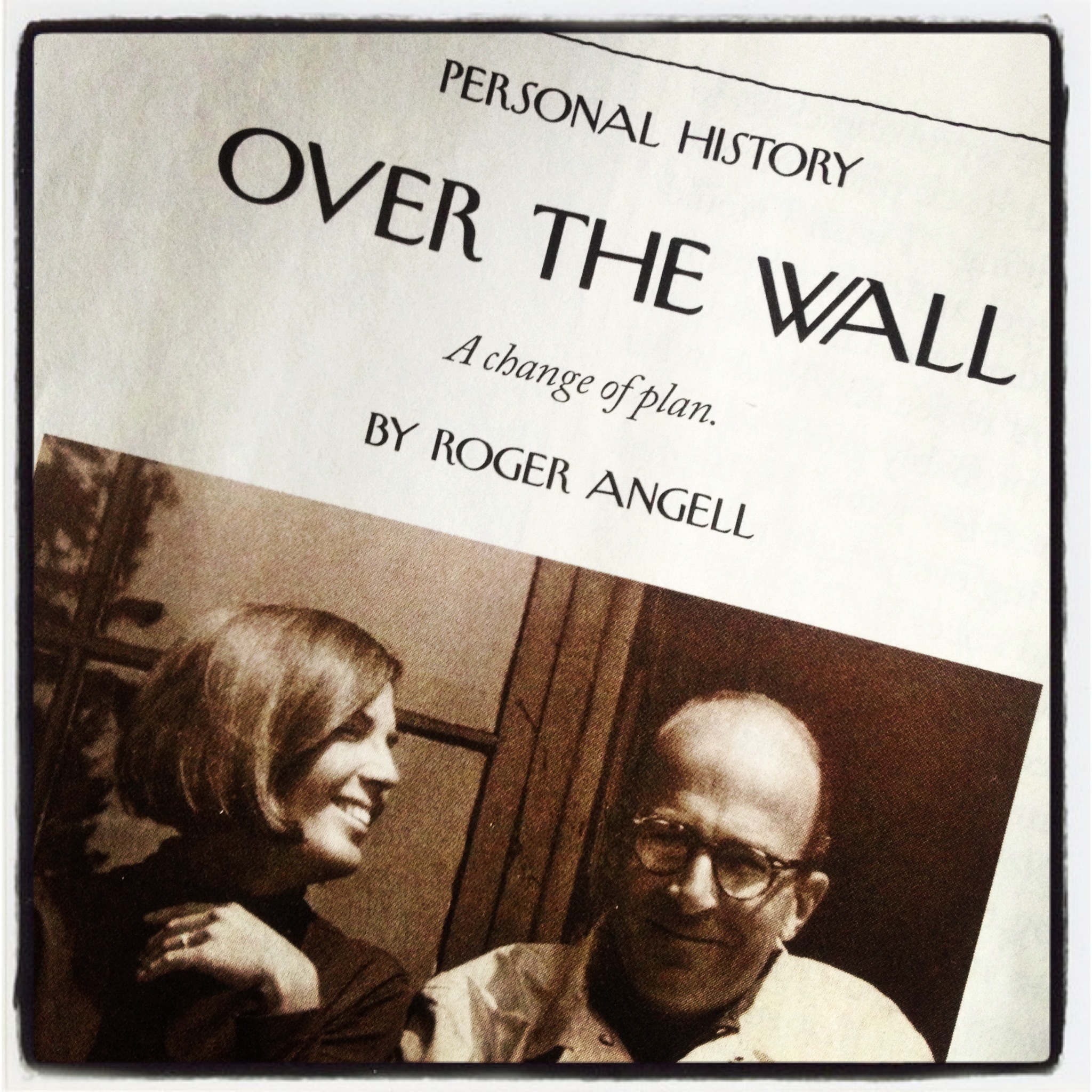
Roger Angell on Loss

Roger Angell, writing in the New Yorker, says it all perfectly…

“My wife, Carol, doesn’t know that President Obama won reelection last Tuesday, carrying Ohio and Pennsylvania and Colorado, and compiling more than three hundred electoral votes. She doesn’t know anything about Hurricane Sandy. She doesn’t know that the San Francisco Giants won the World Series, in a sweep over the Tigers. More important, perhaps, she doesn’t know that her granddaughter Clara is really enjoying her first weeks of nursery school and is beginning to make progress with her slight speech impediment. Carol died early last April, and almost the first thing that she wasn’t aware of is our son, John Henry, who is Clara’s father, after saying goodbye to her about ten hours before her death, which was clearly coming, flew home to Portland, Oregon. Later that same night, perhaps after she’d gone, he had a dream, which he wrote about briefly and beautifully in an e-mail to the family. In the dream she is hovering close to him, and they are on 110th Street, close to the Harlem Meer, at the Northeast corner of Central Park. The Park is bursting with spring blossoms. She is walking a dog that might be our fox terrier Andy. Then she falls behind John Henry. He turns to find her, and she has become an almost black shape and appears to be covered with feathers or black-and-dark-gray Post-its. She and the dog lift off the ground and go fluttering past him, and disappear over the low wall of the park.

What the dead don’t know piles up, though we don’t notice it at first. They don’t know how we are getting along without them, of course, dealing with the hours and days that now accrue so quickly, and, unless they divined this somehow in advance, they don’t know that we don’t want this inexorable onslaught of breakfasts and phone calls and going to the bank, all this stepping along, because we don’t want anything extraneous to get in the way of what we feel about them or the ways we want to hold them in our mind. But they’re in a hurry, too, or so it seems,. Because nothing is happening with them, they are flying away, over that wall while we are still chained and handcuffed to the weather and the iPhone, to the hurricane and the election and to the couple that’s recently moved in downstairs, in Apartment 2-S, with a young daughter and a new baby girl, and we’re flying off in the opposite direction at a million miles an hour. It could take many days now just to fill Carol in.”

Stay In Your Nest

It is windy. Not just windy. Howling. Pull-you-from-your-feet-windy. Umbrella-inside-out-windy. Skirt-up-around-your-ears-windy. Trees roots are holding on tight whilst their branches and leaves flail about. I am safe in my stone house. It has stood for a hundred years. Compared to weatherboard cottages I have lived in, I feel unflustered. You know the ones that creak and grind like they are about to be blown off their stumps. I cannot be swept up. Inside we huddle. After school television. Marinating chicken in red wine. So different from a week ago when we were on the beach at Rottnest, worrying about too much sun.

Storm-phobic dogs dose up on your Xanax.

I think of the Three Little Pigs. I think of their house of straw. Their house of sticks. All could be blown down by a Huff and a Puff. But not the stone house. Instead through the chimney, he came. Only to be boiled in the pot.

But outside the weather is fierce. And real critters must contend.

There is a Willy Wag tail nest in our Robinia. It has three pink-mouthed chicks in it. They are all greedy beak, stretchy neck. The Robinia’s pretty soft leaves are whisked into a green frenzy. A fluorescent green feather boa. Bits of her are torn away from the trunk. The babies in their nest must feel like a cork at sea. They are buffeted. Endlessly. What can their parents do? They fly back and forth with the insects they have caught. The red mouths gape open. Don’t lean out little ones!

I ask Graham, “Can you check the willy wag tails?” He looks up, searchingly. “Oh No,” he says, peering up. “I can’t see the nest.” He looks down and scans the garden. He looks up again. After all it is small and the tree is flinging about.

“No. The nest is still there.” He calls back, relieved. It is wedged into the fork of two skinny branches. It is deep and cupped. It is no flimsy structure.

Hang in there babies.

Behaviour in Bankstown

I am attending the Association of Pet Dog Trainers in Bankstown, Sydney.

It is an annual conference where all the dog-lover types get together. There are trainers and breeders, animal shelter and rescue workers. There are people who work with animals for film and television, trainers for service dogs, and people who work with zoo and exotic animals and a handful of veterinarians and vet nurses. What we all have in common is the want and desire to see animals treated well and trained correctly. Positively. I get it, I do.

Let me generalise and tell you they are mostly women; older, with sensible hair, devoid of artificial colour, left to go grey because, well, who can be bothered with hair dye anyway. And it’s probably been tested on bunnies in the first place. They wear sensible slacks and sensible shoes and little or no makeup. They huddle around displays of interactive dog toys like, well, dog trainers.

It’s rare to be in a place with so many other dog-people. Granted, I am used to them, since I am a vet. But being here makes me one of them too. We are a bit obsessed. We are a bit preachy. Changing the world through dog training? Who are we kidding? Yet we persist. Amongst the converted it feels okay to be this excited about an interactive dog toy, and spending money on things a dog really just wants to chew up.

What I discover is that I am on the right track in regards to the advice I give owners with dogs with behaviour problems. I am following a well-worn path, laid down by the likes of Karen Pryor, Jean Donaldson and Patricia McConnell. These animal behaviourists follow a scientific approach. Behaviour is a response to environment. From the smallest to the largest creature – we all learn the same. If we perform behaviour and something good becomes of it, we are more likely to do it again. It’s all about reward.

With the rise of popular dog training shows, that do not follow positive reinforcement, there is a general public perception that dogs are out to dominant and rule the world. But dogs are not seeking worldwide domination – they are just looking for the tasty morsel and the easiest way to get it. They are sometimes scared and anxious, and lashing out at the unfamiliar because they have been unsocialised at critical periods in their development, or else have had a bad experience during these sensitive periods. Have we forgotten that dogs are animals? It seems to me, we often think dogs should be able to get over their distress without recognising that humans have irrational fears themselves where no amount of “buck-up, get over it” rids them of their alarm.

This was brought to light perfectly by one of the speakers, American trainer, Pat Miller. She flashed a series of large slides to the audience of three hundred dog-lovers. The images ranged from snakes to babies, to tattoos and praying mantises. Then she asked us to gauge our response – neutral, positive or negative. She asked if anyone had a very strong negative response to a picture. When it came to the praying mantis a woman sat with her hands covering her face. She was crying and shaking. The image needed to be removed before she could bring her hands down and tell her story. People comforted her as she got through it. She spoke of how, when she was a child, she saw a tree covered in hundreds of them. Perhaps the trunk appeared to be moving? She didn’t know if it was even a real image or something she had imagined. She could hardly speak of it. She was so terrified of the insect that she had sought therapy, which hadn’t been successful, and had once dropped her baby when confronted by the insect on the pavement. Pat Miller’s point was that there was no easy way for this woman to lose her fear. Even though she knew it to be irrational. She had an emotional response on seeing the insect. Something was triggering primal fear, deep in the amygdala of her brain. And this is akin to what dogs are going through when they are barking and lunging at the end of the lead in terror of the unfamiliar. They are having an emotional response. We cannot reach them then. No amount of correction or alternate behaviour training is accessible to a brain running on fear. Our job as trainers, she said was, to turn around the emotional response. Only then could we bring permanent change to behaviour.

So…not so easy.

And now let me tell you about my experience of Bankstown. It was mostly confined to the interior of the sports club. You know the kind of place. It has garish carpet that has had lots of beer spilled on it and still seems to ooze tobacco, even though people are no longer allowed to smoke inside. It has pokies. A section of the sports club is set aside for the glossy gaming machines that whiz and ping and occasionally burp coins. People sit in front of them, transfixed by the shiny baubles, and shove money at them. I guess it is the perfect example of intermittent reinforcement at work. Just like the dog, who sits beneath the toddler’s high chair, knowing that every now and then a treat is falling from above due to the baby’s low skilled cutlery control, the gambler keeps feeding the machine the coins, knowing somewhere down the track the windfall, however puny, is coming. Any minute now.

The ATM in the foyer has a sticker on it that tells punters the chance of winning is less than a million to one, and to THINK! of their families. Perhaps the print is too small.

It is its own whole world inside the sports club; there is a rain forest with brooks and streams and ferns and moss, and a Tuscan village, complete with cobblestones and drying washing from the high verandah window. In the cafe, while having breakfast, an elephant can be heard trumpeting.

One day, beginning to feel the claustrophobia of being inside the club, I decide to walk out into the street. I find myself in Vietnam. The grocers sell Asian vegetables and the meat shops are full of different cuts of meat. The fish shops have no fillets, just whole fish with fresh eyes agog. Old Vietnamese men in loose cotton shirts and long trousers play checkers on street corners smoking cigarettes. Small girls are done-up like princesses with shiny shoes and frill lace socks.

All roads and signs lead back to the sports club. It seems to suck people into its interior. It is cool. The perfect temperature. The drinks are cheap. Filled to the brim. There is entertainment for the kiddies. You can pretend you are really eating in Italy. You never need leave.

I find my spot back in the Grand Ballroom to hear more about the amygdala – the emotional centre of the brain. I love the word. Like Bollywood and Hippocampus. Like mandala and myriad. I think of it like a little hot spot in the brain – making mayhem. I think of my dislike (well come on, it’s almost phobic) to small and large rodents alike. It stems from a childhood experience when a mouse ran up my out-stretched arm, as I reached into a cavernous wheat bin, to fill a tin, in order to feed the chooks. It didn’t hurt me. It didn’t bite me. It wasn’t even that shocking, at the time. It just zoomed up my arm, leapt from my shoulder and disappeared. Now. It is their feet. Scurrying. It is their tails. Their hairless scaly tails. It is irrational. But they give me the creeps and I cannot handle the sight of them, the sound of them, or the knowing that they are nearby.


Missing

I think of her everyday.

I have a bookmark, made for her funeral, loose in the console of my car. As I drive to work and stop at the lights I handle the glossy card. The picture is of her on the phone, laughing. I imagine she is talking to a friend. Or perhaps she is talking to me.

She would be telling me about the Not Guilty verdict of Lloyd Rainey. Together we would scoff. She would be asking me to place a bet on a horse running in the Melbourne Cup. She would choose it because she liked the jockey or maybe the gelding’s name. She would be barracking for Obama.

I hold the card while I drive. Hi Mum.

I think of her everyday. I tell her stuff.

But it is different from when she was alive. Then, I was needed to do things. I had mandarins to buy. I had magazines to purchase. I had appointments to arrange. To drive to.

I grumbled to friends and family about the burden of the tasks. I felt smothered by her need to see me. Her joy, as a I entered her dimly lit room, only made me sigh.

To turn around now and say I miss her seems fickle. I feel unable to tell the people I complained to, that really it is simple, I miss her. I miss her everyday.

My life has a new rhythm without her in it. No nagging need to get this, do that. But. I miss her everyday.

No one is as interested in me in the greedy, consuming way she was. She had a need to know everything going on in my life. I, of course, hid it from her. I didn’t let her in. Not really. I kept it to myself. The way I do most things. From most people. Like a kid who shields their work with their cupped hand from the kid sitting next to them. Somehow petty. I wish I had shared more.

She would have been thrilled to hear about my recent trip to Sydney. She grabbed at stories. She gulped them in. She wanted my fulfillment. She wanted me to have happy experiences, with beautiful things. To stay in flash hotels and go to fancy restaurants. She wanted me to do the things she wished she had done, so I could tell her about them. I would watch her eyes fill with sparkle at the stories I would bring back from elsewhere. She could then have news for her carers and her hairdresser. She could be the entertainer then.

I imagine her sitting up in bed, watching the Presidential race. And Charles and Camilla happen to be in the country too. A feast of news. And Thank Goodness, no football. Her thin blue ankles on the plush throw rug. Her Hush Puppies by the bed. She will have a cold cup of tea on her tray. She will sip from it anyway. She will wrap the uninteresting biscuit in a Kleenex and put it with the others in the bedside drawer. I will attempt to ditch some older ones when she has her head turned.

I will give the flowers fresh water from the tap in her bathroom. I go through some letters she has piling up by the television and see what I can throw out. She will not allow any to be binned.

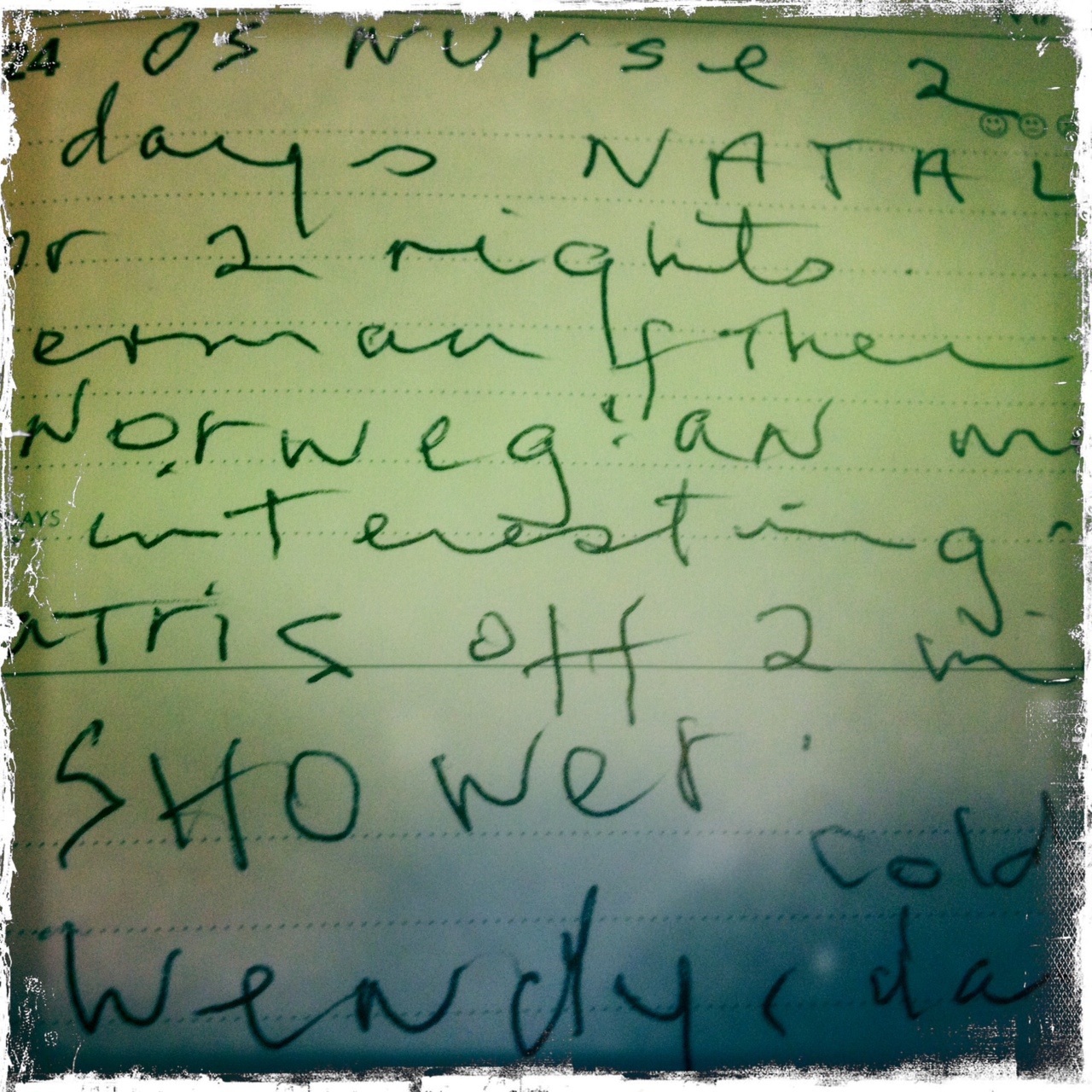
She will ask me to mark some dates in her diary. In here she writes which carer has given her the shower and who was on night duty. These are the things that are important to her. She will ask me to write when I am coming again. Is it tomorrow or the next day?

Halloween

Graham researches the internet for the makeup requirements of a zombie face. It morphs, as only internet research can, into how to do a half unzipped zipper face where the flesh around the mouth is exposed. Sixteen million other Halloween hopefuls have followed this google path. All manner of gory can be found – you just need to click. Someone else demonstrates how to do a face half-eaten away, a fake tongue half-ripped from the throat. You can find anything on the internet. Degloving injuries to get a plastic surgeon’s heart all a flutter. Graham is transported from his other unusual distraction of the moment; the construction of his own steady-cam from hardware found around the house, a skateboard shop and Bunnings. All for forty-five dollars. There is gluing, hammering, use of the oven. The guys at the skateboard shop know what he is up to when he asks to buy a single bearing for a gimble. Making your own steady cam – cool man.

A zombie face is made with a paste largely made of kaolin. A bit of kitchen sponge with rounded corners to apply. For a house of natural, blemished faces, unaccustomed to makeup of any kind, it requires the rapid attainment of a new skill and a trip to the discount chemist warehouse. The goo is plastered to the skin of the semi-reluctant ten-year-old model. But it is preferable to the plastic mask from last year, with its claustrophobic, I-am-buried-alive feel. The paste is grey blue. The colour of rot. Beneath the eyes black and purple eye shadow complete the putrefaction. The fake blood dribbles from the ears. He will not be saved. As the blood dries, it cracks and peels, lifting like decomposing flesh.

First we have piano lessons. It is Gypsy’s first time teaching the undead. Jasper plays a lullaby while blood congeals around the edges of his lips. His unmade-up hands are angelic and swift across the keys. Meanwhile his face continues to die a little. His teeth are too white, too perfect. Next time we will have to go the whole hog and get the teeth rotting goo. Sweet piano music from the fingers of a decaying boy. It is itchy beneath the mask. An instinctive scratch reveals healthy skin beneath the grey. A touch-up in the car will be required.


from “Swimming Home” by Deborah Levy…

I devoured this short book on a plane ride home from Sydney. It was a gift. Delivering me from myself into a world of a French holiday villa and a troubled young woman in love with a poet. While the pinstriped-suited business man next to me, clamped in his Bose headphones watched Spiderman followed by Brave and then episodes of Modern Family, I was reading sentences like, Kitty stared at the sky smashing against the mountains. It is a book – mystical and magical. It is intensely visual and visceral. It is eerie and strange, and affecting. I love the deft touch across the characters, just enough, like you are glimpsing them through veiled curtains and then sometimes probing deeper, stepping into the room, sitting on the edge of the bed, holding their hand as they speak. It feels like Michael Cunningham’s “The Hours” and I am sure someday it will be a film.

Here is a taste…

“So his lost daughter was asleep in Kitty’s bed. Joe sat in the garden at his makeshift desk, waiting for the panic that had made his fingers tear the back of his neck to calm as he watched his wife talking to Laura inside the villa. His breathing was all over the place, he was fighting to breathe. Did he think that Kitty Finch, who had stopped taking Seroxat and must be suffering, had lost her grip and murdered his daughter? His wife was now walking towards him through the gaps in the cypress trees. He shifted his legs as if part of him wanted to run away from her or perhaps run towards her. He truly did not know which way to go. He could try to tell Isabel something but he wasn’t sure how to begin because he wasn’t sure how it would end. There were times when he thought she could barely look at him without hiding her face in her hair. And he could not look at her either, because he had betrayed her so often. Perhaps now he should at least try and tell her that when she abandoned her young daughter to lie in a tent crawling with scorpions, he understood it made more sense of her life to be shot at in war zones than lied to him in the safety of her own home. All the same he knew his daughter had cried for her in the early years, and then later learned not to because it did not bring her back. In turn (this subject turned and turned and turned regularly in his mind), his daughter’s distress brought to him, her father, feelings he could not handle with dignity. He had told his readers how he was sent to boarding school by his guardians and how he used to watch the parents of his school friends leave on visiting day (Sundays), and if his own parents had visited him too, he would have stood forever in the tyre marks their car had made in the dust. His mother and father were night visitors, not afternoon visitors. They appeared to him in dreams he instantly forgot, but he reckoned they were trying to find him. What had worried him most was he thought they might not have enough English words between them to make themselves understood. Is Jozef my son here? We have been looking for him all over the world. He had cried for them and then later learned not to because it didn’t bring them back. He looked at his clever tanned wife with her dark hair hiding her face. This was the conversation that might start something or end something, but it came out wrong, just too random and fucked. He heard himself ask her if she like honey.

“Yes.Why?”

“Because I know so little about you, Isabel.”

He would poke his paw inside every hollow of every tree to scoop up the honeycomb and lay it at her feet if he thought she might stay a little longer with him and their cub.”

The River House


It is all about the water.


Seen from the house it captures your attention. Look at the river now. So smooth. Not like water at all. Some other kind of liquid…


At the bottom of the gently sloping lawn it runs. Sometimes it is gravy; silky and glossy. Insects skim across it, like miniature skaters on a polished rink. Sometimes wind kicks its face, turning it pitted and pocked. The breeze rakes it from smooth to furrow. Sometimes it is a deep suede brown like the leather of a farmer’s boots. It changes from moment to moment. Then it is sliced by a pontoon boat, singing its way down stream. A bare-bellied man takes charge with one hand around a stubby holder and the other on the steering. Women with their feet up, sun their freshly waxed legs. This is Yunderup, on the Murray.


From our jetty the boys can fish. They can snag their lines on the submerged bits of trunk and tree, unseen in the brown. The dog can teeter on the edge of the jetty as he strains to see what is being reeled in. His wet black nose a-twitch. A puffer fish. Flapping and fitful on the hook. Prey. The red dog is set to wonder; what miracles of life lie below the brown, waiting to be plucked by the silver line?


Only one fish is big enough to keep. Measured on a man’s forearm. The rest are returned to their preferred murkiness.  After the fishing is done the red dog still paces the jetty wondering how.


Three kids with boney knees. Two males, one filly. The boys are hankering to spend three dollars at the shop on bubblegum and war heads. Past dead verges and broken down yards to get sour sweets. You have to take Veronica.

But we’re going on our skateboards. We’re fast.

I’ll run, she promises.

A single shop half a mile away. Selling booze and dog food, tampons and toilet rolls, white bread and baked beans. After they’ve gone I start on the tea cake. No cinnamon. I google the shop. I ring.


Hi. Have you got cinnamon down there? She goes to look. Between the shake and pour pancakes and the vegemite.

I’ve got cinnamon sugar.

That’ll do. You’ve should have three skinny kids in the shop getting lollies. Tell them they need to buy the cinnamon sugar too.


I imagine their expression. What our money! On cinnamon.


Back through the fly wire they come, three little white paper bags full of their bounty.


You get it?


Jasper, scowling, hands me the cinnamon sugar saying, she told us you needed cumin for your cake. It made the adding up hard because we had sorted out how much we each got to spend and then we had to put stuff back because of your stupid cumin.


It’s not cumin. And it’s not stupid. It’s for tea cake.


Pontoon boats – like floating patios drift past the windows. These sinkable lounge rooms of cream vinyl and boomy stereo clink up and down. Aussie flags too. Then back to the stillness. Jangle. Settle. Jangle. Settle.


On the far side of the river a couple have carried down two deck chairs and placed them on the end of the jetty and sit looking out. Like movie watching in their media room. Their chairs have holders for cans of drink on the armrests. No need to bend down. They sit the same, with their legs crossed at the ankles, breathing in the river. The woman sprays a fog of mosquito repellant around them. A dog intent on the ducks takes to the water and swims up stream after the birds. As he gets nearer they take to the air and flap several feet ahead and then touch-down again in the water, out of dog-reach. The dog keeps on, till, exhausted, he heads for the bank and finds a way to scramble out. He shakes himself off and stands on the edge of the bank watching the ducks putter around.


The river moves about the base of the trees that grow on its banks. It laps at the bark, like a dog licking its sores. The trees drop their leaves and branches into her soup. It is a brown composting sludge. It smells of mud and worms, of algae and fish. It has darkness and depth. Something says it is teeming. It has a slippery bottom, a toe-squelching queeziness, to its earth. It takes away tree limbs and breaks them down to silt, returns them to their roots, to grow to tree once more.


It’s all about the water. It is ink. It is metal. It is silver and it is blue. It is milk and it is mercury. It is a mirror for the sky, reflecting the clouds. It is molten and grey, as the sun tucks away and the clouds take over. It is all about the water. Come look with me.

from “This is How You Lose Her” by Junot Diaz

In his new collection of stories Junot Diaz writes,

“If this was another kind of story, I’d tell you about the sea. What it looks like after it’s been forced into the sky through a blowhole. How when I’m driving in from the airport and see it like this, like shredded silver, I know I am back for real. I’d tell you how many poor motherfuckers there are. More albinos, more cross-eyed niggers, more tigueres than you’ll ever see. And I’d tell you about the traffic : the entire history of late-twentieth-century automobiles swarming across every flat stretch of ground, a cosmology of battered cars, battered motorcycles, battered trucks, and battered buses, and an equal number of repair shops, run by any fool with a wrench. I’d tell you about the shanties and our no-running-water faucets and the sambos on the billboards and the fact that my family house comes equipped with an ever-reliable latrine. I’d tell you about my abeulo and his campo hands, and I tell you about the street I was born, Calle XXI, how it hasn’t decided yet if it wants to be a slum or not and how it’s been in this state of indecision for years.

But that would make it another kind of story, and I‘m having enough trouble with this one as it is. You’ll have to take my word for it. Santo Domingo is Santo Domingo. Let’s pretend we all know what goes on there.”


I love this.

I love that in telling us, the readers, what he would tell us if this were another kind of story, he tells us anyway. I guess it’s an artifice. A clever technique. Maybe he feels the character wouldn’t talk to us in this way but Junot, well, he really wants us to know this stuff. And I’m glad he does.