Hawaii – Part 4

We fly to the Big Island. I am pleased to finally be able to pronounce a place name. We collectively decide that I would never be able to live on Kauai because I cannot say it correctly. We are sad that here there are no free roaming chooks which give an island that run down, lay back feel of Kauai. The inter island airports are small and have a sixties feel. The furniture is retro cool, the floors spanking polished vinyl.

In Hilo we are on a mission to buy Graham’s Kanile’a ukulele before finding the Cliff House further up the coast. Hilo has a rundown, Cuban feel to it. The weatherboards are harassed and shops disheveled. Flaky paint and uneven sidewalks. No Honolulu high-rise, no condos. It is altogether a different, better feel than Waikiki.

The music store is perfect. A ukulele paradise. Floor to ceiling instruments. The storeowner has a sister who lives in Fremantle. He has been around. He’s played and drunk with ACDC, back in the day. Now he’s sober. He advises on the best instrument for Graham while we all have a strum and a pluck. A concert Kanile’a is chosen made of solid koa wood.  He restrings it for a left-hander. We ask him for his recommendation for somewhere to eat lunch and have a great meal, although slow, at Ocean Sushi in Keawe Street.

We have a bit of a drive to the Cliff House in the Waipio Valley. The drive is lush and tropical, a reminder of Northern New South Wales. We collect the keys from the Art Gallery and make our way to our accommodation down a grass driveway, past another house and a paddock with two chestnut horses. The host has prepared the house with fruit and chocolates and a pantry with many essentials. The view is so magnificent that we decide to stay in for dinner and cook on the BBQ. We ring Richard, the owner, and he suggests we drive into the town shop for some Spencer steak. After all the Big Island is known for its ranches and herds of beef cattle.

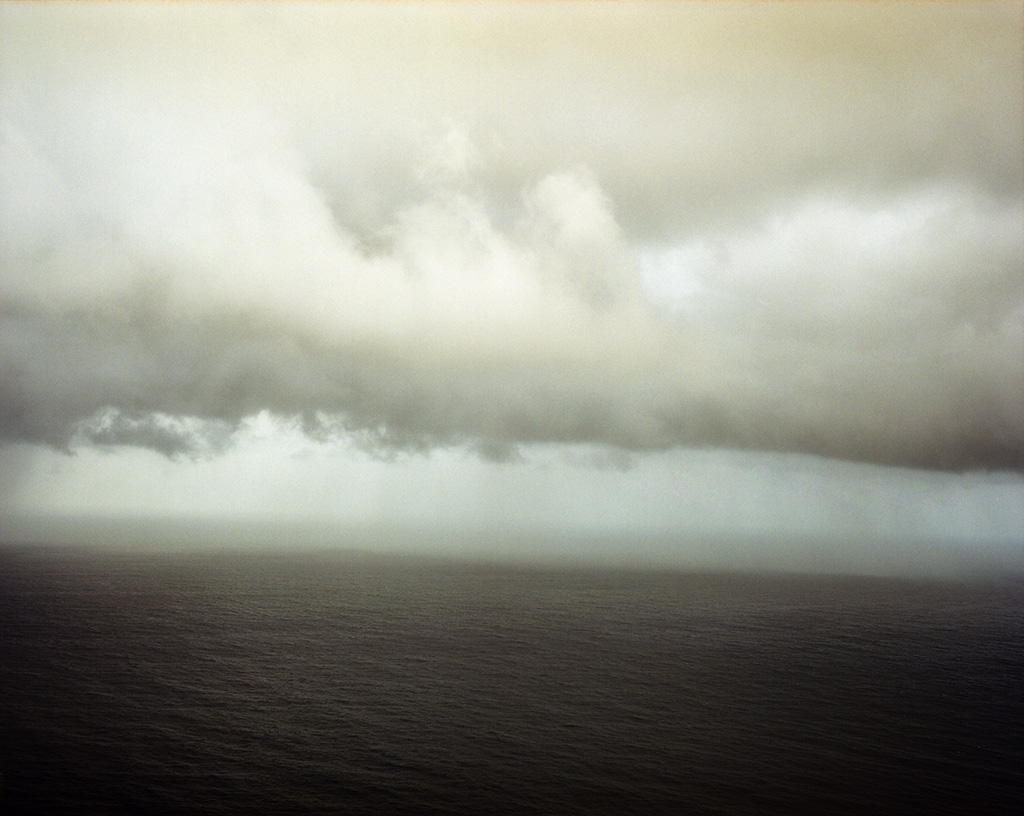
The house is all-alone on the cliff face. It stands on stilts, a twelve-step haul for Graham, but is on the level once inside. A verandah faces the ocean and the sitting room has an enormous six-foot square window that frames the Pacific Ocean hundreds of feet below. Whales can be seen often from this vantage but we are staying at the wrong time of year. There is mist and storms further out to sea and the horizon is smudged and indistinct. There is the distant sound of the ocean on the shoreline below. The valley is an ancient, sacred place for the Hawaiian people.
We feel privileged and lucky to have found this special place. Everyone who stays here feels the same. Reading through the visitors book are the oohs and ahs of welcomed travellers. Graham is straight away on his ukulele. It is an instrument suited to him. Easy to hold, to carry, to transport. It makes you smile. It is happy, joyful, friendly. Jasper is writing an adventure tale, based roughly on the travelling he has done so far. It has vomiting in it.

We have homemade fruit salad for breakfast made from all the in-season fruit left to us by the owner. Pawpaw, pineapple and banana. We are driving today around the Northern part of the island and will check out some beaches. First Jasper and Graham do a hike down to a black-pebbled beach while I read Joyce Carol Oates in the car. I watch as car after car stops and people pile out to do the trek and then return sweaty and red faced an hour or so later. We have lunch in a small town, green mango salad and chicken kebabs.

The beaches give the impression the hotel and condo complexes that line the coast privately own them but they can be accessed. We can get reasonably close and then Graham piggybacks me the final way across the sand and into the ocean. It looks like he is about to dump me on a rock submerged beneath the surface as my unspectacled eyes detect a dark shadow. But then a mottled head appears and we realise we are right next to a giant sea turtle slowly making its way along the coast. The ocean is clear and warmer than we are used to back home. The swell is gentle and mild.

The sand cannot compete with the pristine whiteness we are used to and take for granted. Here the world is new, geologically speaking, and the sand still fresh from its volcanic beginnings.

We check out some other beaches and stop on our way home at an art gallery to see a famous painting by Herb Kane of Captain Cook and his landing on the Big Island. We stop at the supermarket and are appalled at the lack of quality fresh produce, but then again we are only in need of Spencer steak, potatoes, onions and red wine before driving back to our cliff house for another night of BBQ and ukulele on the verandah. Jasper has made friends with the horses and we need a carrot to hand feed. A horse quality carrot can be purchased, luckily. As well as the much needed exercise notebook to write his adventure story. Leaving the car park the Stop sign reads Whoa.

We leave the next morning and on the way out of town have the local Hawaiian donuts so heavily commented on in the guidebook and visitors book. Plain with cinnamon sugar voted best.

We are heading for Volcano, the other side of the island, and are going to stop at Kealakekua Bay where Captain Cook met his death. We take a long road down towards Napoopoo pier to a car park where some locals have kayaks that they hire out to tourists. Kayaking across the bay is the only way to reach the secluded spot where the Hawaiians bludgeoned Captain Cook to death and where also some of the best snorkeling can be done. Jasper is both cautious and eager. You can see the tug inside him. Yes I want to see what Dad’s talking about, his interest in Captain Cook’s voyage spurred on by recent readings on this Hawaii trip, but the look of the choppy ocean in the bay and the dots that the kayaks turn in to as they disappear across the water holds his enthusiasm back. But Graham gives him no time to focus on why not. They are out of the car, they have warm gear in a waterproof bag, and they are off.

They are dumped in the ocean off the jetty and are paddling. Jasper sits in front, Lord Muck and Graham paddles from behind. I watch as the orange boat bobs along across the bay. I get a wave. Beside me in the car park various pick-ups come and go. Locals have a few kayaks they must try and rent out in between beers. More men, more beers. Special hand shakes. Fuckn this, Fuckn that. Board shorts, cap backwards, tight brown belly. Islander life. The man who Graham got his kayak from comes to check on me, like he’s concerned for me amongst the swearing locals. Xcuse me Ma’am, you ok? Just checking on you. They are not doing much trade with their kayaks. They sit in the open tray of the pick up. Mother fuckn Billy the Kid. A postcard is handed around and a discussion about how he died ensues. Burps like a blocked drain clearing.

I watch as kayaks returning come into focus. I can detect two paddlers. Not them. Eventually I spot them, making good ground across the choppy water. Yes they stood where Captain Cook fell. Snorkeling was luscious. Fish with yellow and blue stripes. The monument to Captain Cook had been defaced….

to be continued…
 

Tennis lessons

While school age children play tennis the mothers and the small children, too young for instruction, mill around outside the courts under the pergola. They have been brought from day care or preschool from where they have been cooped up. Now they are free and run amok. There are geraniums in bloom ready to have their heads pulled off. Fuchsia pink petals spatter the grass. There are spare tennis balls ready to lob over the cyclone fence and onto the lawn courts that they are not allowed on. The precious flat grass dotted with fuzzy yellow.

The squealing children squeal. A reminder of piglets having their tails chopped off. A pink fairy outfit, over sized with a ribbon tying the shoulder straps together at the back, does nothing to soften the squeal.

The mothers are oblivious to the squeal. Piglets having their eye teeth pulled. It is the type of sound that puts off childless couples and cements their choice never to reproduce.

Two teenage boys arrive early for their lesson and must wait amongst the toddlers and mothers. The boys both wear glasses and are not the athletic type. But they can do tennis. Pimples and all. They have stated to grow upwards but their muscles lack definition. They have custard thighs, creme fraiche arms, cream cake cheeks.Their sneakers are enormous, feet already bigger than their fathers’? They hit some balls against the beige brick wall, feet heavy, no deft touch, till all the balls are lost over the roof of a shed and then they plonk down on a wooden bench seat, face in phone, thumbs working hard.


Hawaii – Part 3

At night a gecko barks.

Another thunder storm. All night. Heavy rain. We wake up and worry about our helicopter flight booked for later in the day. We remember to wish Jasper a happy birthday. Nine. There are lots of low hanging clouds obscuring the tops of the mountains. We take the road to Lihue and continue on to Popiu Beach. Here Jasper can try out snorkeling. It is windy and warm. Life guards sit atop their towers. One, as brown as gravy, offers us the use of a beach wheelchair. But the water is rough and not inviting so I will sit out under the beach shades and watch.

The boys disappear under the surface.

The wind picks up a beach umbrella and tumbles it over the sand. It is caught, one handed, by a man as it flies past. He gives it back to its owner who has come chasing after it. He takes it back to its rightful spot and again pokes it in the sand. It doesn’t want to stay. He must hold on to it. But he will not give in to the wind. The flimsy rainbow coloured brolli turns inside out but still he refuses to take it down. It is not providing shade. He sits determinedly on his deck chair, gripping the umbrella pole.

Other beach goers congregate in the communal shade of the beach shack and a couple preparing their assault on the sand pack their belongings into their bag after changing into their bathers in the toilets. A man says to his wife, “Don’t lose my teeth out of there. They’re zipped in the side.”

By the road side are Tsunami warning sirens.

The boys emerge from the sea having seen an eel slithering through rocks and numerous fish.

We are killing time before the helicopter flight. Walking by the ocean that has been browned by the recent heavy rain and run off from the rivers.

At the helicopter reception we watch a film on safety and then we head out to the airport where our chopper and pilot awaits. We are directed on board. Jasper will have a window seat and I will be next to him and Graham on the other side. Jasper seems sedated by the anti nausea tablet we have given him. Uh oh. The chopper takes off and arches over the airstrip, Hawaii Five O style. Every motion picture with helicopter vision in it comes to mind as we swoop along. Apocalypse Now. We have headphones on and communicate with each other and the pilot. In the background there is a sound track of ephemeral music to add to the viewing pleasure. Our pilot gives a commentary. After the recent rain the island’s waterfalls are abundant and everywhere are silver streaks of water coursing down the steep slopes. We hear how a single family, the Robinson’s, own one third of the island after an early purchase from a Hawaiian King and how their commitment to conservation has meant it has remained unspoilt and undeveloped. The Napali coast is where Pirates of the Caribbean is filmed and we weave our way in and around canyons and gorges. Like a marble in a wine glass the pilot rotates the chopper to gives us a three sixty view. The steep cliffs appear covered in soft green moss but really it is trees and bushes we are seeing from a distance. The pilot tells us how the Hurricane of 1992 blew down all the chicken coops and since that time the chickens have run free. After the hurricane not a single leaf was left on a branch and the entire island was brown.

Jasper is pale and sighing. I know he isn’t feeling good. The pilot has already told us of the whereabouts of the comfort bag. I ready it. Up comes the fried chicken from the take out. He will not want to eat that again. I am trying to keep one eye on the scenery, afterall it is costing us $250 each as well as hold open the vomit bag and hand out wipes. We are nearly at the end.

Jasper says he still had a good time, despite the nausea.

For Jasper’s birthday dinner we go back to our favorite Baracuda but it isn’t as good as it was the first night.

Next day, we drive out to Waimea Canyon, the Grand Canyon of Hawaii. Tourist buses snake up the hill side and oversized Americans struggle up the paths to get to the look outs. We are listening to IZ, Somewhere over the rainbow. From a viewing platform we watch as white tropic birds sail the current winds of the canyon. The canyon, unlike the Grand Canyon, is green and lush, but lacks the spectacular jaw dropping surprise one feels when coming across the Grand Canyon’s gaping enormity.

On returning to our beach house we discover that Goong Goong has died. Opening the emails I read from the top and mistakenly get a message from my sister giving instructions for the funeral parlour before I read the email telling me of his death. Of course it cannot be a surprise. Only this morning before leaving the house and once again checking emails for news of him we all remarked how odd it was he was still alive. Jasper said, believing it to be possible, perhaps he will hang on to you get home Mum. He’s pretty strong, is old Goong Goong.

I have no tears. I ring my mother. I cannot remember what I say to her. I think I say I am sorry to be away from her, for her sake. I tell her if she needs Lisa to come she must ask.

We head out to dinner at the Dolphin for Alaskan crab, white grilled fish and sushi. We talk about Dad and toast him. In the distance is the sound of the river, hurtling by, so alive, so free and full of force. Water is a vivid reminder of life and energy and now a reminder of death too. We toast him for his dependability, his devotion to us, his small family. Like a loyal dog that doesn’t much care for outsiders but is warm and tail wagging with ones he loves. We must brave the road again because of the lack of footpath. Imagine being run over now.

We want an early night because our plane leaves early from Lihue in the morning and we must make the 45 minute drive to the airport and return the hire car. But we have locked ourselves out of the beach house. We had two keys and one was initially hidden outside but because we didn’t want to forget to replace it in the morning I put it in my bag and my bag is now locked in the house too. I blame the stress of my father dying. Graham’s iPhone with all the rental details is locked inside too. The Californians that rent upstairs are out. It is raining. The road is full of mud. We huddle under the carport and imagine what it might be like to spend all night here waiting to get inside. Graham does a reconnoitre around the house trying to ascertain if we can get in. It is too secure. He goes across the road to see if we can access our email from another tourist’s computer and hence find the owner’s number to ring her. We know she doesn’t live in the village but I recall reading an emergency number on an email. Our upstairs neighbours return but their key doesn’t fit our lock. I ring a trusty school mother knowing it is 3pm Perth time and give her my hotmail details so she can search my email for the owners details. I think I tell her my father has died too. Saying it is like trying it out.

Do you remember saying “I’m a virgin”?You only get to say it for a short time with any feeling. With any real impact. To the boy that will take that virginity from you and perhaps to a few prior you don’t give it up to. My father’s died is a bit the same. It is a short lived sentence. You can’t really say it to strangers. If you do they offer their condolences and you automatically say it’s okay, like it’s not their fault. It’s not what you mean. You want to thank them for their sympathy but instead you say it’s okay. Like you might to a waiter who is apologising for bringing you burnt toast. There never seemed the right time or the right someone to say, “My father’s died.” Perhaps it would be something that just swirled around inside my head, that I said to myself till I believed it. Knew it had happened…

to be continued…


What to do while waiting?

A girl of eight or nine years old, wearing a lilac polyester tracksuit, skips in tight circles on a beige brick paved driveway. The house is a house behind a house and weeds push their way through the cracks of the paving. Super six fence is inches from the windows. They have no view. A car idles in the carport, warming its engine so as to make it down the street. She waits for a parent to come from the brick box to take her to school. She skips in tight circles.

Hawaii – Part 2

The beach house at Hanalei is serviceable. It is one street back from the bay and an easy walk to town. The bathroom is smaller than we expected and, because of the positioning of a vanity, I will not be able to get into the shower . Somehow I blame Graham for this. There is thick spongy carpet (his fault too), mats everywhere and bulky furniture. The bed is made up with dark brown sheets. You guessed it. There is no tea. All of which ends up making me sullen and sulky. Luckily there is another shower in the carport- of the outdoor variety – but it’ll do. And I can make it to the toilet.

We walk into the town. There are no footpaths and so we are on the blacktop, but there are few cars. What traffic there is is enormous and clearly very heavy. Squashed flat chicken, squashed green frog – suggesting the road is not safe for smaller less visible beings.

The town is just one main street and touristy, but backed by a mountain laced with waterfalls and covered in dark, luscious forest. The top of the mountain gets lost in the clouds and mist. We have a drink at a bar where a man plays the guitar, while still managing to watch the ice hockey game on the TV screen. Two televisions at either end of the bar; one with the hockey, the other with rodeo, hijack most people’s attention, but he plays on, robotically.  Afterall he isn’t even inspiring himself. We go elsewhere for dinner; to the best restaurant in town – Baracuda. It is tapas style and really good. The chef has moved here from San Francisco. We eat pork belly and Greek style donuts for dessert.

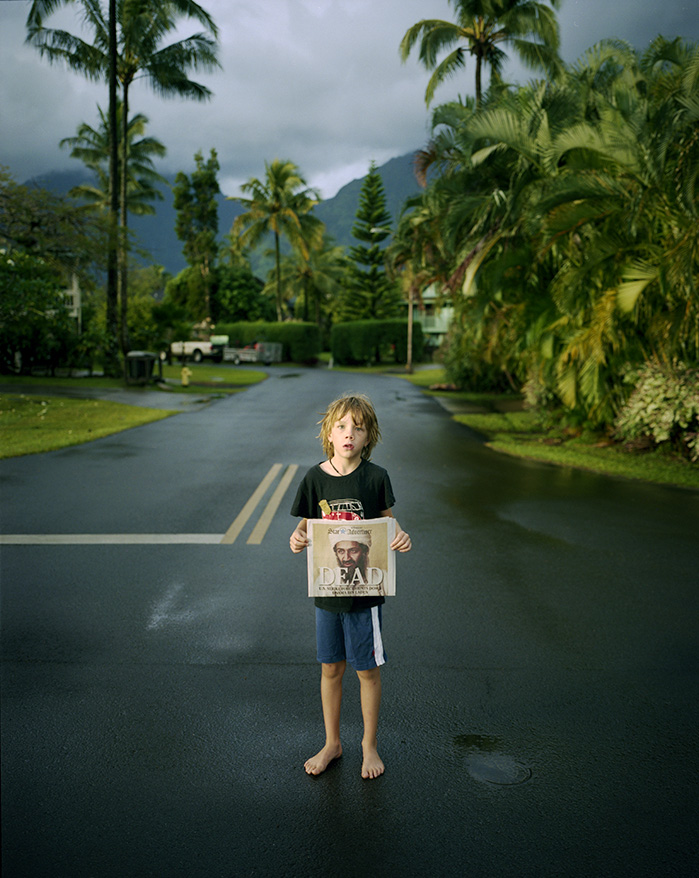
The next morning we realise that overnight Osama Bin Laden has been killed in a raid in Pakistan by the Navy Seals, Unit 6. His picture is on the front page of the newspaper and the headline reads DEAD. It could have read “Got ‘im”. Graham plans a picture of Jasper holding the paper in front of his chest in a mellow street in Kauai, where news of Bin Laden’s death couldn’t seem less important.


Graham and Jasper will go off hiking a trail at the end of the road and I will stay in the beach house, reading Joyce Carol Oates’ memoir, “A Widow’s Story.” In it, after the sudden death of her husband from E.Coli pneumonia, she grapples with her loss. It is the kind of writing I like. Unhurried, clear and to the point, but open and honest, not scared of itself. She worries and prods. Over and over. She tells of their close lives; enmeshed, embedded, despite the fact that he never read her work, ever. “but he did not read most of my fiction and in this sense it might be argued that Ray didn’t know me entirely – or even, to a signifigant degree partially… For writing is a solitary occupation, and one of its hazards is loneliness. But an advantage of loneliness is privacy, autonomy, freedom.” I think of Graham and his failure to get around to reading so much of what I write. It heartens me that I am not alone in this and that it is not a marker of a doomed marriage. Afterall it doesn’t bother me – but rather frees me. For concern for readers is a writer’s death.

Intermittently I turn on the TV to see what the news is saying about Bin Laden but there is only so much American patriotism one can watch. Only so many times you can hear a force described as “elite”. Bin Laden’s killing could be the saving of Obama’s presidency as commentators show him with furrowed brow, behind the scenes and praise his cool headedness.

I go into town and over hear a man on his mobile talking to his doctor. An MRI has revealed bulging discs in his spine. He tells his doctor of his excruciating pain whilst bending forward. What a holiday wrecker. If I was Joyce I would insert an exclamation mark here. I order a Mango Madness smoothie for lunch from the organic shop. It is impossibly thick and takes a lifetime to suck through the straw and  I hear another Californian having an exasperated work conversation on his mobile, pacing around the grass outside the lunch bar. Chickens peck and rake at the lawn around him like he is phoning from chook yard. Some people just can’t leave their lives behind. And yes, he has reminded me, I must ring home too.

I speak to Mum. She can’t hear me. I am shouting. How’s dad?  Because you can’t really shout, Is he dead yet? Yes the Royal wedding was marvellous. Simply marvellous. The best television she ever saw. Dad is just the same. Yes we’re having a wonderful time. I envy the writer overhearing me.

I begin to wonder how long he can go on like this. Could he survive the entire time we are away?

The boys return. Their walk was long and semi strenuous. They swam in pristine water at the end of the trek and made beach scultpures with rocks and pebbles.  We go to our local beach for Jasper to try out the surf board. But the attempt to surf is short lived. Jasper’s not really the type to enjoy the surge of instability the lifting wave gives the board. Dumped a couple of times and bedraggled he drags the board back to the shore. Instead he invents a game involving explosions, bombs, shootings, fist fights – but it is all imaginary and the outward effect is of him hauling and flinging himself in the breaking waves, running through the foam breakers and collapsing on the water as if he is throwing himself onto a bed.  A man walks the beach with freshly woven green straw hats. He stands in front of women in Brazilian bikinis, while they lie on the sand, doing his best to make a sale.

At night the thunderstorms come, heavy and pounding. There is the crack of thunder and the flash of lightening bursting through our sleep. In the morning we are woken by bird song and see Red Crested Cardinals hopping about the garden. More waterfalls cascade down the mountain and white tailed tropic birds sail high in the curves and crevices of the mountain.  The water sodden hill side is like a billowing ballgown, with its green velvet folds and waves. We meet the two couples who are staying in the flat upstairs. I have a conversation, in the car port over the washing machine, with Tom and learn how he works for Campagnolo (explains the cyclist’s calves) in San Diego, how he grew up here with his parents who built this very house hoping to retire here before his dad, who was an eminent cardiologist at UCLA, got early Alzheimer’s and died prematurely.

Back in the town centre we watch a dog nearly get run over and killed on the main street. A group of boys straggle behind trying to catch it, but it keeps its distance. It veers away from them, dangerously close to the road again, tail tucked beneath its belly. We have gone to the shops to buy motion sickness tablets ahead of the planned helicopter flight tomorrow for Jasper’s ninth birthday. Jasper gets a super hero sticker from a vending machine and the dog appears. It won’t come to Graham and tries to follow two girls leaving the shop, but they get into a car and it is alone again in the car-park. We call it to us and it begins to follow us away from the road into the safety of  an alley way. It likes small boys. It wants to be close to Jasper and sidles close to him and gives a tentative, small wag of its tail. We talk softly and calmly to it. A black guy approaches and we ask him if it is his dog. No, but he is following it too. He is trying to get hold of it, he says, but it takes off when he gets close. I think it is fearful of men, I say. It likes girls and children. It continues to sit beside Jasper as he strokes its head. The black guy is called Gerard. He kneels and beckons the dog to come to him. But it has glued itself to Jasper. Another man, watching, says “Careful, you’ll get bit.” The dog is stressed; yawning, licking its lips, grinning. We tell Gerard that we’ll keep it here if he goes gets a lead. He lopes off. When he returns with a rope we tie it around the dog’s neck and the mongrel is his. He had a dog once, good one too, but it got lost in the bush and he’s bin looking for a new dog. This’d be a good dog, he reckons. So this is how you get a dog in Kauai – just find one in the street and get a rope on it. We feel good about the rescue from the road, the wet night and pleased for Gerard to have a companion. He says he is going to buy it some food and we ask him what he is going to name it. We suggest Dingo…

to be continued…

Illness

Yesterday was a lost day.

Before bed we watched “28 weeks”, a movie set in London when it is attacked by a zombie virus. In the movie the virulent infection turns the humans into raging, attacking maniacs whose faces are covered in blood as they rip open the eye sockets of their victims. It is “good” sci fi, but I went to bed a little nauseated and thinking of the movie over and over as I fell asleep. Then, I woke with a pressure in my guts. Deep. I had the shakes and shivers. I threw the bed clothes off. I groaned enough to wake Graham. Get the thermometer, I said. Perhaps I had a temperature like when I got cellulitis in my leg. Whenever I am sick I think of that time and how I had failed to notice the blotching of my leg that was the tell tale sign of bacterial infection. But that’s another story. No temperature.

I get Graham to cover the chair with a towel and race to the bathroom. Even though my sensation within my abdomen is incomplete I get the sense that it is the source of my illness. I am leaning forward on the toilet and groaning my death groan; the one I do when I am about to vomit. At times like this I wonder about how I would ever be able to have chemotherapy or the like. I just am the worst at nausea.

There is the sound of someone throwing buckets of water on the bathroom wall behind me. If I had sensation I would know that this is coming from me, but I don’t and it’s the weirdest thing. It is weird, till I realise I have sprayed shit all behind the toilet and down the walls. Weird, till I am attempting to clean up while still feeling vaguely outside myself and blurry. I have taken my glasses off, a good thing. The foulness is muted by poor focus. But the stench. I am yelling Oh My God and asking for towels and garbage bags. Graham is passing things through the door and I am saying Stay Back.

In the hour that follows I am washing down the bathroom and having showers as I ooze uncontrollably. Everything is foul. Jasper wants to know why one of his toy catalogues from the bathroom is in the bin. Because it’s got shit on it, says Graham.

Being vets might help us handle a morning like this I think. We are used to shit. Dogs with parvo; where their guts literally come away from them and spill out in shredded globs of blood. But there seems nothing more foul than human excreta.

I use lots of Radox for Men that Graham brought home from Woolworths by mistake when the check out girl put it in our shopping. I use it several times that day so it will always be a reminder of the day of illness. It is a dark green, like bathing in algae and smells strongly of male deodorant. I go back to bed, lined for safety with towels and ball up. I can’t get comfortable for most of the day. I drift in and out of sleep, groaning, when it seems the only thing that will help. Outside there are men at work on the oval planting trees. I can hear the thud of the shovel on the earth.

I can hear Graham in the kitchen playing his ukulele.

He brings me gastrolyte and an enormous vomit bucket.

Luckily school duty can be left to him. I am a bundle of illness. I think of nothing but my stomach. It takes all my thought. I try laying one way and then the other. Nothing is comfortable. I am cold and then I am hot. I can hear the thump of Jasper’s basket ball in the lounge room when he gets home from school. I can hear him asking Graham to go outside to play. I can hear Graham frying onions. I can smell the bolognese cooking and I hate the smell of it.

I hear them outside calling Murphy, who is not coming, and I think they have not taken treats with them. I hear the front gate swing open and know they have got him inside, contained in the front yard now, and they are probably kicking the footy. The paper barks  being their goal posts. Murphy will be standing at the gate wishing to be out but they cannot be bothered to watch him as well as play their game. I can hear Charlie and Sally from next door. In my musty bedroom I feel the haze of illness here under the sheets with me.

It is not a real day. There is no thought of doing anything but surviving it and getting through. How strange it is that when you are sick it seems difficult or impossible to recall being well. The feeling is so far from you that you cannot capture it. It is like you have been ill for your entirety and will be ill for ever more.

Jasper is very disappointed that I will not be getting up to watch Masterchef. It is proof that I am really sick. It is dark when they get back from piano lessons. I hear them run through the new song, then later Jasper reading Dr Seuss. Still the smell of Bolognese wafts up the hall. I hear them hoop and holler as Lleyton comes good at Wimbledon. Graham makes up the spare bed in Jasper’s room to stay away from me and my cloud of illness. I eat a banana. It is heavenly sweet and I take small mouthfuls. It leaves my mouth furry but I am beginning to feel better.

A dog is barking on the oval outside my window.

I am taking sips of water.

It is a new day. Today I will air the bedroom.


Hawaii – Part 1

With my father on morphine we leave for Hawaii. I know it looks bad. I know he is dying and, hence, I will not be there when it happens, but I choose to go all the same. I have many reasons, (or excuses), in my head and they all seem reasonable to me. I have a living family to think of. I have a nine year old boy who cannot go to Hawaii if I don’t, because without me there will be no one to bring him home. Graham is sailing from Hawaii to Samoa and so will not be accompanying us back to Australia. I have to go. There is no insurance to cover the loss of the fares. My father would want me to. My mother gives me permission-of-a-kind with the statement – It’s up to you and your conscience. If you can live with it, go.

Maybe I have no conscience. Of course she wants me to stay, but she would not say so outright. I tell her I feel bad about leaving her, on her own, as he dies. She tells me how when her own mother was dying, my sister and I were under five. Her mother’s two sisters were by her bed, day and night, and wanted her there also. But when it came to tea time, she said she needed to go home. She had young children to think about, a husband, a family to care for. Those were her priorities now and she went. Her mother died that night.

Tomorrow we fly out to Sydney and then Hawaii. Today I want to be with him as long as I can. Another mother has Jasper.

Mum goes to the dining room for dinner. I am pleased to have some time in the room with him on my own. There are things to say. I hold his hand. It is cold and bony, the skin is papery. “It’s okay to go Dad. Go now Dad. Please go.”

I wanted to say it. To give him permission to leave us. To tell him we’d be okay. Of course afterwards, long afterwards, even now as I write this, there are other things I wished I had said. People always say you should tell them you love them. I didn’t say that. I guess I took it as understood. I should have thanked him. I should of told him he’d done a good job, because that is what drove him the whole of his life. In my head I hear him saying. “If a job’s worth doing it’s worth doing properly.”

My last words to him as I put a hand on his stubbly chin and rubbed it was, “Goodbye Dad. You be good.” A perfunctory instructive.

It was something I used to say to him often as I left him under hospital care. Like leaving a dog in a kennel. A “No barking” type instruction.

If he could hear me I wanted him to be comforted that it was business as usual. That I would see him soon.

Of course I knew, or should have known, that that would be the last time.

And then there was the relief. Relief at knowing I would not have to sit and do a vigil. For watching dying is hard. Escaping overseas meant I would not have to do it. To be there at the end is gallant and brave and somehow considered the right thing to do. I had been watching him die for months. Being present at his actual last breath had lost its significance to me. I felt relieved to not have this final duty to do.

I think, with disdain, the emphasis people put on the moment of passing away. Like being there then will make some kind of difference. Dying, like birth, is something you do alone.

The Occupational therapists at the nursing home deliver Mum a “dying basket” containing a fancy tea cup and saucer, a battery operated candle, tea bags, a mini long life milk carton and a packet of Wagon Wheel biscuits. We don’t have a kettle in the room to make tea, so much of the basket is pointless. We look through it together vaguely bemused by its contents. Why Wagon Wheels over Tim Tams? Who made this choice and why?

My mother, despite Dad’s dying, was bewitched by Kate and William’s wedding. It was the best television she had ever seen.

We flew off.

It is raining heavily as we leave the Honolulu terminal to catch a cab to our hotel. It is tropical rain. Fat warm droplets. There is a queue of happy travellers waiting for taxis to Waikiki. At Hotel Renew our room is not ready and so we leave our bags and wander the strip. It is touristy, of course. Beach sand has been trucked in. But the waves still break in long foamy rides. Beneath a statue of a Hawaiian king homeless people congregate. A sign lists amongst the Do nots; No shopping trolleys, No horse shoe throwing.

Resort style hotels hug the beach, invading and overtaking it. Their bars and beach chairs own it. Gardens are lush and tropical with paths weaving through them. At the Moana Surfrider we are drawn to its old style colonial elegance. Its rocking chairs. Its white washed boards. Two men play guitar and ukulele, and sing while a woman dances the Hula. Jasper has a tropical drink with a cocktail umbrella and chunk of pineapple.

I ring my mother. She says dad has spoken to her and recognises the nurses. The fact that he is compos mentis enough to speak seems remarkable and I do wonder if she is lying to make me, or herself, feel better. Is Hawaii wonderful, dear? Oh yes, it’s wonderful. For how could you say otherwise? How could you say it’s okay. How my mother would have loved a hotel like this one, I think, while my father would have worried over the price of the drinks and not have let us sit down. I think she is asking, is it worth it? You better be having the time of your life over there whilst all this goes on over here without you.

We are up early the next day to go to Pearl Harbour. We get a private car, a limousine, because it is cheaper than a taxi. Jasper thinks this is what it might feel like to be famous. He sings,” I wanna be a billionaire so frickin bad”…But the car is old and worn and smells like air-freshener covering up yet older, staler smells.  Our driver reminds me of Graham’s brother with his discoloured teeth, his smell of smoke, his rake thinness. His name is K.C and he tells us how you are not allowed to take bags into Pearl Harbour. Only your wallet and a camera. There are lockers at the entrance or he will keep our stuff in his car as he will return to pick us up.

Not having a notebook bothers me. More than leaving my belongings with a man we just met. What if I want to write something down? Denuded of pen and paper, we enter.

Tora Tora Tora, came the call of the Japanese pilots as they realised they had succeeded in surprising the American fleet of ships. The radar that had detected the planes had been ignored because, as new technology, it was not believed possible that the planes arriving across the Pacific could belong to the enemy. The US aircraft were bombed and the torpedoes fired and the USS Arizona and others were sunk, entombing the naval seamen.

A ferry takes us out to the memorial that floats over the watery grave. Oil slicks shimmy the surface of the water and patriots tell how the oil droplets symbolise the tears of the lost sailors. People stand and reflect. I try and imagine the bombing, the chaos.  Sailors were burnt as they fled their sinking burning ships and swam through water alive with liquid fuel. Others wouldn’t have even known what hit them. Standing in sunlight waiting for our ferry to take us back across the water, tears are seen on the faces of burly men.

Today Japanese are common tourists to the site. There seems no animosity here towards them. Then, even more remarkably, for the 50th anniversary of the bombing, some of the surviving Japanese pilots, now simply old small men, returned to hold hands with American survivors of the attack. Embraced they did. That such ferocity and power is replaced with simple solicitude and forgiveness seems odd to me, even if it is admirable. That friends are made from arch enemies convinces me even more of the pointless stupidity of war.

These memorials to lost lives become to me, such powerful anti-war proponents. How could anyone come away from such a place and think it was worth it.

We are bussed to the battleship Missouri memorial. It is where the treaty to end the war was signed. It is hulking and we are ants crawling over and within her. The men that sailed on her love her like she is a home country. They speak of her like she is more than metal. She has a soul.

While Jasper and Graham explore the submarine, the USS Bowfin, I submerge myself in the museum. Headphoned and reflective, I listen to the tales told by survivors of the attack. Before we leave there is time for the shop. We buy replicated newspaper headlines from the day after the attack, as well as a war plane and a pack of cards.

K.C takes us back in the limo. Our stuff is returned to us. The traffic is bad because tonight is the Waikiki Spam Jam. Hawaii holds the record for its consumption of the tinned processed meat called Spam and love it they do. The reception staff at the hotel tell us how much fun is the Spam Jam – all the restaurants will be represented as their best chefs show what they can do with Spam. It does not look good or any more palatable than I had remembered. It is still just polony with goodness knows what in it. People dressed as Spam tins wander the streets. Every conceivable thing can be cooked with added SPAM or else improved by the adding of its flavour- for example – Macadamia nuts flavoured with Spam. Enormous people with oversized plates of rice atop Spam sit on the kerb and tuck in.

We have booked a table at Roys, with pork belly in mind. Pork belly was out and to make up for it they gave Jasper a free dessert – chocolate souffle.

On a small plane from Oahu to Kauai we see a couple who were staying at our hotel. From the moment we arrive on the  Garden Island we see free roaming chickens. Our first is in the airport carpark.

To get our hire car we take a bus to the rental office, equipped with a wheelchair lift. We have an hour’s drive to our Beach house in Hanalei Bay but cannot check in till after 4pm, so there is no hurry.

At the hire car we see the South Americans again. They too are heading for Hanalei. On the drive up we stop at a waterfall and then a small town for something to eat. We order fish tacos that neither Jasper or I like. The wraps are full of brown rice and overcooked Mahi Mahi fish. The coast line is battered and buffetted by strong winds and rough sea. The beaches are closed.

We pull off the road at Anini beach, where the people are rich enough to own polo ponies that graze the fields across the road, and the houses have secluded private gardens that fringe the beach. Jasper gets an Amercian version of a giant Sandwich from an icecream truck. We park under coastal pines with other cars, mainly American pick ups, where poorer locals have parked and congregate around the backs of, drinking soft drink and eating chips. I imagine Raymond Carver lives for them all.  On deck chairs some older fatter types sink into the sand while they read value for money fat fiction. A river meets the sea here and people amuse themselves on kayaks as well as surfing or swimming or stand up paddling. Dogs roam.

Finally at Hanalei we pull in at the beach. Again locals seem to have a section. They drive onto the beach, for what added purpose it isn’t really clear, since the beach is not wide or difficult to cross. Perhaps just because they can. They sit in the tray of the pick up rather than on the sand.

We come across the South American couple again, already checked into their apartment, they have made friends with a local and are sharing his BBq on the beach. A cement jetty with a covered end pokes out the southern part of the bay and I sit out there while Jasper and Graham swim in the Pacific. Others jump off the jetty despite the signs prohibiting it. A mother chastises a child who has dived off.  For what if it was too shallow and she hit her head? The mother no doubt is thinking of me, sitting there like a doomed omen of spinal damage. When the girl does it again, she has her arm yanked on and is marched off. The boys swim out to me and climb up the ladder to join me. A midget teenager, fishing on the jetty, gets his line caught by a surfcat and needs to get into the water on a board to go untangle the line from the boat….

To be continued……


Conference Hotel

I wait for the lift. Already sensing it is one of those hotels where lifts move as if in slow motion. You hear it reaching the floor, shuddering in its shaft. You wait for it to stop completely before it opens its silver mouth. Like a yawn. It wouldn’t really matter except that there is a man coming towards me, unsteadily. For him the ground is heaving. He asks me, “Where is the bucket room?” He asks other people as they leave the lift. I pretend I can’t see or smell him. Like dealing with a dog I don’t trust. No eye contact. Never works for drunken people though. He has an empty glass in his hand. Is he looking for ice, or somewhere to vomit?

I enter the lift with a woman and say, “He’s wasted.” Like I am an expert, or I just need to say something to show her I am not with him, that I don’t approve. “Yeah,” she says but not with judgement or condemnation. Just resignation that this is what it’s like around here. Doesn’t bother her in the least.

Everyone here is a little bit on the edge. Like they can’t quite afford the shabby hotel that is definitely overpriced. Like they have to pack in as much drinking before the sun rises. An islander guy with thick muscular calves and a tattoo creeping up his neck asks the receptionist what time she finishes. He wants her number so he can text her and get her to join them after. “Maybe we can hook up.” She gives him a slip of paper and I wonder if she has really written her number down. Is this the way people meet these days?  This Hooking Up business doesn’t sound warm and fuzzy. The opposite of slow. It’s metallic, sharp, easily detached, easily addicted, locked onto too.

I go to breakfast at the dining room. There is a buffet under lamps. The food is shining. All you can eat. Breakfast included. They ask me for my room number. Am I with the poultry symposium? No Behaviour. Animal Behaviour.  But in my head, “What I really like is watching people.” A table of four poultry men in pressed slacks talk about the industry, production numbers, layers, meat birds while I crunch on cornflakes. Someone mentions a troubled teenager but then its back to feed rations and vitamin supplementation. Standing after breakfast, hands smooth down slacks, wipe away toast crumbs. Folders under arms.  Back in front of the buffet a woman says, “it’s good isn’t it?” I smile one of those I don’t think so smiles and she looks back at me disappointed, looking for collusion over stale Danishes. But I can’t stomach silver bainmarie trays of fatty bacon and congealed scrambled egg. Sad rockmelon and even sadder watermelon slices.

It is not a five minute stroll through the gardens of Sydney University, as advertised in the hotel brochure. Being in a wheelchair it was never going to be. It was further, and the terrain typical Sydney – foot high kerbs, for all that rain, and slab foot paths lifted and cracked by tree roots protesting their life beneath the dirt. I am anxious, not knowing the way, and forever fearful at coming across an insurmountable kerb. Perhaps I will have to take to the street with its roaring buses? But for now I am on the footpath, Parrammatta Road beside me, like a fast flowing, thundering river of rubber and diesel. Down hill for a bit, I overtake a man walking briskly with a briefcase. I think being in front of him is good as the road begins an incline. If something impossible is around the next bend then he will be behind me to offer assistance. I rehearse the asking of it as I hear his footsteps and then I am over taken.

Now in the grounds of the University I can slow down, veer onto the road if I must, since cars drive slow within the gates. There are hills to climb. It is humid. I will arrive sweaty.

At the Law Building, where the conference will be held, there are steps, but I trust it is an accessible building, since I have checked repeatedly, and I have been told it is.  An organiser sees me and rushes over to show me the way. Back around, and down this lift, and up this ramp. The lecture theatre is very large and very steep but there are a couple of wheelchair spots at the back that have no seats but  still have little lonesome swing desks, canopying the carpet. The lecturer wants everyone to move to the front and waits for them to oblige. “So we don’t have to strain our necks. You can’t believe how difficult it is to lecture to the back,” she says. So I am left all alone in the final row, like a stubborn child.

On my phone I get a text message from Graham saying Mum has had a period of unconsciousness. It lasted for fifteen minutes, but she is talking and “back” now. Meanwhile the American expert is talking about feeding dogs pate to stop them fretting over storm noise in Florida. “That’s all it takes sometimes,” she says “Black Forest Ham.” And I see pens scribbling.  Anxiety issues in dogs. Solution Black Forest Ham. She solves everything with food treats and Prozac. She thinks Cesar Milan is an abuser of dogs. She is too polite, too American, to swear at the mention of him, but clearly she hates the man. American Behaviourists Most Wanted.

As the conference rolls on, panini after panini, mini eclair after mini eclair, lecturer after lecturer, my respect and indeed my love for Cesar and his methods is eroded by the experts. It’s like discovering the scout master is a paedophile.  They call Cesar’s technique flooding and it is never a good idea.

Out of the lecture theatre I can get away from the icy grip of the air conditioner and suck in the warm moist air of Sydney.  I can see another text.  Mother is fine. Parrots busy themselves at the destruction of nearby trees. A couple of vets have come outdoors to smoke. They hide themselves off in corners, down steps. I wonder if they too lament the loss of love for Cesar.

You can gauge how shabby a hotel is from its corridors and from the walls in its corridors. These corridors are musty and grimy. My nostrils detect the sour odour of vomit. The walls are scratched and stained – how do you spill a drink, or anything, ten feet up a wall, I wonder, as I view something brown near the ceiling? The air smells of smoke despite the rules. No pictures hang. Perhaps they would get nicked.

Late at night noise drifts up from the pool below. I have my window open to avoid using the air conditioner that ends up making the room too cold. I can hear laughing. At night the sounds of people partying by the pool echoes and throbs. Perhaps the bucket man has found some shoeless friends.  At the window I see planes crossing a darkening sky. I can see a tower block of apartments and real lives going on within them. Not just Hotel lives of making a cup of tea and watching TV from your bed. With curtains and blinds open, and lights coming on, the filmic people move about, making dinner, reading the paper, packing a school bag. I wait and watch. Wishing to see an argument, a thrown saucepan lid. Something.


Finally…

Finally he is gone.

No more gauntness to contend with.

No more gripping claws.

The sigh is heavy, full of relief – for him and, oh yes, for myself.

I take pleasure in buying bones for the dog.

I love to watch him crunch through them. Chicken wings like twigs between his jaws.

So much life in a scruffy dog.

I have poems to look through – to find the right one – for the funeral.

I remember how he’d love the touch of a dog’s wet nose against the back of his hand

hung limply from a nursing home chair.

I hear him in my head say what a good dog.

The carer says I loved that man and it sets me weeping.


Grace on the Park

Twenty thousand people on a park, jostling and moving together, swaying and gyrating to music is proof of the sociability of the human species. I am less sociable than most and sometimes a crowd like this is too much. But when Michael Franti is in the crowd you want to be part of it. Hands reach out to touch him. To steal a morsel of his sweat. I wanna see you jumping. And they jump. I wanna see your hands in the air and they raise and pump them. Anything you say and we will do it. His ropey hair hurls around his head, while his strides large and gazelle-like, see him leap across the stage. Barefoot. Real Freo Type. His shirt claims he loves Perth but you know he is really only talking Fremantle.

Under foot the grass is trampled flat. In front of the stage the dedicated fans push forward. To feel the bass. To feel the rhythm through their skin, not just their ears. You want your innards to vibrate. The earth shakes with the drum beat. Back on the rise the grass is spotted red with the cardboard seats like pizza boxes. Tents hug the perimeter no-climb fencing with their generic signs: Bar, food, toilets, ATM, tickets, First aid, recycling, water. Lines of people snake their way to buy a ticket to buy a drink. Little sachets of wine to be sucked on baby-like through a straw. But why leave the music? It is the music you are here for.

On a constructed platform for the viewing pleasure of the disabled, me and my eight year old are parked.  It is a logistical nightmare to get off the platform. It requires asking half a dozen other wheelchair bound people and their carers to move them and then risk losing your space. Queen to Bishop. So we don’t go. Don’t worry I have come armed with a box of  Shapes, a packet of peanuts, a water bottle. We are in for the long haul. This is festival survival.

Over the mosh pit crowd we have a clear view to the stage. When Bob Dylan comes on he is small. He has a cream wide brimmed hat. He faces side on playing the keyboard. Jasper says he can’t see his face. Neither can I. Nor the remaining thousands behind. And we are so close compared to most. There is no projection of him on the screens. We look back to the sea of people. Ones outside the perimeter too, up on the hill in front of the school tennis courts, take in the sound if not the sight for free. But Bob is moving. There is energy in his swagger. The music is still his, delivered by him, possessed of his spirit, even if his voice can no longer deliver.  Jasper has been drip fed Bob Dylan but the music is unfamiliar to him, the voice unrecognizable, as the man his father claims is the greatest, croaks through his songs. Jasper’s lids grow heavy. Next thing he is asleep. Mouth agape. As a hard rain is going fall. I cover him a shawl and he could be anyway.

A woman older than me, the carer for her disabled and non speaking husband, starts booing Bob as he sings. Boo Boo she goes right beside my ear. He can’t hear you I say, but I can. Please don’t boo.  It’s a travesty that he’s singing like that, she says. Like she believes he has the power to change the old, aching state of his voice. Maybe this is the best he can do. She takes her husband and leaves. Disappointed. How will they feel about Bob when they get home. Trash their collection? Will he no longer be a hero of the mute man?

It is mellow. The crowd wants more. Keeps praying he will look their way. Really look at them. Maybe say something too. How wild would they go if he said Hello Fremantle?  In the end he glimpses up only a few times. But when he does he seems happy to have seen us.

Grace Jones couldn’t be more opposite. You imagine her wishing to be devoured by the crowd of eyes. She wants you to see her all. Even the bits you’d rather not. She has a body of which to be proud and proud she is. In fish nets and a velvet corset she totters on heels. She nearly falls, swears and then makes fun of herself and her crew that she tortures. In her band is one of her sons and I wonder if he finds her antics excruciating. She is the original show girl able to effortlessly hula hoop through an entire song, proving her fitness. She knows how to make the audience adore her and she willingly gives them want they want. It is all artifice beautifully agreed to by both parties. Her severely short Afro and her sweat, every crevice and curve filmed and blown large on the screens beside the stage show her, transvestite-like and viper, trawling the stage like a street walker.The crowd both her pimp and her john. Pull up to the bumpa baby. Jasper is awake again and agog at her presence. He’s not sure if he likes her but he can’t take his eyes off her. Mesmorised.

We, the crowd, pour out like cattle. Slow moving through the narrow exit gates, churning sand beneath our feet. The Blind Boys are still playing and the crowd in the Big Top still hooping and hollering their love. Eight hours, nearly the equivalent of a soon to do plane journey to Hawaii, has passed. Not so long to sit and ponder perhaps. But stuffy plane air, not outdoors under moonlight with whiffs of spliffs, and clouds less entertaining than Grace on the Park.