Dirty Laundry

front loader Image

I don’t know what I am doing here.


Call me a no good, sticky beak, nosey parker.


Do you feel better if you have a note pad to look down at and scribble in? Curiosity overwhelms shame. Something in me wants to dig deeper.


I should be at home doing my psychopharmacology assignment. Instead I’ve caught the train with the morning city workers. I’ve pushed through the city, contemplated a takeaway coffee, but been put off by the long queues at the supposed best places, and finally arrived at the Central Law Courts in the east part of town. There is airport type security to pass through, before the lifts, which lead to the courtrooms. I instinctively expect a pat down when my wheelchair makes the metal detectors go off, but they aren’t as officious as airport guards and, after asking if I have anything concealed, let me proceed.


It is a peaceful building. It is the opposite of the chaos and disorder that is the central discussion of most of the cases and events whose narratives are told before a judge.


It is supremely clean. Cleaner, I suspect, than most public buildings. Like it should be. Like it is saying to the public who enter it – see – this is how ordered and polite society behave. Look what you can do if you just clean yourselves up a bit. Peering out of the high windows, the road and alleyway beyond appear shabby, the concrete car park an eyesore. Cars even appear disheveled. Inside the carpet is striped and bold, the chairs are seventies chic. The bathrooms are white tiled with bleached porcelain sinks. Paper towels are provided. Soap dispensers have soap in them. There are sharps dispensers in the cubicles, an open acknowledgement that illicit drugs might be consumed here, but it is convenient to do the proper thing with your used needles.


I am looking for Court 51 to attend the Coroner’s Court to listen to the final day of the case of the toddler found dead inside the front load washer/dryer. Daily the story has captured my attention in the local paper. Washing Machine Inquest. And now I will hear the mother describe, in detail, the moment and the lead up to her discovery of her child – locked inside the closed machine, found dead with the stiff cadaver of a pet cat called Snowy. Call me ghoulish.


On the morning of the 20th September 2010 three people were alive in the Hilton home. The man rose early, did not have breakfast, and went to work. The mother, Ms. Murphy, twenty-seven, claimed to have overslept and when she woke to find her son, Sean, was not answering to her calls, she searched frantically, turning the house upset down. Then something awry caught her eye, as she stood in the hallway and looked into the laundry. What was that in the machine? She opened the front loader door – pulled out the stiff cat and then her hot, limp son, his head and hair wet. She carried him out to the hallway, lay him down and began CPR. She rang triple 0. When the paramedics arrived they took over the resuscitation of the already deceased boy whilst the mother phoned her partner to tell him Sean was critical and would be going to the hospital. When Ms. Murphy said she needed to lock the house before being able to accompany the paramedics, and began searching for her keys, the ambulance officers had the gut feeling that something was not right about the scene. It felt weird to them. She felt weird to them. They left the house without her. Later they informed the police.


So much of the story does not make sense. What active normal toddler allows his mother to sleep till 1.30pm without being fed, when it his habit to wake her early by jumping on her stomach? She talks of Sean’s Thomas the Tank Engine clock. It has a face that changes from asleep to awake. He knew not to get out of bed till the face changed at six o’clock. After that he was free to shake the house. I am reminded of my own son’s early mornings as a toddler. We took it in turns for the predawn shift, feeling as if a whole day had elapsed before the other parent got up to take over after seven.


There were photographs on the camera that showed Sean had been alive earlier in the day, in the same room where his mother slept, taking flash pictures, and yet she claims to not have woken till 1.30pm when her partner rang her on her mobile rang. She gives no reason for her sleeping-in that day.


She has strawberry blonde hair pulled back into ponytail. Her pale eyes are rimmed with pale lashes and even paler eyebrows. She wears no makeup. She could be dusted with flour. She looks drawn and annoyed to be here. She could be 17 or 37 – an ageless, unwrinkled face. She is sometimes curt and agitated with the questioning from the counsel assisting the coroner. And sometimes it is accusatory. But she is rarely visibly upset. She never sobs or breaks down on her descriptions of her son. She describes his love of Diego and Elmo and her voice is breaking, but she gets through it. It makes her seem hard.


I am reminded of the nation’s judgement of Lindy Chamberlain and how the portrayal of her inadequate emotional responses was labelled hard and callous. So incredulous was the nation to her story of a Dingo taking a baby that she was swiftly branded a child-killer? What was she really guilty of? Not seeming to be a good mother? It made her appear guilty – her inability to cry.


This mother is also unlikable. The pale blue high-necked sweater makes her look conservative. But the outfit feels like a lie, an attempt at manipulation. Has she been asked by her lawyer to wear this colour? Baby blue. Is it supposed to be a reminder of the lost child? She wears a black velvet jacket too. She has tight-fitting trousers and long grey boots with flat heels. I watch her feet as they jiggle constantly beneath her chair during questioning. Like someone sitting an exam. Some of her answers feel rehearsed.


At times the coroner, Mr. Alastair Hope, takes over the questioning, as if he can get to the bottom of this. There is a general feeling of disbelief at the possibility that the child could climb into the washing machine, with the cat, and then close the door, from the inside, and trap himself and the cat inside – and there – suffocate and later be found dead, virtually unmarked, with no scratches on him.


There remains the possibility of the dog of the house – Simba – being the one to have closed the machine door. As an active exuberant dog perhaps he was chasing the cat and the boy and they hid in the machine and the door closed behind them by the action of the dog jumping or knocking against the washer’s door? Possible perhaps?


How do you prove this? How do you prove you are innocent, if you are? You are presumed to be innocent until proven guilty, but there is a distinct feeling that there is a need to show innocence here. What can this mother do to demonstrate she didn’t do it? Would crying now help?


The coroner sits alone at an expansive desk. He is higher than everyone else. He enters from the innards of the building, almost as if he is joining us through a secret entrance. Does he come up from beneath the ground? His associate announces his arrival and asks us all to stand. Wheelchair bound I am unable to. When we re-enter after a short recess, he is not yet present. It is a bit like being in a school classroom before the teacher arrives. There is banal chatter amongst the legal teams. The coroner’s associate tells the lawyers that Mr. Hope is ready to resume. “Are you psychic?” a lawyer jokes. “I can hear the click of his door,” she answers. Then smiling adds – “one Powerball.” One lawyer asks the team behind, “Where’s your client?” We can’t begin without her. I imagine Mr. Hope standing in the back, like a thespian waiting to make his entrance from behind the curtain. “She’ll be having a cigarette, or two,” her counsel says. Another moment passes, “or an entire ashtray.”


The press has not returned and I feel privy to a strange camaraderie between the lawyers. They are just playing their roles. It is their room. They know what lies behind the wood paneling.  As the families and journalists file in there is a straightening of jackets, pulling down of sleeves and the questioning picks up where it left off.


When Ms. Murphy is directly asked if she was the one to put Sean inside the machine, she denies it. She admits to having difficulty with the boy and his three-year-old ways. Don’t all mothers? Ms. Murphy is not unusual in describing her struggles to put a toddler to bed and for him to stay there. But she says she was more frustrated with her inability to cope as adequately as she saw other people than she was frustrated with Sean’s behaviour. She sometimes disciplined him with time outs and the occasional smack on the bottom and, for a time, some months before he died, she had tried to get his sleep more ordered by tying his bedroom door shut. She claimed this was the suggestion of her partner’s, but they had initially failed to tell the police because they felt it made them “look bad.”


It wasn’t the only thing that made them look bad. The lies began to pile up.  There was the state supplied housing that they both lived in, but told the authorities only she lived in. There was a phone call from her partner (the one that woke her) in which she told him she was next door, rather than admit she was asleep till 1.30 in the afternoon. There was a video found on the partner’s phone that showed Ms. Murphy holding a frantic cat in a towel and then dropping it in front of Simba whilst gleeful laughter rings out from the collected audience, which includes children, as the dog chases the distressed cat around and tries to “play” with it. The cat strikes out at the thin, rangy dog. Ms. Murphy was subsequently charged with animal cruelty, pleaded guilty and fined $3000. She claimed to be an animal lover and seemed a little bemused by her conviction. The courtroom watched the phone video, periodically closing their eyes and covering their gaping mouths with their hands. Ms. Murphy dropped her head.


Her assertion was that she had been getting the cat acquainted with the dog so that she could look after the cat while her friend was away. Simba loved cats and would never hurt another animal. She however had been scratched in the event. The cat was fine. It was uninjured she assured the courtroom. The owner of the cat had been present. She had not objected.  But the footage was damaging. Does it show a woman who just doesn’t know better? Or is she wantonly cruel? Do you make the leap from animal cruelty to human cruelty to killing your own child?


Then there were the pictures that showed the house – in a state of bedlam. Ms. Murphy claimed to have made the mess turning it upside down in her search for Sean. It made partial sense. But there was also other evidence that suggested it was always filthy and disordered. She said, “Stains do happen.” It suggested a life on a downwards spiral. She said the Homewest house was bent in the middle. It sloped towards the front and back. Maybe this was why the washing machine door would bang closed so easily.


There was the state of the kitchen, which included a chair in the middle of it, and on the chair sat a pair of hair clippers and the detritus of recent hair clipping on the floor. She apparently had stepped around this clutter whilst cleaning the dishes from the day before, yet failed to sort this other mess up. It was the source of an argument between Ms. Murphy and her defacto boyfriend. He went to bed and Ms. Murphy to her mattress in the lounge room. On the couch beside her lay clothes that needed to be put away and other dry items awaiting folding.


I think of my own washing machine – of the inside of its cool cylindrical metal drum and its sieve like holes. These dints left an imprint on the toddler’s skin as he pressed up inside it. Dimpled him. Later, I look at three-year olds in the street and measure them up in my mind. I imagine them climbing in and tucking themselves up to fit inside. With a cat.


I think of the clutter inside my own house and its own usual state of disarray. Too many books. A single son given too many toys. If tragedy were to befall my family or me what would the forensic photographs of my house reveal? Just because her house is filthy (she calls it “lived-in”) does not mean she killed her child. Just because she fails to put away the laundry does not mean she killed her son. Just because the usual storage for all the dirty washing is the laundry floor does not mean she killed her son. Just because she fights with her lazy defacto does not mean she killed her son.


What are we asking of the justice system here? We want to know the story. The truth. But that is not possible unless we can become a witness to what was unseen. We can only hope for an approximation. The counsel knows this already. Perhaps this is why the female counsel assisting the coroner has a slightly bored sound to her voice and is twining a vine of her lank hair around her index finger while she questions the mother. Making a tendril of her hair, her finger a twig. I imagine she has been a hair twirler since a young girl. I picture her doing it on the couch, a law student watching LA Law.


Does she know too well the futility of her questions? That there will be no satisfactory answers to this tragedy.


The mother’s counsel gets Ms. Murphy to reveal her diagnosis of Borderline personality disorder. She tells us sometimes she feels different from the rest of the population and when things are difficult she “shuts down.” Are we supposed to understand her now? Does this condition explain her unusual response to her son’s death and her lack of “normal” response just a symptom of her condition, as opposed as a sign of foul play. We hear of her adoption at age three from England by her Aunt and Uncle and her troubled behaviour as a child. Of her own accord she contacted child services, two years before Sean died, to ask for assistance with his difficult behaviours, only to be told by case workers that the toddler’s tantrums, which included kicking, biting and screaming, were age-appropriate. Were her pleas for someone to help her with her son ignored? Are these all bits of a jigsaw puzzle that add up to something or are they just more white noise, blurring an already impenetrable story?


I sit with a note pad, like the other reporters, although I am not one of them. They have deadlines and copy to complete. They will work late tonight. They report the facts. They keep themselves out of it. I am an imposter. I am an outsider to the courtroom experience. I still find the bowing to the judge odd. I bristle at the hand placed on the bible. I enter with a takeaway coffee, ignorant of the No food or drink rule. What am I hoping for? Answers?


I have my own questions and I can’t know if they have already been dealt with in the previous days, but simply not reported, because they are too mundane and not considered news worthy. I am no sleuth. I am just another mother, wondering how this might happen. A witness to a mother in pain, and yet removed from her pain. What she feels few can share. Even though she is not charged she sits as if accused. Mothers blame her. Fathers blame her. At the very least her neglectful over-sleeping while her child roamed the house resulted in her son’s death by misadventure.


I want to know when the cat died? Was the cat alive when it entered the washing machine? Surely it would have panicked as the air supply dwindled and it struggled to get a breath. How is it that there are no scratches on the body of the toddler? How would a toddler hold onto a cat and get it inside a washing machine in the first place? Normally Snowy didn’t even like to be held. Cats are not easy to grapple with for the best of wranglers. How do you close the door of a washing machine from the inside?


I want to know what course the mother was studying on-line at the time of her child’s death. I want to know if she has gone on to complete her study. What does her life consist of now? Where is the dog? If she believes the dog trapped the child inside the washing machine, how can she bear to have it around as a reminder?


I watch the families. A sister sits crying on and off for most of the day. It is the response you expect. She periodically wipes the tears from her cheeks. An elderly woman, perhaps a grandmother, makes it through the day too, dry-eyed, sitting staring forward, listening. The mother of the ex-partner shakes her head at the testimony being given that labels her son as “lazy” and as having “anger management” problems. I watch as her feet, pushed into black flat-heeled shoes, swell over the day.


And somewhere out in the world is the biological father of Sean. He isn’t mentioned on the day I attend. The paper says the boy was born out of a violent relationship and that the toddler had no association with his father. Perhaps he never even knew Sean existed.


When the questioning is over there is much looking at diaries to decide when Mr. Hope will deliver his findings. It appears that the eventual date, three weeks from now, isn’t much good for most of the lawyers and they make their excuses one after the other. Hair twirler has furniture removalists coming that day. Mr. Hope accepts all their apologies. He sincerely thanks them for their efforts thus far. They all have the look of needing a seriously stiff drink in a bar full of other wigs and pinstripes. But I will be back and find my spot again in his courtroom. I will finish my takeaway coffee outside. And I imagine the families will be there too. Searchers for truth will be interested to see how the experienced coroner finds a path through all that he’s been told. Will he step out into a vast open clearing and enlighten us, or, as I suspect, end up in a dank muddy swamp of indecision?


The court is shown a picture, discovered by detectives during the investigation into the boy’s death, taken about a year before. It shows the cheeky blonde boy with wonderful Shirley Temple curls smiling for the camera, his head poking out from a disused dryer without a door. It eerily predicts the event that results in his suffocating death. His mother says they did not warn him of the dangers of such a game at the time. She regrets this now.



Good Bug Bad Bug

snails

In the SAKGP today at East Fremantle Primary school I spend time in the garden.

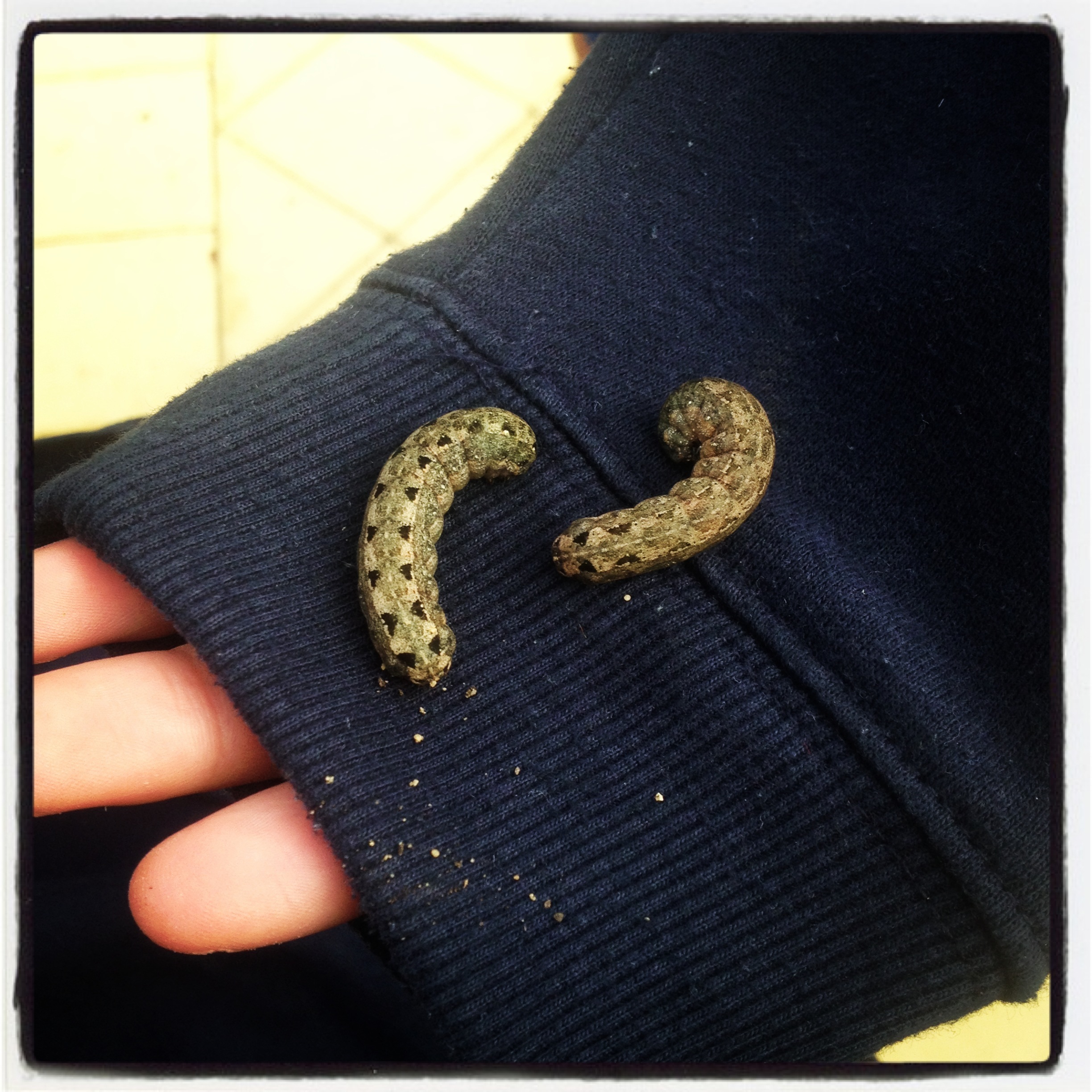
Things happen at a slower pace in the garden. After all things don’t grow in front of your eyes. It takes patience to grow stuff. Soil needs to be nurtured and enriched. Weeds need to be pulled. Time needs to pass. Nor do they die and disappear in a puff. Although that’s what it seems like for the beetroots that have struggled against the onslaught of the bad bugs – snails and caterpillars and slugs. Their leaves have been stripped bare. Now just stalks remain.

Today war has been waged against the pests. The army of blue uniforms are out searching the leaves and the hidy holes of the grubs and collecting them in the bucket. Garden Specialist, Katy, has the disposal job, since the kids are not keen on destroying the molluscs. They come over all Buddhist when talk turns to the final elimination. Especially after naming them Curly and Whirly, Creepy and Sebastian.

Still. It’s kinda nice to see kids that don’t take pleasure from stomping on a snail. Doesn’t it say something?

Too much personification – the adults warn. Then comes discussion of whether snails go to heaven. How philosophical a morning in the garden has become. But it is too late. They have been slimed by them and had them wriggling across their palms. The snail trail zig zags its way across a blue wind cheater. The kids are really inspecting the snails – the way they move like mini tractors across the dirt. It makes me recall the book about the movement and munching of a snail written by a bed ridden Elizabeth Tova Bailey over a year where she lay listening to the sound of one eating. In her close observation of the creature she grew attached and, through her attachment, came meaning and solace and understanding. Some are mere babies, the children say, and I imagine a snail secreted home in a pocket, named and stroked, to a bedside table, to become a new pet.

But gardening requires the tendering of the plants and that means the beasts must be got rid of, so collect them, they diligently do. On the way to the bucket of death the kids marvel at the way the molluscs have eyes on stalks that swivel about. How cool would that be? Seeing round corners, under desks. The kids have their empathy and imaginations dialled up high today, suddenly brothers to the creepy crawlies. Many kids may never have taken the time to get so close to a snail. What kid these days spends time in dirt and poking about the garden? Some may not have had the courage before to feel the suck of a snail to the back of your hand. But when everyone else is doing it, it becomes okay, to feel, to prod, to explore. And besides, this is school work – we are supposed to be getting our hands dirty.

There are not enough good bugs in our garden. The lady bird is revered. She is carefully pointed out and then left alone, despite the desire to pick her up and feel her little bug legs march across your skin.

The worm castings are diluted in watering cans and each plant gets its three-second drink of the extra good stuff. The time in the garden has gone quickly, despite the relaxed pace. Less frenetic than the kitchen, its results are slower and take more time to notice. Snail pace. But we have hunted and gathered today from our very own garden and delivered up the reddening capsicum and now it joins the salad of spinach leaves and very soon will be belly-side. Before any pesky snails get to it.

caterpillars


Letting the day slip away…

study

There is guilt of course.

There is a lime green file. It is full of pages of neurology and psychopharmacology. It is mind bogglingly hard to fathom. When it starts to grind down to the DNA in the cell and the enzyme RNA polymerase I feel something slipping in my brain. I read and reread the same sentence. Neuronal stutter. Like the old Holden EH clutch that my mother’s foot fumbled with at the hill by the prison going to visit my Dad in hospital as a child. How she dreaded the hill. Even as children, in the back seat, we felt my mother’s dread of the hill. Sitting on our hands on the sticky blue vinyl. Her anxiety a wave of heat. Please turn green lights so she doesn’t need to ride the clutch and do a hand brake start and risk rolling backwards into the car behind, or else konking out.

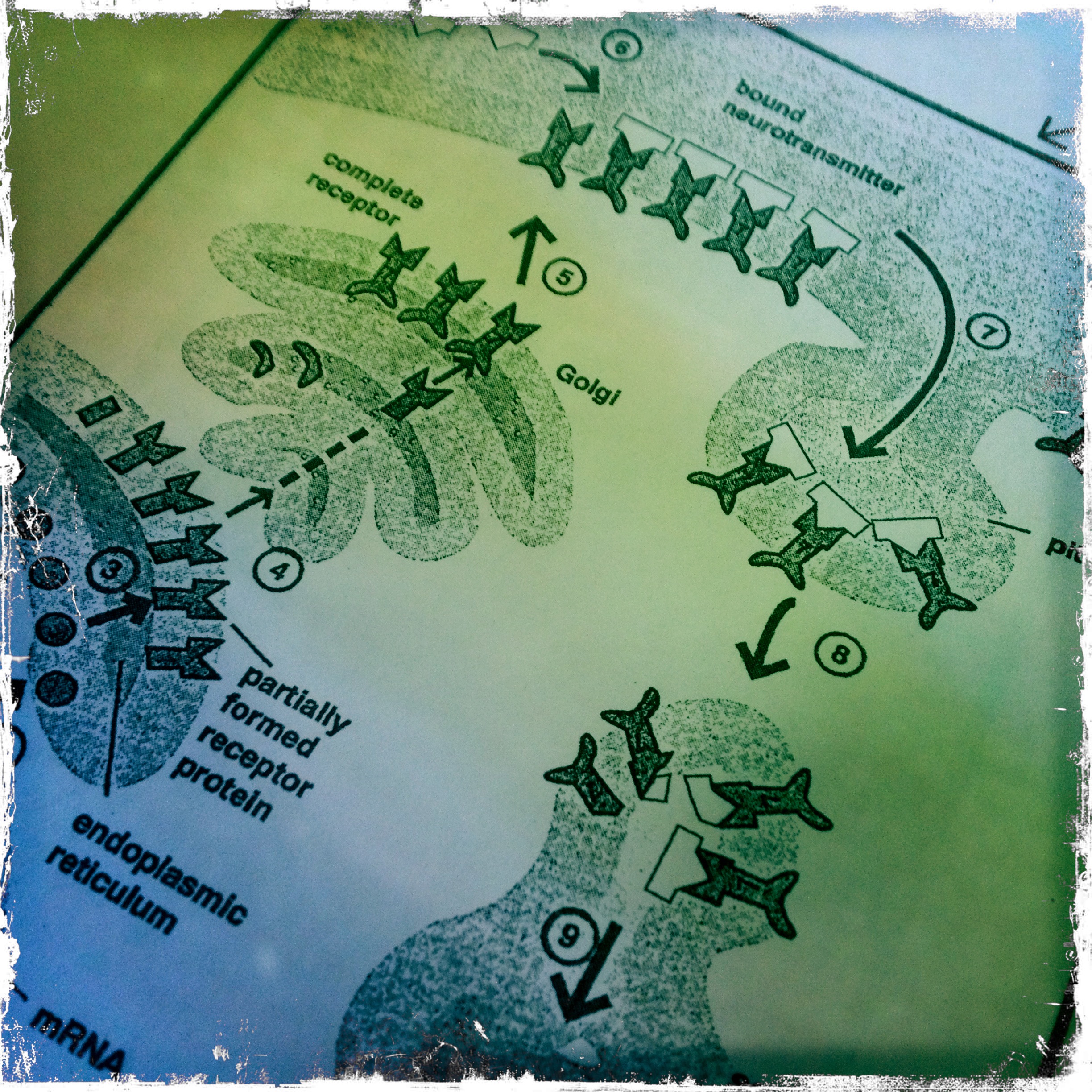
The green file notes try to make analogies that are easier for the brain to grasp. For instance, it cutely describes neurotransmission as a “pony express.” But somehow I can’t quite make the jump from molecules to horse riders and it just makes the whole thing harder still. I am learning that the brain is not a collection of “wires” (I am not sure I ever thought it was) but rather is a chemical “soup”. The neurotransmitters are swilling around, turning on and off the genes in cells so that axons grow and stop growing. Make connections. Stop making connections. I don’t think it’s quite that simple, but that’s how I am imagining it. This is today’s take home message. Brain = chemical soup.

I learn that 90% of the neurons made by the foetal brain commit apoptotic suicide before birth. The discoverers of the process who named it apoptosis wanted the word to rhyme with the messy process of cell death called necrosis and used the Greek ptosis meaning “falling” and apo meaning “off”, just as autumnal leaves fall from a tree. Even in science humans search for words to be beautiful. Cell death = falling petals. In apoptosis the neurons just shut themselves off and disappear. No pus. It seems only the strongest and fittest neurons survive and thrive in our adult brains. In the adult brain there are still changes being made all the time but they are not as dramatic as those of the foetus or child. An adult brain is like a well-established garden where the neurons, like roses, need pruning and shaping, but, please, no major landscaping.

Even in science, or maybe especially so, we need to keep bringing it back to something more understandable. Something more concrete. Gardens and cooking. Houses and sheds. Nerves as having branches, brains as full of soup. For who can imagine the inside of a cell with its mitochondria and endoplasmic reticulum. We need the mitochondria to be the energy power house, the nucleus the central headquarters. But despite its helpfulness there is still chemistry and molecules and who can really understand that everything living is made of atoms of carbon?

And maybe some where along the way I lost that neuron (or two) that was responsible for that little bit of understanding and that’s why it’s so hard. Perhaps when all the neurons were in a lemming-like mass walking off their apoptotic cliff there were a couple who really should not have leapt. They were the ones supposed to “get” the DNA and RNA and the enzymes and peptides. And as science is able to dig deeper and examine more and more finely we discover more and more detail. You think you have come to the end of something and then they explode it apart and describe it again at a more intricate level. Ad infinitum. When once seeing inside the cell seemed miraculous, now we can see inside the structures inside the cell. Just as space goes on for ever, can we continue to magnify and see deeper and deeper into molecular structure? We can explode apart genes so they become lists of proteins. We can see what receptors are made of. Like an artist who constructs a world on the top of a pin. Each cell is a world.

Doesn’t it blow your mind?

war games

Doggy Dementia

winter

Just the other day I euthanised a pooch whose owner described him as having doggy dementia. She came in with him clutched to her. He was a sixteen-year-old little white fluffy who spent his days wandering the house, soiling himself and the floor, refusing to let anyone rid his coat of the tangled matts and deteriorating into a bundle of anxious quivering. She didn’t care that he stunk. She did care that he was in pain. If she could have admitted him to a nursing home for dogs maybe she would have. Maybe not. Recently she had had to go away and she’d left him with her sister. He’d not slept for three days.

Now I am reading Rebecca Mead’s absorbing article in The New Yorker about the advanced-dementia care at Beatitudes and I can’t help but think of the little white fluffy. Dogs get dementia too.

The director of education and research, Tena Alonzo, at the unusual and forward-thinking nursing home says, “All behaviour is communication.” With dogs it is even more so, since we never have a verbal language in common to begin with. We cannot ask them how they feel. To be a vet you must watch and listen. To know dogs is to observe and interpret their body language. To understand the demented human, body language needs to be read too. Alonzo gets the staff to practice interpreting non-verbal queues on each other, by having another staff member instruct them in a foreign language. She also gets the staff to brush one another’s teeth and to spoon feed each other – this is how you come to understand what it feels like to be the resident. The dedicated take to wearing adult diapers – to get a real sense of what life might be like for a dementia sufferer.

Alonzo says, “When you have dementia, we can’t change the way you think, but we can change the way you feel.” This might be true for dogs in distress too. We could always do with a little more empathy.

She describes how a black square of carpet at the entrance to the lift might stop a demented patient entering, since people with dementia have been shown to be unwilling to step onto such a black space, imagining it to be a hole. Reading this I thought – how like the cattle grid at the farm gate. Perhaps as we slide into dementia we are becoming more akin to animals. When Alonzo talks about her own old age – she says, “when I have dementia” knowing that cognitive decline comes to nearly all of us. Most of us will go there.

She says, “one of the things that create comfort for people who have trouble thinking is space. If you are too blocked in you feel frightened.” Think again of the animal that cage guards. Lunging and growling at anyone coming near, but as soon as the gate is opened and freedom is sensed, the animal can be handled.

When a patient can’t seemed to be helped with pain killers and distractions Alonzo says, “we’re going to try chocolate.” Hershey’s Kisses are a mainstay at the nursing home, because “it’s hard to feel very bad when there’s something tasty in your mouth.” We manipulate the behaviour of dogs with food rewards and lures too. Trainers and vets have long used the momentary pleasure of food to minimise distress. Keep feeding as nails are trimmed. Offer a popsicle coated in peanut butter to be licked while a coat is brushed. We can change a dog’s perception of something it is frightened of by repeated pairings of a food reward with the thing that is the dog’s monster. All the puppies I see for vaccination are injected, mostly without ever feeling the needle, as long as they are distracted by some tasty dog treat. As patients slip into deeper dementia it is as if the primitive structures of the brain take over. There is pleasure and pain. There is fear and anger. There is flight and fight. These core parts of the brain are similar across all animals so that in the end, when we are old and have lost our cognitive function, we are not so different from a frightened dog. Or horse, or cow. We may no longer be able to operate on a high intellectual level, but we still feel. Emotion lives on, sometimes stronger, unchecked, unleashed. Patients are described as “resisting care” when really they are like the dogs who are objecting to being restrained for grooming – they just want the man-handling to stop. In the nursing home the supply of pleasurable food helps avoid conflicts and makes people feel good, just as the only thing that could quell the white fluffy’s pacing was roast chicken from the corner store.

I think about how vets have learnt a lot from paediatric dentists. Today in the dentist’s there is no fear. It doesn’t even smell the same. Fuzzy green toys hang from the lights. Toys are handed out after the clean is done. The child’s dentist is so very different from what he was like when we were little. No white coat. Now they know how to distract and comfort rather than force and bully. The nursing home is changing too. It is no longer acceptable to bomb patients with antipsychotics (developed for schizophrenia) just to make them easier to handle for staff. Rather than becoming obtunded on Haloperidol, something as simple as Panadol may be all the patient needs to feel less pain and become more cooperative. It is better to lower the bed, so there is less harm in falling, than restrain people to their mattress. People need to maintain dignity, just as animals need to feel calm. It’s all about the kind of handling. You can take them gently by the hand and lead them or you can put a collar on them and pull. Which one do you do?

Just as humans are afflicted with dementia, our pets also suffer from cognitive decline. They seem to do the same things as our human relatives do. They mix day and night. Sundowning for dogs.They wander the corridors and holler for someone to help them. They don’t know where home is. They stand in corners. They forget who their relations are. They hear non-existent noises and bark at them. They are in pain.

Seeing others. Feeling like others. When we work well, at whatever we do, isn’t it because we recognise the emotion the other is feeling? Be it animal, be it human. We aren’t as different from other animals as some humans would like to think. Connectedness. When we strive to understand what another is feeling we make great steps to knowing ourselves.


Pollan in the kitchen…

fresh

Michael Pollan knows a thing or two about food. He has been writing about eating and the dilemmas of making food choices for some years. He has thought about the moral choices, the health choices and the political choices. But strangely, until recently, because he didn’t really cook that much, he forgot about the soul. Since reconnecting with the basics in his kitchen he has come full circle and discovered there is power and real creativity in cooking. Getting ingredients and making a meal from scratch anchored him to the planet and what the planet needs from its guardians. It gave him connection. We cannot simply keep taking.

In his latest book “Cooked” he writes, the single most important thing we could do as a family to improve our health and general well-being – was to cook. Something as simple as cooking for your family might also end up making the western world’s food system healthier and more sustainable too.

Wouldn’t Michael Pollan be impressed with the SAKGP. It would be right down his alley. In the kitchen today a child knew instantly that the white bulb with the fuzzy green top was fennel. And how come it smells like licorice? All senses alive. Unlike the six-year-old American children who, when asked by Jamie Oliver, what were the names of various common vegetables, stared blankly back at him, unable even to recognise a tomato from a potato. Their food comes packaged or frozen or wrapped in paper and delivered out through a hole in the wall and then wolfed down in the car.

The wonderful thing about the kitchen is the noise. Engaged and cooperative. Happy noise. It has been six weeks since this class cooked so there is a buzz in the air. The routines are a little rusty. Are you a Melting Moment or an Afghan? What group are you in? If you are in the garden this week we need to tend the worms. Children are busy. Some prefer the garden. Others want to cook. Some (believe it or not) are actually good at cleaning up. Some one grazes a knuckle with the grater. Yes, cooking is sharp. Stoves are hot. Onions sting your eyes. Swimmers goggles hang beside the bench for those who can’t take it.

A salad of winter vegetables is made from finely sliced cabbage, both green and purple, and apple and carrot. Then fennel too. The dressing is honey and mustard. But let’s not stop there. Let’s collect fresh herbs from our garden and pluck the leaves from the stems and add them too. Then we pound some pepitas in the stone mortar to add a crunch to the salad. Lets sprinkle it with poppy seeds.

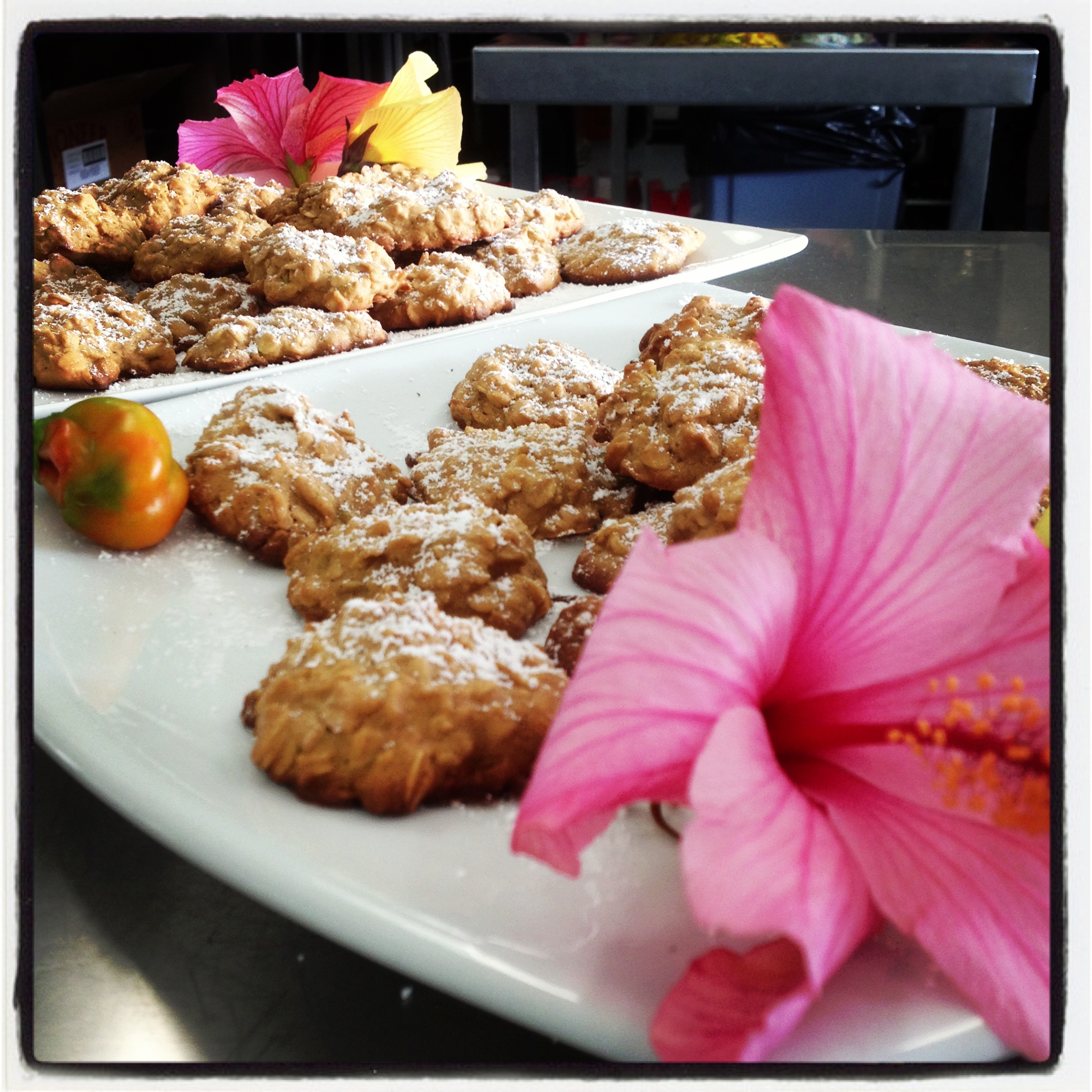
For afters are oatmeal biscuits with cinnamon and brown sugar. Cleaning up is to be done before a biscuit is taken and whisked away into the playground. The kitchen aid does the creaming of the butter and sugar. One boy thinks that because his home doesn’t have this machine he will be unable to replicate them. Just use your hands, assures Lee. Squish it. Let the butter come to room temperature. Then, just as if the butter and sugar were play dough – it will come out just the same. The mother agrees. She could never lift down the machine from a high cupboard when she was little and did the creaming with a wooden spoon. It can be done. And less washing up. Lick your fingers.

Back by the worm farm the boys are sifting through with gloved hands and extracting the garden rubbish that has been incorrectly placed there. It means getting close to bugs. Telling the less brave that the bugs can’t hurt you. Despite their mutated look. Cockroaches and slaters have taken up residence and are stealing the worms’ food. Girls are skittish about getting close to the insects but after some encouragement they too have their hands in the dark rich organic matter. Everyone is learning to try stuff they would not normally do.

The mother on oatmeal cookies is using a spatula to scoop every last skerrick of mixture to form the biscuits. Witness the children hoping mind control will make her stop short. The hyenas stand by, pining for a spoon to lick or a dirty bowl to run a finger round. There will be barely a morsel. They watch as the temperamental oven manages to bake the clumps of muddy mixture, turning them darker and crisp, and emerging almost as tasty as the uncooked dough. Yes they would try this at home – with or without the help of a mixer.

And as Pollan says, what he learnt about cooking is this; “that cooking gives us the opportunity, so rare in modern life, to work directly in our own support, and in the support of the people we feed. If this is not “making a living,” I don’t know what is. In the calculus of economics, doing so may not always be the most efficient use of an amateur cook’s time, but in the calculus of human emotion, it is beautiful even so. For is there any practice less selfish, any labour less alienated, any time less wasted, than preparing something delicious and nourishing for people your love?”

biscuits

Head cold meets Knitting

Jasper's Knitting


Jasper says, “I wish I could knit on the couch while the TV is on, like you do…”

“I can teach you. What do you want to knit?”

“A beanie.”

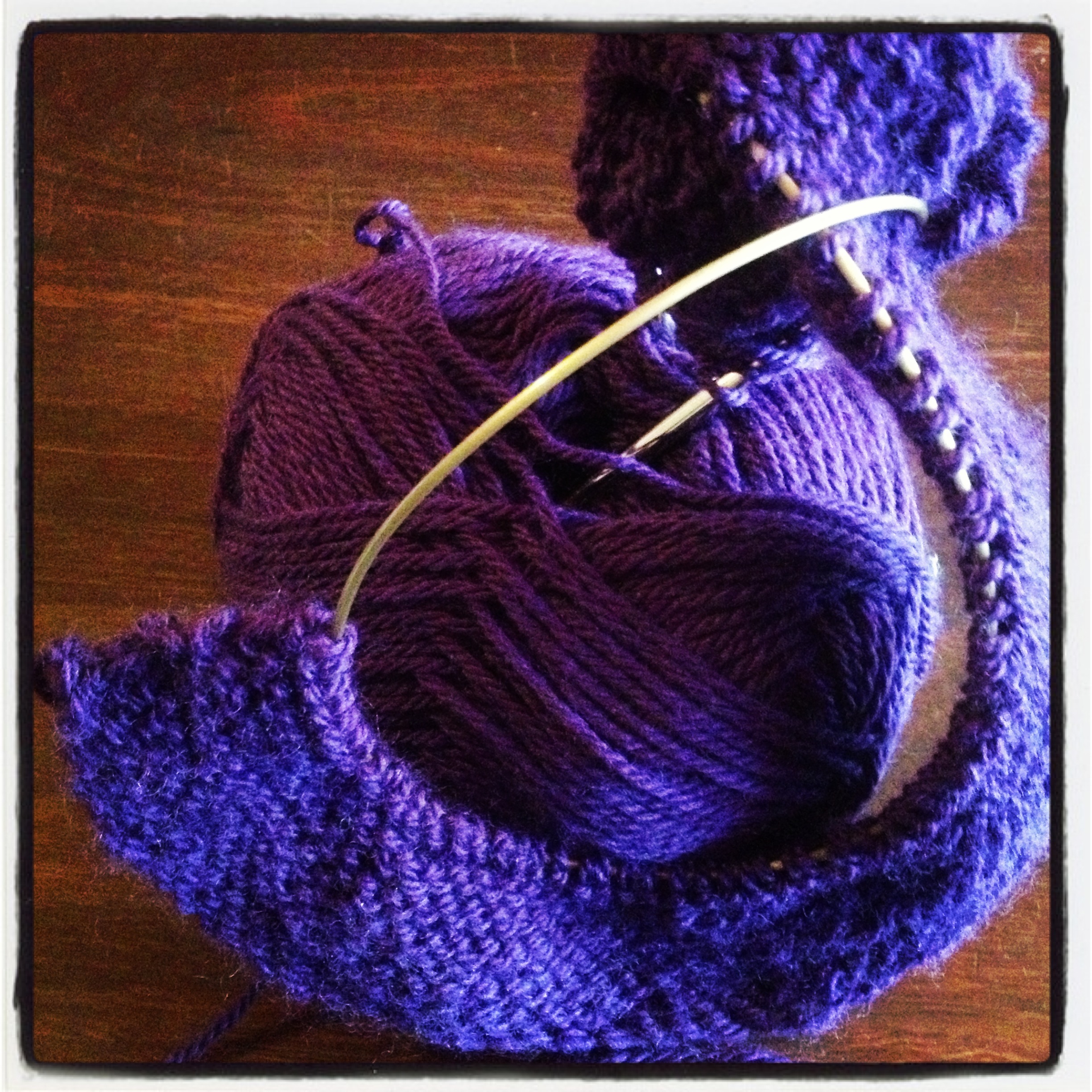
A free-off-the-web beanie pattern is downloaded. A spare ball of wool is located from the cardboard box beneath the bed. Ninety stitches are cast on. I show him how to knit a stitch.

It is not easy for boy hands. The task is delicate and dainty and very much a sitting still activity. But he is inspired by it. It is repetitious. You get better at it quickly. The thing you are making is growing before your eyes. Be it slowly. Lucky to have knitting when you are at home with a head cold. When the outside is beautiful and still and clear and crisp. But you have a sore throat and a runny nose and a heaviness to your head. And just inhaling the air is making you cough. No outside for you.

Mistakes are plentiful. Bumps where bumps should not be. Holes where holes are not. But knitting is forgiving. Just keep going. A wonky stitch will not ruin the thing. It is a good lesson for him to learn – the boy who hates smudges on paper, or creases on books. The boy who adjusts his singlet and then takes it off. Who checks the used-by-date on his Mocha milk before purchase. A knitted beanie, I tell him, doesn’t need every stitch to be straight. You will see. A few gaps here and there add character, Fremantleness. It will be better because you made it. Because it grew from you. From your industrious hands.

It struck him, momentarily, that knitting was a thing girls did. He sees no males do it. When we searched online for men and knitting the only knitting males involved themselves in was speed-knitting, their hands moving like machines. Needles like drum sticks. How to ruin knitting – turn it into a competition. But something about knitting overrode the girl-thing.

And then there is the sheer joy of a mind-numbing activity. I don’t think enough people appreciate the peace that comes with doing the same thing over and over. Like the person who doodles flowers or stars. Runners get it. Like the swimmer doing lap after lap. Swimming and knitting and meditation and breathing. All the same.

Dogs know the power of repetition. They know the joy of monotony and predictability. They strive on routine and regularity. It mends the mind. Awash in oodles of serotonin, my dog spends all day on the couch. He needs no surprises. He wants for no deliveries, or new friends. At 2.30 pm he begins to predict the school pick up time. He shuffles and rises when he hears me ready myself to leave the house. It is not all he gets but it is one of the predictable walks he longs for. He stretches and arches and shakes off. He will pee on at least three of the Stobie poles. He will mark the dustbin on the corner. He will drag his butt on the braille-for-the-feet street crossing. Knowing him completely is part of his charm. His presentation of his Kong on greeting. His knitting-like nature. Day after day. If he were ill, it would be immediately obvious.

The activities that quieten my mind always seem to have a repetitious nature to them. Like scrubbing the sink. The squirt of the Jiff. The way it doesn’t lift the grime without some effort. Not like on the commercial. One wipe and it is gone. It does require scrubbing. But that is part of it. If wiping were all you wanted, you would not be at the sink with a scourer.

Typing. Tea drinking. Knitting.

To Test or Not to Test

GATE

Testing.

Who likes doing tests?

To see how much you know. To see how much you don’t know. To stare down a bit of white paper and be confused and angered by a question that, to your eleven year old self, makes no sense and is boring. Boring equals hard.

Is confidence built by doing well in a test?

Is confidence lost by doing poorly? Where does confidence go when it is diminished and trod on? What can we do to enliven it again?

What are we testing when we test boys? Their ability to sit still, like girls. Girls are good at tests. They are good at writing neatly and making borders around their work. But some boys like to move to think. Some boys like to throw a ball while they talk. Some boys like to skate. Some boys are messy.

Failure is supposed to help us succeed later. But in the moment failure is just that. It is flattening. It deadens us to that feeling that is success. Success seems slippery. Others have it. Not us. Skipping ahead, around the corner, the girl in the colourful skirt with the pretty curls. The boy child – his body sags and his shoulders push earthward. Shoes laces dragging undone, since doing them up just wastes time that could be spent running. They will come undone once more. The nature of shoe laces. Ugh another test.

And to have to miss Hockey because of a test. No reward seems good enough. He harps on It’s so unfair. My bargaining begins – Star Trek movie and a mint choc bomb perhaps.

And what is gifted anyway? Gifted – handed to you. Unearnt. Something someone else gave you that you played no part in? Gifted through good genes. Gifted and Talented exam. GATE to the parents who, like me, might have signed their child up, hoping for a spot in an elusive school. Saying GATE somehow seems less irksome than gifted and talented. And so if you don’t get in, then you are Not gifted and Not talented. Just a regular eleven year old kid with no interest in a test on quantitative reasoning and abstract thinking. Just an ordinary kid who must go to an ordinary school with ordinary teachers. Only 2.5% of kids can be labelled Gifted and Talented, so it’s a stretch to get in.

The acronym GATE is apt. Maybe WALL would be even better. For most students the GATE is locked and high and barbed. The GATE is not open wide or welcoming. It is latched and chained and bolted. Combinations and passwords and special handshakes required. It is the beginning of difference. Is eleven too young to begin to know? Maybe this is the first real gate they have come across. You have always held the door wide for them. Perhaps you are discriminated, as I am, by steps and stairs and steep driveways. Or maybe it’s the colour of your skin and the curl of your hair that prevents your inclusion. Maybe you can’t relate to people or you relate too much. Maybe English is not your first language. You live in the wrong part of town. Maybe you are a woman.

This afternoon, after school, I must ask him to sit and look at the sample questions so the exam paper does not come as a shock tomorrow. I need to tell him to not rush the paper, in the hope he can leave the room early. Only guess if you really don’t know and have no time to try to work it out. I already know it will be a battle to get him to look at the samples. When the sun is shining and friends are meeting at the park it is less than alluring to ponder a puzzle your mother looks pained to make you do.


Nearly Mother’s Day

mum

Last Sunday I accused my son and partner of forgetting it was Mother’s day. It wasn’t. I had the day wrong.

They said, it’s next week. I said, google it. They did. They were right. Maybe they had thought of it after all. All my indignation had no where to go. A little sharp pin inside.

She is looking out at me while I type this. A fading black and white image of my mother holding Jasper as a chubby baby. So briefly chubby. Now a stick thing. Wears a fitbit and counts his steps and flights of stairs and burns through calories.

She has on her photo smile. Slightly strained, but real none the less. It’s all about the eyes. Smiling happens there.

How she loved being a Grandmother. Even though she couldn’t lift him. She once told me she pushed him around the backyard in the wheelbarrow.

I can’t recall her last Mother’s Day. Blended with the mundaneness of ageing. Days determined by the menu. Fish on Fridays. A good day decided by who’s on night duty. Which carer she likes, on which day. Oh Carol is on holiday. How will she survive? I would have bought her a nightie from Suzanne’s or Myer. I would have taken her mandarins and peeled them for her. I would have cut her fingernails on her right hand. She would have complained about me hurting her as I did it. And when I finished she would tell me they weren’t short enough. I would have made her practice wearing her hearing aid. We would have watched some pre-lunch news. I would have opened her bed side drawer and thrown away the scrunched-up tissues and the mandarin pips. I would have tried to chuck out other things but she would have prevented me.

I think of visiting there – just to say Hi to some of the kind staff. Carol, Marie, Jane. But then the week goes by and I have not found the time. I never look at the mandarins in the grocers. What would I do once I got there? Poke my nose in the room, that is not hers any longer, to see another frail bird in the bed? To have my nostrils reminded of the smell of old people. See, that unlike Mum, they prefer the curtains open to the garden and the sun.

I am not sure what it is I feel when I remember her. What is this emotion of missing? Wishing more for them? Wishing for more for ourselves? It is an unsatisfying emotion. All this unresolved wishing. It goes out from you and leaves a hollow feeling behind. In the end you resemble a husk, after all the wishing is done. What can she be thinking, wherever it is that she is now? I want to wrap a blanket about her thin arms and hold her. I want to feel her soft curls. I want solid. I want strong. I want words that work, but words are failing me here. I feel all her longing for me and for my happiness. She had a way of devouring me. Again there is the act of disappearing, of taking away. I could never love her back with the same intensity that she felt for me. Piano playing fingers reaching for me. Even now I feel it.


Red Hen

Image

Jasper is cleaning out his bedroom. He is decluttering. He is exhuming the detritus of a ten-year old because soon he will be eleven and eleven-year olds have moved on from Little Golden Books, and Dr Seuss.

Anything you don’t want just put in a pile because I will go through it, is my plea.

Because to me books are treasures. They are more than words on paper. Of course. A story, a sentence. It worms inside, to the heart of you. There are books that he loved, and then there are books that I loved, and hence read endlessly to a toddler who cared little about what was being told as long as he could turn the pages.

There is something special about a loved book – one you’ve read out loud to a child so many times that its words have worn a track through your brain. Like a single lane walking path through a wooded forest. Grass woven flat, as hard as concrete. Pine needles beneath your feet. Your mouth shapes the words before your eyes have read them. The pictures are so familiar. Like old photographs etched in your memory. The smell of a winter stew cooking as the sun goes down. The rumbling sound of a Kombi pulling into the drive. The tilt and flow of language.

Will you help me plant this grain of wheat?

Not I! said the duck…

Then I will plant it myself, said the Little Red Hen. And she did.

The industriousness of the Little Red Hen was always remarked upon. All that planting, reaping, carrying, turning flour into dough and baking was done without any help from the duck, the cat, the goose or the pig.

The selfishness of the “Not I’s” saw that they ended up with no bread. How right things were in the world of the Golden Book.

So I keep the Golden Book. First published 1954. I keep it for myself. Maybe one day I will read it to another small child. Maybe one day Jasper will unearth it in my old possessions and find himself on the forest path.

Cleaning out my parents house I find similar kept treasures from my childhood. Dolls’ clothes. Hand made babies’ dresses. Christmas decorations made in kindergarten from toilet rolls and cotton wool balls. My mother kept a book I had loved as a child. It was tucked away in camphor and would not have been looked at for years. Probably it had been forgotten about it many years previously. But there would have been a time when she held it over the garbage bag for Good Sammies and hesitated before dropping it in. She would have looked through it and remembered my delight in it. It would have brought a smile to her face. She had kept it as I am keeping the Little Red Hen now. It was so familiar when I found it, like I had looked at it only the day before, but it had not been seen or thought of for forty years. I turned the pages and found the favourite picture I had puzzled over. It was the story of a princess, but the pictures were not drawings, but photographs of dolls dressed in real fabric and with doll house sets. In one picture they sat at a table eating a royal meal and the food in the pictures must have been life-sized, since on a plate is a single pea that seems the size of an apple for the princess. This wrongness appealed to me. Everything else miniature and perfect, but the food. And I would wonder at the people who made the book. Did they run out of ideas? How did they imagine the princess would eat such a pea? What would an apple-sized pea taste like? How would I make the princess a meal?

With Jasper’s mountains of work and drawing there is always the question of what to throw away and what to keep. How many pages of scribbling can you really want? For a whole term at Montessori Jasper would bring home cardboard boxes glued together into towers and present them as if they were sculptures. We kept none. I squirrelled away a favourite blanket, a pair of booties, his wrist band from the hospital where he was delivered. I have not kept teeth or hair. And yet the book feels more powerful than some of these other treasured things because I can hear its magical song. Reading it aloud is a meditation back to mothering a toddler. When reading aloud at the end of the day signalled the respite that would soon be yours when he was in bed. There is a sighing to the reading of the story. It is short. It is complete. The tale needs no explanation. The little Red Hen; she had no help, she did it herself.

golden books

Stillness

sky

It is the perfect ANZAC day.

No wind.

A sky as grey and warm as an army blanket.

The leaves in the trees are motionless, as if they too know there is a need for a sombre earth.

I shirk from what it can mean. I would prefer we need not remember. I don’t like flags. Especially waving ones. I would like to be certain we are not glorifying. Instead why not mourn our failure to learn from what has gone before. March for Peace.

But. Maybe. If you have loved a solider and seen them sail away across a silver sea. Watched them turn to a speck. Felt the tug of their distance. And they have not come home, then today is something. Like medals, locks of hair, a remembered song. You loved them and they are lost.

The jets break the silence. So much louder when there is no air moving but them. They boom. They crack open the sky. They remind us war is anything but silent. Messy, bloody, dirty. Not like this still and perfect day.

A bugle is beautiful. How does he form the notes?

The reverence of ninety-three thousand football fans makes you hold your breath, while he hums a tune through pursed lips.

If only we could remember.