Mad Mother

brain drawing

In my attempt to not embarrass him, I keep my cool.


There are stairs at the entrance to the sign-in area for the GATE visual arts testing all-day workshop. Deliver me from evil. This is not supposed to be a test of a parent’s resolve, or a parent’s coolness under pressure. We have already waited as a herd of uninformed, uninstructed parents with our stressed and unenthusiastic eleven-year olds – asked to do a whole day of testing during the holidays to get into an arts program at the public school of their choosing. Everyone would rather be somewhere else (like still in bed) as opposed to at this seventies High school that resembles more a detention centre than a place of learning.


They have an arts program here too, but amongst the grey shoddy brick and the moth-eaten grass, I feel distinctly unartistic.


We follow the mistaken directions of a janitor in a fluoro vest. By luck we find a ramp that allows us access to the sign-in area where the two women are perplexed we had issues. A pin-striped suited man says he wasn’t informed someone would be attending in a wheelchair. I am a parent, I say. I need to drop my child off and pick him up. I presumed the school would be accessible. It is a government school, is it not? In the year 2013. As a community we are interested in equal opportunity and access, aren’t we? Isn’t it your job to check things are equal for all? I am speaking to people who have never encountered a problem with stairs. It never crossed their minds. Legs like racehorses. And when I suggest maybe some better signage for the other souls who stood about with us wondering where to go, she says, yes we had the same issue last year. I feel Jasper at my side willing me to shut up.


I don’t want to shut up. I want to tell pin-stripes how it is. Blonde bob too. I have the urge to push my point. To be understood. Be in my seat for a moment, looking up at you from the height of a ten-year old, and feel my rage, my frustration, my sadness, my awkwardness. Jealousy. In the end my voice a quiver. Just to get my son to the test.


He is there now. Breathe. And I am in the State Library that I still call the Alexander library – where around tables bunches of students work in groups of four or five. Through thinking doors. Entering a vacuum. Ahh books. Students are plugged into music, others have their phones by them to keep an eye on their social networks. During their short interludes of study they are silent, but mostly time is spent idly chatting, files open, pens down. Denim-clad legs all a jiggle. From the mezzanine level there is the shrill cry of toddlers and babies. Libraries are not silent spaces anymore and it seems nobody expects them to be. A dirty homeless man makes use of the nice surrounds and finds himself a comfy chair to settle down in. He carries on a conversation to himself.


I am in the medical section – pouring over neurology texts trying to make sense of the limbic system and the brain. I draw it, as best I can. I wish for coloured pencils like the ones Jasper might be using. I remember anatomy and the feared neuroanatomy lectures. How is it that something as squidgey as jelly, as unctuous as mucous, be so complex? I read about the primitive brain. The one we share with other mammals. A rat in a cage. A red light flashes and then the rat receives a shock through the floor. Next time the red light  flashes the rat  anticipates the shock and so now simply the appearance of the flash results in fear from the rat. You know how when you smell the antiseptic in a doctor’s surgery? This is how I feel about the sight of stairs when my child needs to be at the top of them and we are at the bottom. It is primitive. It is amygdala-based. It sets physiological events rolling and I have to rein them in with the cognitive powers from my higher brain. In the end we are all just brain chemistry.


I head out on the street to find lunch. I am not hungry, just conditioned to seek food at this time. If I were Graham I might wait till I had an appetite and it was the inconvenient time of three o’clock. The bain-maries would be empty or else diseased. I eat half the sandwich and leave the rest beneath the paper napkin. I should have asked them to remove the cheese. I’m not really fond of seeded mustard. I go back to the library past some book shops. I am drawn inside to their smell. I pick them up, finger the covers, read their opening lines, think about purchasing because I love the way that word follows that one, the perfect sentence, but think of my house and the way it risks being subsumed by tomes.


On the incline heading back to the library a woman wants to push me. She offers help. I decline it. She says, “it looks hard – the pushing.” It is. Shrug. But. I can do it. We hang on, at least I do, to the things we can do. Having her push me would be worse than she realizes. A stranger on the handles of my chair, her breath behind me. Like looking at a flight of steps. Only Jasper, and Graham, take the handles of the chair and push on an ascent. They sense the need. There is no call for them to ask, for me to accept. To some a marathon is the street. The pole vault a six inch kerb. A steep driveway is my Alpe d’Huez. I shuffle to the front of the chair to get an inch taller to reach a neurology text from the top shelf. I could ask some one. Instead I stretch. How long my arms have become.


Two girls sit opposite each other – grilling the other on the epidermis. Do you know what a mast cell does? She takes her red plastic sandals off – they are jellybeans like the ones we wanted in the seventies. Her feet could be sweaty. She folds her legs beneath her on the chair. Her heels in her buttocks. Her brain makes them do it. Her spinal cord too. Effortless beauty. I watch them. Leg envy. Maybe we don’t need to know all the fancy stuff, she says. Who cares that mast cells release histamine? Somehow I think she will need to know. Next question. Name the two stages of wound healing? To think there are only two.
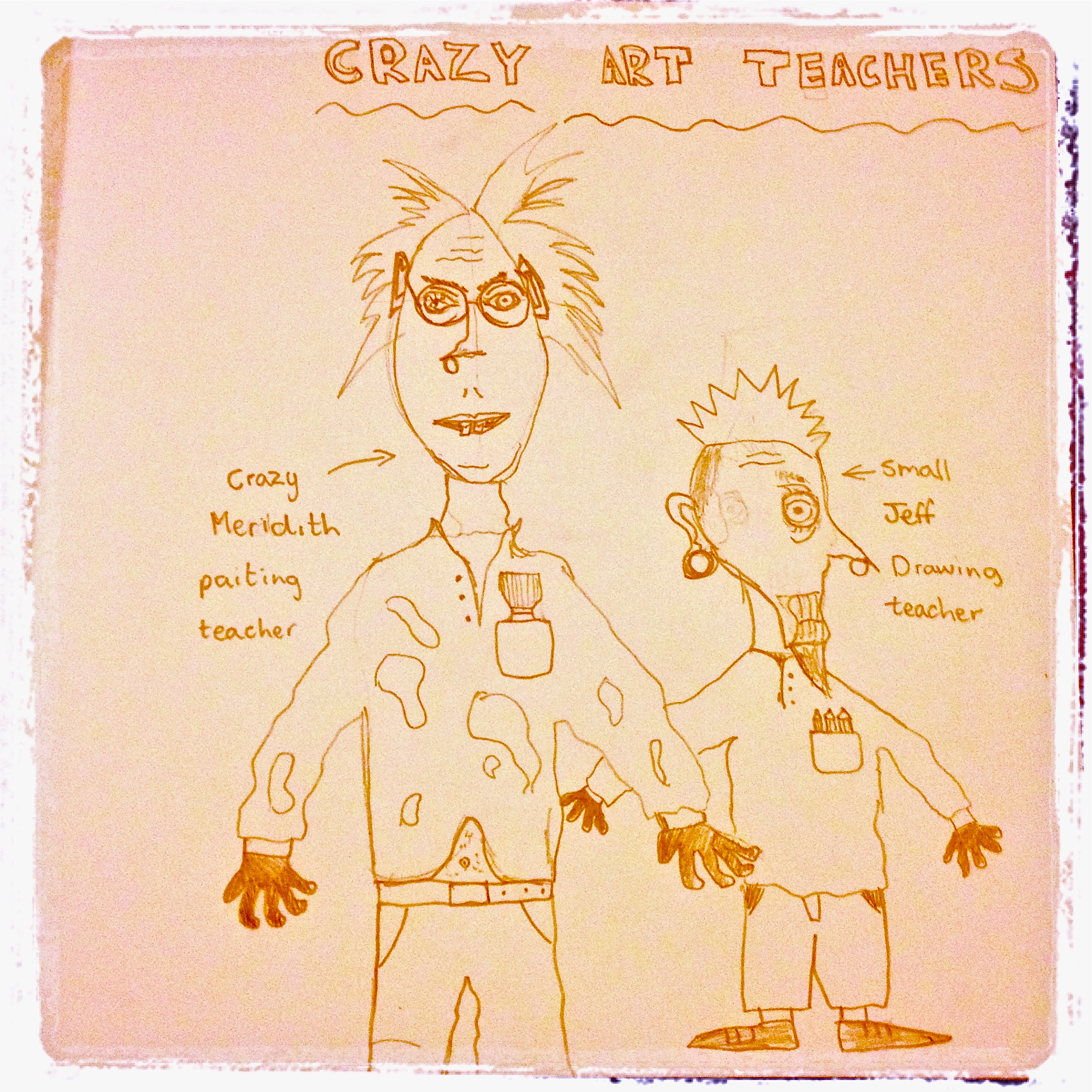
Jasper's art teachers


Stephanie and The Purple Garlic

purple garlic

When Stephanie joins the kids (from East Fremantle Primary and Singleton Primary schools) in front of the gathered audience at Garden Week, everyone is a little nervous. After all, she is a legend. Her program is responsible for teaching some 35 000 Australian primary school kids how to grow food and cook it. She has earned her reputation through hard work.

She is more silver than silver. She has her large beads. Her expressive eyebrows.

She talks to the audience while the kids around her cook. She knows she can leave them to it. She hovers behind, but not obtrusively. She says she tries not to be bossy. As mothers, we all know how hard that can be. She compliments a child on his knife skills. She shows some others how to cut the rib out of the silver beet, but also has suggestions on how to use it. She crisps up the sage in the butter because it can’t be merely wilted, it needs to crack like dry leaf. I am pleased to think that kids are learning this.

The Singleton Primary students must be as nervous as the East Freo kids are – they wash their silver beet twice. No one would want Stephanie to taste sand or grit in their dish. It’s hard to get the temperature just right on the fancy outdoor kitchen. She says you could call her primitive, but she prefers to see the flame over which she is cooking.

While the zucchini colours she expounds the virtues of local extra virgin olive oil and one of our students tells her of how we made it ourselves last year. We know, first-hand, from our own experience of pressing the fruit, that there is nothing added to the final product. It doesn’t require chemistry or a factory. No emulsifiers. No animal has suffered in the process. Stephanie describes it as as simple as fruit juice.

While the kids rub the toasted bread with the raw garlic, Stephanie tells us how we must avoid the bleached and imported kind. Buy locally grown Australian garlic – purple – not bleached or sprayed to stop it sprouting. Its papery mauve skin like tissue paper – veined like spider webs through ageing skin. Each clove so moist that when it is crushed beneath the blade of a knife, garlic juice wets your palm. Try growing it your school gardens, she says, as borders to the other plants.

Our students pick some edible flowers to decorate the plate and Stephanie says how important it is to serve the food at the table. Zucchini Bruschetta with preserved lemon, goats cheese, garlic and sage. Have a bit of time to admire it for yourself in the kitchen and then take it to the table for everyone else to feast their eyes on. Don’t dish it out in the kitchen. Let it be seen, complimented on and finally enjoyed. She opens her arms out wide to the audience. See what these kids can do…


Hockey Dogs

sponge cake 2

Hockey training takes place on an oval in Fremantle. It is a multi-use oval with cricket nets and clubrooms shared by both the cricket and the hockey fraternities. For the cricket families it would be a refuge from the heat. Somewhere to get a cool drink and away from the sun. For the hockey mums it offers warmth and dryness.

The building is made from dark brown brick from the seventies or eighties. A building made when we watched Countdown and listened to ABBA. The textured masonry makes you think of a thick slice of chocolate sponge cake. It makes you long for a hot cup of tea. Inside old wooden honor boards with names in gold lettering line the walls. An asterisk beside a name signals the person is deceased. There are the ubiquitous stacks of stackable plastic chairs. Many families have spent hours huddled in here while young ones take to the turf. Already I can imagine being inside when it is cold out and the Juniors are playing, regardless of the weather.

Parents drive up with kids who exit high cars like horse-riders leaping off steeds – gripping mesh bags with their armour (shin pads and mouth guards) – hockey sticks like lances brandished by jousting knights. (Do you sense already I have sat here too long?)

Most parents leave. They have stuff to do. So do I. I could grocery shop. At least I could get toilet paper. I could clean my house. Instead I stay to watch. The children must run down the steep embankment to the field. It’s the kind of steepness you can’t walk down. It makes you run, like you are falling over yourself. The field is marked up with hula-hoops and cones for dribbling and pushing a hockey ball around. I watch from the upper bank by the car park and the charity bins, by the side of the chocolate sponge cake wall. An old swing set waits to be swung on.

Other cars pull up and dogs pile out. They are as exuberant as any child. Some dogs come to the park with owners on foot from nearby houses. It’s that time of night – dog walking time. Some owners bring plastic tennis ball throwers while others bring a tug rope. Some bring just their pooch (and a pocketful of yellow poop bags).

In one afternoon – a puppy dachshund, a Siberian husky, a newfie, two bostons, a bunch of poodles, a border collie, a blue stuffy, two whippets, a pit bull.

The dog walkers take to the perimeter. These are dogs used to the hockey. They don’t go for the ball. They’re not spooked by hoards of teenage girls, ponytails bobbing, running up and down the banks for fitness. The dogs have eyes for one another and perhaps their own ball. Politely, they sidle up and do the nose to tail greeting. They prance off. They ask another dog for a game of chase. A play bow is offered. Invitations are made. There is zooming and frolicking of the most infectious kind. Smile-inducing dog play. In a corner of the park a man flies a kite and the poodles are off and over; launching themselves into the air, barking, necks arched backwards and noses pointed up, wondering what that strange bird in the sky is doing so damned high.

As the sun begins to dip the swallows are out flying low across the grass hoping for an insect. They make for good chasing. They are, of course, uncatchable. It has never stopped a dog. If you have the energy to run, then run. If your legs hold out, keep running. Never give up, no matter that thing you are aiming to catch is a bird. Ceaseless trying – is a dog’s great attribute.


hockey dog 2


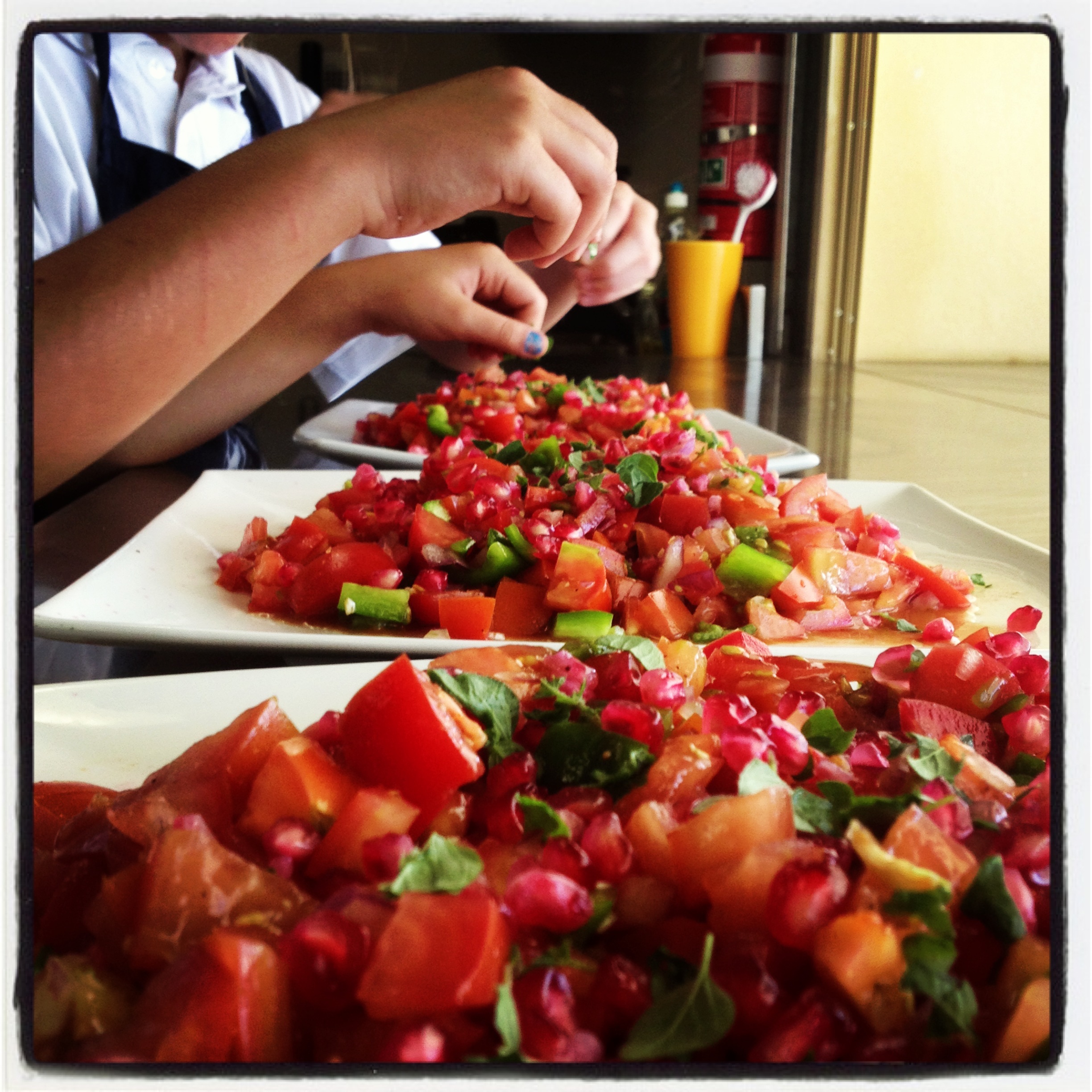
Pomegranate Jewels in The Kitchen Garden

Pomegranate

The glistening beads pop in your mouth. Melded with tomato and herbs they add sweetness and a firm texture. Little bursts. No one can quite believe the little red gems are as delicious as they are. They are an ancient fruit. They seem the kind of thing you might search for in the desert. The saviour that you stumble upon when, blistered and thirsty, you finally make it to the oasis. They come from a hard-shelled case. Of course it is fiction that each and every pomegranate holds the exact same number of seeds. But still, imagine. Its brittle matte surface defies the beauty underneath. It is a fruit I remember from my childhood garden too. Sometimes we cracked one on the red cement path, or used a tool from the many hanging on the wall in the garage – when Mum wouldn’t let us inside because she was vacuuming, or mopping or just because. And so we were outside and we were hungry. We could eat Gooseberries too – cocooned in their lacy lantern. The kind of fruit you don’t buy. Like lemons and figs and passionfruit – every good garden needs to supply its own.

In the Kitchen Garden it is time to cook. Long crusty baguettes are sliced on an angle and toasted in a frying pan. Then they are rubbed with a crushed garlic clove. Five times is the agreed number of rubs for each slice. The zucchini is sliced and cooked in a little extra virgin olive oil till it takes on some colour. Each crispy piece of bread is spread with the mixture of cream cheese and sheep feta cheese (our budget version of goat’s cheese). The zucchini slices are laid on, like fish scales, and topped with a sprinkle of diced preserved lemon rind and a crumbling of crisp sage leaves cooked in butter.

Bruschetta…

Our tasty main is Risotto with leek and yellow capsicum. A fearless mother takes on the task – despite it being the Death Dish on Masterchef. She’s unfazed. She gets her students in a preparatory huddle – they will make the best Risotto ever! It is a winner. A truck load of parmesan. Very cheesy. When not enough jobs remain the students find ways to garnish the dish with slices of radish.

At the communal table a child seeks my permission to lay his healing hands on my broken spine. He has the class reputation for healing headaches. Why not? Give it a whirl, I say.

When all the dishes and washing up is done – there are biscuits with raisins squirrelled back to the playground – turning to blur and dust in a pocket when a game of soccer rounders seems more pressing.

These days the year 6/7 group move around the kitchen with precision and speed. They know their work space. They have yet to work out the ovens, but either have I. Mostly they know where stuff is, although there is always a contingent of boys who need to ask for the item right before their eyes. Today I am about the clumsiest in our group as I nearly lose my grip on a slippery bottle of olive oil and send it to the floor. I save it in the nick of time. Kids are beginning to be confident around sharp knives and have mastered the skills meal-making requires. They no longer avoid the messy or tedious jobs. Well mostly. They work as a team to get the food on the table. Then they enjoy it mixed with conversation and pride. They know there is cleaning up to be done. They know the scraps need to be recycled and sent to the compost. If only we had some chooks. There are girls so keen on tomatoes that they scoop up the leftovers. The kitchen is ready for the next group. There might even be time for a cup of tea between classes. Funny how they think the tea towels might dry in a wet pile…

risotto

from “The North London Book of the Dead” by Will Self

Will Self“I suppose that the form my bereavement took after my mother died was fairly conventional. Initially I was shocked. Her final illness was mercifully quick, but harrowing. Cancer tore through her body as if it were late for an important meeting with a lot of other successful diseases.

I had always expected my mother to outlive me. I saw myself becoming a neutered bachelor, who would be wearing a cardigan and still living at home at the age of forty, but it wasn’t to be. Mother’s death was a kind of relief, but is was also bizarre and hallucinatory. The week she lay dying in the hospital I was plagued by strange sensation; gusts of air would seem personalised and, driving in my car, I had the sensation not that I was moving forward but that the road was being reeled back beneath the wheels, as if I were mounted on some giant piece of scenery.

The night she died my brother and I were at the hospital. We took it in turns to snatch sleep in a vestibule at the end of the ward and then to sit with her. She breathed stertorously. Her flesh yellowed and yellowed. I was quite conscious that she had no mind any more. The cancer – or so the consultant told me – had made its way up through the meningitic fluid in the spine and into her brain. I sensed the cancer in her skull like a cloud of inky pus. Her self-consciousness, sentience, identity, what you will, was cornered, forced back by the cloud into a confined space, where it pulsed on and then off, with all the apparent humanity of a digital watch.

One minute she was alive, the next she was dead. A dumpy nurse rushed to find my brother and me. We had both fallen asleep in the vestibule, cocooned within its plastic walls. ‘I think she’s gone,” said the nurse. And I pictured Mother striding down Gower street, naked, wattled.

By the time we reached the room they were laying her out. I had never understood what this meant before; now I could see that the truth was that the body, the corpse, really laid itself out. It was smoothed as if a great wind had rolled over the tired flesh. And it, Mother, was changing colour, as I watched, from an old ivory to a luminous yellow. The nurse, for some strange reason, had brushed Mother’s hair back off her forehead. It lay around her face like a fan on the pillow and two lightening streaks of grey ran up into it from either temple. The nurses had long since removed her dentures, and the whole ensemble – Mother with drawn-in cheeks and sculpted visage, lying in the small room, around her the loops and skeins of a life-supporting technology – made me think of the queen of an alien planet, resplendent on a high-tech palanquin, in some Buck Rogers Style sic-fi serial of the Thirties.

There was a great whooshing sensation in the room. This persisted as a doctor of Chinese extraction – long, yellow and divided at the root – felt around inside her cotton nightie for a non-existent heartbeat. The black, spindly hairs on his chin wavered. He pronounced her dead. The whooshing stopped. I felt her spirit fly out into the orange light of central London. It was about 3.00 am.”

A Tree

Lemon scented Gum

Thinking of a tree.

It is the tree of my childhood.

It is an Australian tree. It was always big, but the smaller you are, the bigger it seems. It looks like it touches the sky, when you think the sky is a blue dome in which you live. Before you know the world is round. Before you believe such a farcical idea – that sometimes we are up and sometimes we are down. That if you sail to the horizon you will not fall off.

But back to the tree.

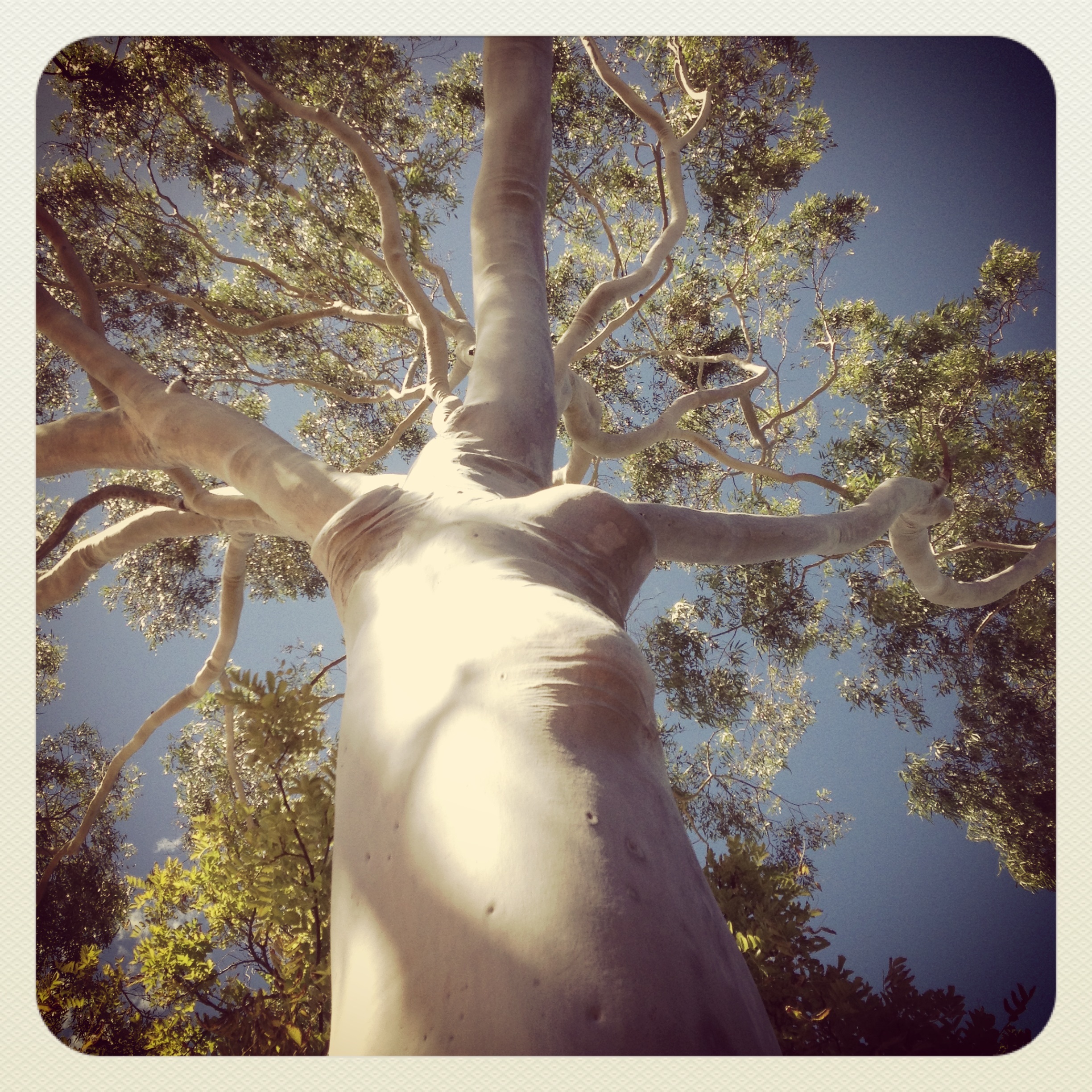
It has a silver-grey suit that changes depending on the season. It is at its most beautiful in the autumn when it is smooth like seal’s skin. The trunk has ripples and dips in its surface. Almost liquid. Your branches are really arms with biceps and triceps and beneath you we play our childhood game. You are always watching. Slowly stretching your deltoids and pectorals – all twisting and twining. Your canopy is sparse and flimsy really. The leaves are skiffs for gum-nut babies, dangling for sale from the tips of twigs. They swivel and turn in the heat and the breeze. They show their pale sides and their silver green. They are beaten and shoved by the wind. They are whipped and thrown around, like a cheer girl’s pompom at the end of her frenzy.

Tell me what you see from up high, Mrs Tree. Below we play on a yellow painted bench. Our father chooses high gloss enamel to cope with the weather. A sensible man. Two girls stand on the seat with arms held wide. We are in a plane, of course. The aeroplane is going down. Everyone will die. Except us. Jump from the bench to the spongy over-watered grass and roll. Prickly buffalo pokes indents in your eight-year-old skin. Away from the burning wreckage. We run around the bench. The dog runs too. This time arms are mimicking swimming. To the tree. Hug it. It is land. We are saved if you get to the tree. Of course our parents perish. What game can be played where the parents survive? Not a desert island game. We have to revise the description of it to our delicate mother; so sensitive is she to think we play a game daily where she is dead.

We have the same species of tree in our communal driveway. No one owns the tree. The four houses that surround it all love the tree. At the end of the day we find ourselves drawn outside. One neighbour hears the voice of the others. The children hear their friends. Gates are opened and the dog brought out. Scooters on smooth red driveway. We sit beneath our tree on a limestone ledge. When her leaves look brown and sad we bring her the hose from the nearest yard and let her drink. We look up at her dead branch and ask that she not drop it on our cars, or at the very least, not our soft heads. In the storm she lets her hair out and really throws herself around. I am reminded again of my childhood’s Lemon Scented Gum. At night, in moonlight, in a storm she was ferociously alive. Like she wanted to up-root herself and be free of the strangling earth. She shook. But she never put her boots on and left. In the morning the grass would be strewn with leaves and small twigs that she had shaken free. In big armfuls my father would take her cast-offs to the incinerator in the far corner of the yard. Her oil would scent the air.

Sometimes a bigger branch would crash down on a neighbour’s fence. Repairs were needed. There was always talk. Men across the fence to my pullovered father. She’s too big. Dangerous. A lot of work. Not called a widow-maker for nothing. But my father protected her. He loved her. He tended her. Raked the bark from her surrounds. Piled the leaves on a tarpaulin and hauled them down the back. Like pulling a body from the surf. Rescued, but still drowned. Till he knew not the difference between a tree and himself. Wood as flesh. Leaves like hair. Bark like nails.

Today ravens sit in our tree and call. Craw. Craw. You either like the black shiny birds or you don’t. Their chalk-white eyes are to one clever, to another evil. Their heavy feet walk the iron roof above my head. Like portly short-legged men. They have something to bang on about. To one another. Perhaps they speak of the swimming carnival across the road. It is that season. The barracking goes on. The air horn signals the races’ start. Butterflies at the starting blocks, the slap of the water on the dive. A volunteer on the loud-speaker assigning the winning faction its points. The splash of churning arms, the gulping of air. Misty goggles. Tears for the ones who find it all too much.

Our tree is youthful compared to my father’s. She has still height to gain and girth to add. One day it will take several children holding hand to hand to ring her base. She will work on the red bitumen about her and seek more dirt. From beneath her, looking up, she has the shapes and curves of a woman. She has bulges and sinkings. She has a collarbone, a belly button. She has moles and scars, dimples and piercings. She stands brazenly naked, ripe. She will see us lose our marbles, just as my childhood tree watched the man stoop and fall in his garden bed of roses. She heard him call out for help, but she could not bend to pick him from the turned soil. He lay still and looked at her. All she could do was offer her shade.

gum tree skin


I’m Back

Database error

Don’t know if you even noticed but, over Easter, my site went down. No little chook house…

It was a blank white page with the gobbly gook words Error Establishing Database in big black letters written across the top. Of course this means nothing to me. I don’t even know what a Database is. I don’t want to know either.

But ignorance of these things leads to panic when you are left trying to fix it. All I could think was that my blog had evaporated and how sad that made me feel. I love my blog. My little bit of internet heaven. I did a google search. I got help from help and support pages but there were too many slashes and dots and commas and semi colons. I could feel it making my heart beat race.

When the internet company fixed it for me just moments ago – I don’t know what the man did. He sent me a smiley face.

So No Need To Panic Any Longer…


Melting Man

Blues N Roots

The man on stage is nearing seventy but he wears the same outfit he has worn on stage for forty years – tight black jeans and no shirt. He is as sinewy as ever but his skin has the weathering of an old man. Think melting wax. He has the energy of someone half his age, younger. There is a brightness in his deep set generous eyes. He loves it, this thing: performance. His stance disguises his ill-made spine and awkward movement. He can twist his legs. He can ping in the air. He can still rock it. His hair is damp dark blonde tendrils. His pants need hitching up again and again. Sometimes his stomach moves as if an alien is about to burst forth. He invites the audience to the stage. His minder, nearly as old and wizened as he, does some protecting. But Iggy is still picked up, hauled around. Where does the lout want to take him? People sense this is their moment to touch him. They reach out. Some are pushed away. Everyone struts their stuff. If you get on stage you want to show off. You turn your arse on the audience and wiggle it. You don’t want to get off either.

I remember how Dylan would not let them put his close-up image on the large screens. He seemed vane, awkward with age. He hid beneath a big hat. Not Iggy. Not a hider. Every vessel under every bit of chest skin is on show. Every arm pit hair. Everything up close. Even from a distance you feel his sweat land on you.

Later Iggy climbs down to join them in their mosh pit. Again everyone is about touching him. Feeling the skin and the hair. You could taste him if you wanted to. He says Bless you and he means it. The audience is his saviour. He asks for the lights to be turned on them. He wants to see them. Bless You. He takes you passenger. He climbs back on stage, his hand down the front of his pants.

But Iggy is punk. Some Blues N Roots fans have wandered home. Too much sun. The audience is thinner. There is space about the lawn. Red cardboard checkers the lawn. Some choose to be witness to this spectacle and watch to say they saw him. A Punk God. Up close it is still heaving. They are the fans that have come for Iggy, despite the other bands in the line-up. They don’t want crooning to by Chris Isaak. They don’t care for Pretty Woman. They would rather die than get Down, Down with Status Quo. They want hard, raucous, real. They want Iggy.


Park Life

fenced out

What do you do if your home is the park and the park is closed off by the set-up that is the Blues N Roots?

You move to outside their house. That house with the Kombis. You bring your blankets and your coke. You wheel your life in a Coles trolley around the corner and into theirs. You leave your rubbish and your toilet paper.

If you can’t take the trolley you stash it in the bushes.

You are skinny with a hacking cough. Can’t run for coughing. Can’t laugh either. The grass is cold at night. The wind too. Your friends are older, but still young. Some of you should be at school. Your black track suit has two white stripes running down the legs, but the stripes aren’t white anymore. Everything you have is grimy. Your girlfriend is seventeen and she won’t leave you alone. Her black trackies hang on her hips and show off her stomach. You made a pillow of her belly just the other afternoon. But today she is psycho. She is yelling, shrieking really, at you, and there is no where to go. Fuck is hers and yours favourite word. If only you had a dollar…That lady thinks you might hit your girlfriend, but instead you walk away. Seventeen follows you down the street and around the corner. She is crazed with bellowing. Her twelve year old brother follows too. You tell her to look after him. What about your brother?

Later you apologise to the lady for all the yelling. Had to break up with my girlfriend. Lady is collecting her mail in her middle-aged, middle-income way, watching the set up on the park. There is a heartbeat beeping of machinery, buzzing of trucks and lifters, clanging of scaffolds. By now thick black plastic covers the rent-a-fence and flaps on the wire fencing. It is keeping us from our home.

Our two older friends have been on the street longer. It shows in their teeth. Both have rotten ones, black ones and missing ones. His hair is blonde and wavy. He has a kitten. He found it on the beach. Now it is theirs. Ours. It travels on Rotten Tooth’s shoulders, its needle claws gripping into polyester track suit. It is on a lead. It drinks coke like we do.

They have a shopping trolley with their stuff. Our stuff. The essentials like blankets, toilet paper, clothes and maybe cat food.

It’ll be loud, you say, when you talk of the Blues N Roots. Yes loud.

Thinking about Spencer

Spencer and Buddhist Prayer

Thinking about Spencer.


I am not supposed to be doing this. I am supposed to be studying. But somehow the picture that his owner, Janet, gave me as a thank you for my assistance in his leaving this world, has caught my attention. He is a small terrier with a big bone in his mouth. His fluffy foxtail is blurred with movement. It is a dog’s joy, is it not, that captures us?


I know she is bereft. We have done what we can do, as humans. We have given him a calm and dignified farewell. A cancer in his belly was growing like a hungry gourd. He felt nothing as he slipped off a needle of very strong anaesthetic. I recited the words the Tibetan monk gave me so many years ago on a Buddhist retreat.


Geshe-La was surprised, wide-eyed, to know, that as a vet, I routinely killed things. He had not long been in the West. He had imagined only the healing. He didn’t believe it was good for my own karma and gave me a prayer for that. At the end of each day I was to use it for purification. I have not remembered it. He gave me another for the animals, and that, I have memorized. The words are supposed to ease the transition from this life to the next. Perhaps the rebirth following will be better, more enlightened. (Of course to believe that we are more enlightened than dogs to begin with is a whole other question.) The short prayer is said in Tibetan and repeated as I inject. I don’t know how it translates and all I have is how the maroon-robed monk told me to say it. What happens if I pronounce the words incorrectly? I carry the mantra in my head. Like Chinese whispers, who knows what wish I am finally asking for and for whom I am asking it? He told me it must be said out loud to the animal as it dies. It is what I do.


Tayata om muni muni maha munaye soha. Tayata om muni muni maha munaye soha.


We clipped some fur for her to remember him by and made a paw print too. We struggled to get the print right and somehow that helped us, the room of people left behind, meddling around looking for something to do, as a spirit lifted off. She wanted to be the one to carefully slide his body into the black plastic that, necessarily, was his transport to the crematorium. There was a feeling, at that moment, that Janet might gladly climb into the bag to stay with him. Spencer had with him a favourite blanket, a squeaky ball and a saliva stained hand puppet, Collin, who had been his chew toy. A dog needs little in the way of possessions to be joyful. A week later his ashes were returned in a well-crafted wooden box. Such a small bundle in the end. The crematorium rang Janet to say, Spencer was ready to come home. What else can humans do?


Janet tells me he still feels present in the house. A collar he wore will be cherished. His bed remains where it was and she senses him. Of course she does. It is only ten days. He was as loved as a child. The loss of him is human-sized. How long do you think it will take to no longer mourn him? A new puppy is on order and perhaps this will help. After all it’s a Griffin. Its piddly, bitey ways will surely distract. But an old dog is priceless. They know us. We don’t need to learn, as I have in my behaviour course, that dogs innately read human gestures, even better than primates. Dogs just get us. They see with our eyes. Owners know dogs understand them. They have always known this.


(Thanks to Janet and Spencer for permission to retell some of their story…)