Room for Behaviour

scout hall

A room full of behaviour vets.


Women mainly. We are described as the ones engaged in the fluffy, feel good stuff, but make no mistake about the science. It is heavy. There is long-term potentiation, serotonin, biochemistry and neuroanatomy, enough to make your head spin. The desire to skip the hard stuff is slowly disappearing as the need to open it up and have it within my cells, known and understood takes over. Like learning a new language. They say when finally you’re fluent you dream in the foreign tongue.


I am feeling positive about doing my membership examination next year. Maybe for the first time. Most of us are buoyed by nearing the end of the course – feeling in a way that things are falling into place. Dr Caroline gives a talk on the brain and up flashes her slide “behaviour = protein” – she tells us it was an epiphany for her. Of course her epiphany is hers alone. They are personal connections. To her brain it makes complete and utter sense. Unless you are a behaviour brain nerd it probably doesn’t give the clarity she is aiming for. But it is a piece of the puzzle. Some bits we still have to put together for ourselves.


Analogies. Metaphors. Stories. Pictures of the Sydney Harbour Bridge being built and being likened to the architecture of the brain. They are all bits of the puzzle.


Epiphanies are being had all over the room. I have my own nonsensical epiphanies over the weekend. Dogs = prisoners. Owner = prison guard.  I think of how the prison workers I have met always correct the word “guard” preferring to be called “officers.” Because even though it is just semantics it is important.


Dr Jacqui steers away from the label of “problem behaviours” and calls them “training issues” and for dogs with the more serious imbalance of a “behaviour problem” as dogs with “mental health issues.” It helps me because the mere swapping around of the words “behaviour” and “problem” has never really differentiated the conditions enough for me. Language is how we communicate our world and with behaviour medicine so many words are already loaded, hijacked by life, before we come to them. Our words in behaviour are words we already use daily when we talk about children and spouses and all the other relationships in our life.


We are warned against using “commands” when we instruct our clients about their dogs. Another cog falls into place when we replace “commands” with “cues.” When we switch “leadership” with “working with.” The beautiful thing about behaviour medicine is that animals have a say, finally. Isn’t it what you wanted when you first chose vet science as a career? You wanted to care about how animals felt. What animals want is important to behaviour vets because we are not all about wanting control. We want peace. This is a different thing. It requires both parties to give some. We need to speak to people about managing their expectations of what they want from their pet. We need to understand the behavioural needs of animals.


Let’s think about not clipping the wings of birds and ridding them of their natural ability to escape. Maybe you shouldn’t have a bird if you want to confine it always to a cage too small for it and have it live with its natural predators looking on. And what about not picking up rabbits, since for a rabbit to be hoisted up off the ground predicts for them that they will soon be eaten. Instead train them to enter their carrier and move them this way. Perhaps buying a rabbit because it is fluffy and soft and good to cuddle fulfills the need of the human animal, but takes not into account what a rabbit wants and needs.


Behavioural medicine with the animals we share our lives with needs to be not just about what owners want but about animals in their care too. Good behavioural medicine gives animals the right to say No. It is a mind switch. Animals can tell us –I am not comfortable with that. I am frightened. It stops us labeling them vicious and mean and bad.


Just as a prisoner officer who worked in juvenile detention told me once; “Kids in here aren’t bad – just sad.” When you work with children who you perceive as being sad, as opposed to criminal, it makes an enormous difference to the way you treat them. Who punishes someone for being sad? The empathy channels are open when they are allowed to be.


Epiphanies – they force a crack open. Okay so maybe we are not having Isaac Newton type epiphanies here, but still. I feel just the beginning of the weakening of the shell, the wall. Soon the crack will widen and all the knowledge banked up beyond will flood into me.
 

Cuckoo

cuckoo nest

I am driving home from work listening to local radio’s Conversations with Richard Fidler. It is one of those chatty programs you can switch on and immediately you’re engaged – like eaves dropping on a couple, deep in chat, seated next to you at a restaurant, while you await your own partner.


Tonight, when I enter the conversation, he is talking to a parasitologist, Paul Prociv, about the life cycle of the rat lung worm and how there is part of the life cycle that requires development in a snail or slug. The larvae develop for a couple of moultings in the slug before the right host (a rat) consumes the slug and then the larvae develop into wrigglers that make their way to the brain or spinal cord, on their way to a large vein which will eventually channel them to the right ventricle of the heart. If, instead of a rat eating the mollusk, a human accidentally does so, the larvae will still go on their merry way, coursing through the tissue of the human brain and spinal cord. But, in the undesired host the damage can be catastrophic, leaving the person in a coma or paralysed. All from eating a slug.


I am repulsed. I am taken in.


I think of my careless washing of the lettuce. I think how easily a little slug could slip through into the salad. Eosinophilic meningitis here we come.


The parasitologist talks about the success of parasites. How, as a group, they out number all other living things. The word derives from medieval France meaning – some one who eats at the table of another. That sounds benign enough. And mostly they’re not trying to kill you. As Richard and Paul converse on the wonders of parasites they fall upon the word “cuckoo.” And then the cuckold man – whose wife’s has had someone else’s children whilst he is busy providing for what he believes are his. And the cuckoo birds who deposit their eggs in someone else’s nest for another bird to do the work of raising.


Their conversation drifts in another direction – to Paul’s family from Russia and his father’s own escape from a Stalinist regime.


I am still on cuckoo.


The obligate brood parasite cuckoo bird places its heavy shelled egg (some times disguised and other times not) into the nest of another bird and the cuckoo’s egg hatches first. Most hatchlings are able to obliterate the other eggs – either dispatching them out of the nest or outgrowing the other chicks  by squawking louder for attention and food.


The word mesmerizes over and over. The feel of it in your mouth. The look of it on the page. I think of “One flew over the Cuckoo’s Nest.” How the word cuckoo has come to mean crazy because of its link with this book. How brilliantly does Jack Nicholson play crazy? Think “The Shining.” Redrum. That sound of the wheels of the plastic trike moving from carpet to wooden boards. You know it. How cuckoo isn’t as crazy as crazy comes. Rather it’s a fraction bit off. Tilted. Who really minds being called a “little bit cuckoo.” Maybe it’s even a kind of compliment.


Buying grog at the Coles liquor shop, after my shop for dinner (salmon, dill, cream), two drunks are buying their booze. One has two large casks of cheap wine and the other a couple of bottles of fortified. Despite being at the counter before them I am overlooked and besides I don’t really mind them being served first. I am busy spying on the one with the crutches’ gammy leg. Doing my own kind of cuckoo work. He has a busted foot. He has a dirty bandage on it. He tells me the cast has just came off today (surprising considering the colour of the bandage) but he is still worried about the sullying (my word not his) of his skin. “It’ll take time, “ I say. He says it’s been good while already. I consider asking how the cream sherry helps. But that would be straight out cuckoo.

cuckoo 2

Learning Theory and Facebook Likes

like

As I study veterinary behaviour and study how animals learn I see evidence of learning theory in action all the time.

Just take Facebook for example.

For a behaviour to continue it needs reinforcement. For users of Facebook this is what that little thumbs up “like” button is all about. Every time a photo or post receives a “like” you are spurred on to contribute more. To up the ante. To get more “likes.” People may think it is superficial or silly, but it follows the laws of behaviour. In essence you can’t help but be motivated by the positive reinforcement of the little thumbs up. When a behaviour is positively reinforced with a “like” the behaviour is encouraged and the learner even keener to see if they can get a repeat pat on the head. Compare this with a mean-spirited comment which acts as a “punisher.” (A punisher is anything that makes a behaviour less likely.) A churlish comment attacking your post might mean a retreat from the using of Facebook – a wounded learner. Think of the dog who doesn’t come when called if all it gets is a berating from its owner.

When we want animals (and children) to engage and learn we would do well to remember what is motivating. It is not inspiring to be told you are not working hard enough, or you could do better. It is motivating to hear the American phrase “Good Job”, or “Thatta boy.”

I wonder if Mark Zuckerberg knew much about Learning Theory (he did study psychology so probably yes is the answer) when he designed Facebook with its little “like” button, or whether it just came naturally to him to praise the efforts of his peers. Because the “like” button is a generous thing. Push it often. Don’t be surly about it. It doesn’t cost you. It makes the author of the post know the post was read and received with pleasure. It means they will post this way again. Just as the dog who has the best recall will return from across the oval for the snippet of liver treat. Those “like” buttons are powerful reinforcers.

But controversy exists over who really came up with the “like” button first and a Dutch company claims to be the inventors. Rembrandt Social Media has sued Facebook, asserting that the “like” button violates two patents granted to Joannes Jozef Everardus van Der Meer in 1998. But of course no one can own the idea of “liking.” It is what we humans do – we have opinions on things and we want to express them to one another. As a completely social animal it is no surprise that Facebook is such a success. People may bemoan the lack of real intimacy in today’s world but to me Facebook is a testament to the craving that people have to connect with one another.

What seems good about the Facebook “like” button is that there is no nasty alternate “dislike” button. You just say nothing if the content of a post doesn’t appeal. Just slide on past. Just as you ignore the barking dog or the dog that jumps on visitors. “Extinction” is the practice of ignoring a behaviour with the intention of it not receiving any positive feedback, it will eventually die away. What if your posts never received a Like? After many repeated check ups on your posts you would eventually tire of checking in. You would do so less often. Having no “likes” decreases the amount of time someone spends on Facebook and therefore acts as a negative punisher – absence of reward causes behaviour to decrease. Then one day you would wake up and you would not even recall your password. Facebook would have become a place of inconsequence for you.

And then there is the “share” button. This may be the most positively reinforcing button on Facebook. For a “share” denotes special love of a post. Not only do you “like”, but you “like” it enough to go that extra mile and “share” it on your page. When you ask a child to share there is a feeling of losing some of what they have and of having to divide it amongst a hoard of others. Sometimes just sharing with one is hard. Sharing leaves you with less of what you want. If there are eight people eating cake, how much do you get each? Many a mother has lamented the child who has trouble sharing their toys. Isn’t this a reason for play dates? Learning to share. But we all know the value of sharing as we grow up. There are share plates of food at restaurants which invite conviviality and conversation, there is sharing a bottle of wine, there is sharing the bed. And now in the age of the internet there is sharing information, ideas, images and, of course, words. As far as Facebook goes “sharing” is multiplying, not dividing. It is expanding and sending forth, propagating and spreading. I like to think of it as a “seeding” button. Wind and birds pick up kernels – taking them far and wide – the seeds are scattered, deposited in fertile soil and the germination begins.

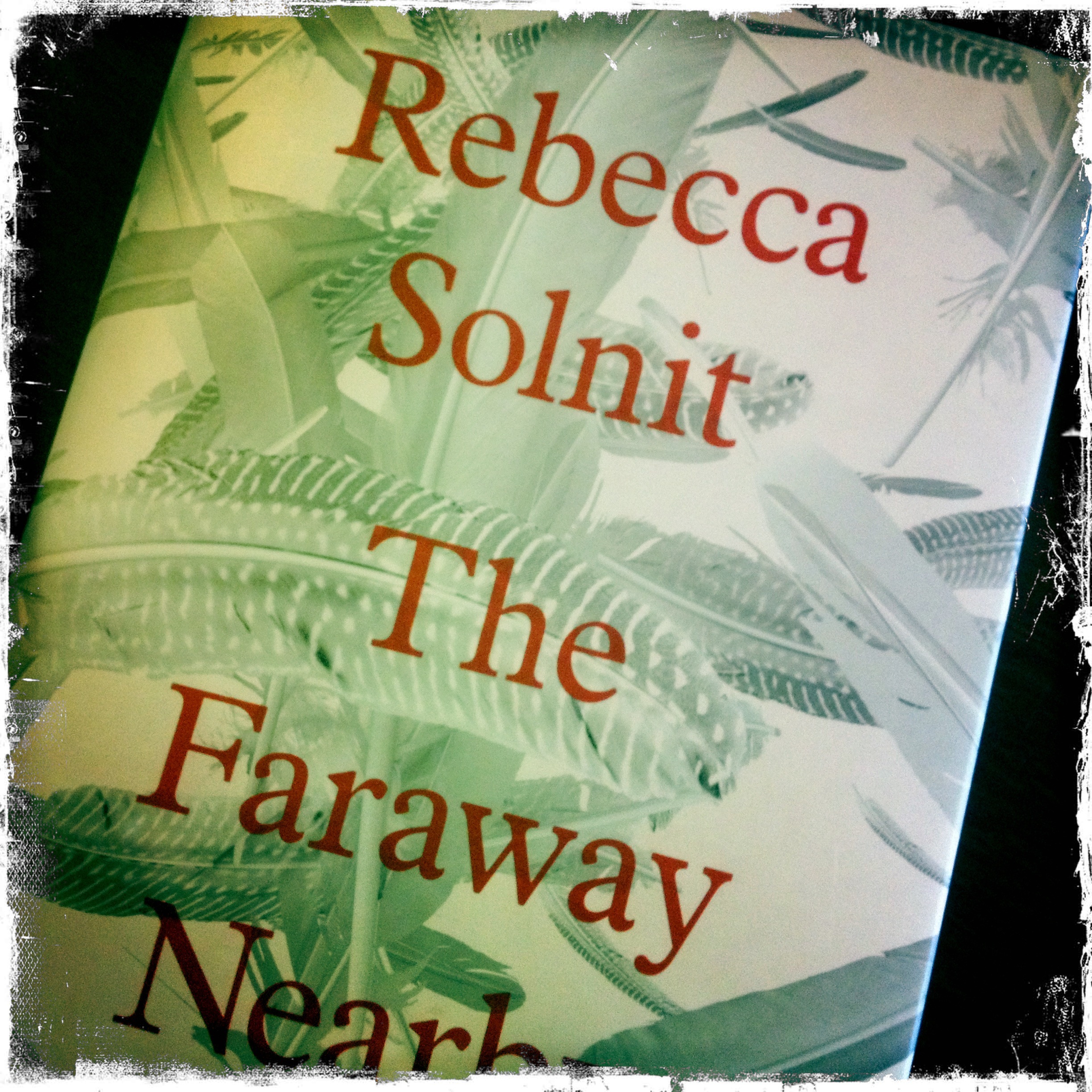
from “The Faraway Nearby” by Rebecca Solnit

Rebecca Solnit

“Sometimes the key arrives long before the lock. Sometimes a story falls in your lap. Once about a hundred pounds of apricots fell into mine. They came in three big boxes, and to keep them from crushing one another under their weight or from rotting in close quarters, I spread them out on a sheet on the plank floor of my bedroom. There they presided for some days, a story waiting to be told, a riddle to be solved, and a harvest to be processed. They were an impressive sight, a mountain of apricots in every stage from hard and green to soft and browning, though most of them were that range of shades we call apricot: pale orange with blushes of rose and yellow-golds zones, upholstered in a fine velvet, not as fuzzy as peaches, not as smooth as plums. The ripe ones had the faint sweet perfume particular to that fruit.

I had expected them to look like abundance itself and they looked instead like anxiety, because every time I came back there was another rotten one or two or three or dozen to cull, and so I fell to inspecting the pile every time I passed by instead of admiring it. The reasons why I came to have a heap of apricots on my bedroom floor are complicated. They came from my mother’s tree, from the home she no longer lived in, in the summer when a new round of trouble began.”


Rebecca Solnit writes an anti-memoir about her mother’s decline into Alzheimer’s. I love that it is called an anti-memoir. Who knew that was a genre? That’s the genre I would like to end up in. A dark corner of the bookshop where maudlin people hang. Maybe what makes it an anti-memoir is its refusal tell a story chronologically, or to tell a story at all. Sometimes it feels like reading a literary thesis as she rambles on about Mary Shelley’s Frankenstein. Reading this book you fall into the maze of the writer’s mind.

My own parents had a similar tree in their yard. Like Rebecca’s mother apricot. Except a mandarin. From the kitchen window it could be seen. My father hung his little pots of honeyed poison from it to catch the fruit fly that threatened it. A visit to their house at ripening season meant leaving with a shopping bag of freshly picked mandarins. Wanted or not. They were small and not very juicy. Their skin was fiercely adherent and difficult to peel. They often had discoloured patches that quickly turned brown and soft. Most of them ended up in the bin. But how my mother loved the fecundity of the tree. She loved that she had something for free that she had previously paid good money for. She loved that she could give containers of fruit to the neighbours or anyone who came visiting. A visit to June meant leaving with a dozen or so mandarins, a few of which were already on the turn.

Graham gave me the Rebecca Solnit book after reading the opening scene about the apricots. He knew it would remind me of my mother. A pang. Apricots. Mandarins. The fruit tree you harvest as its crop becomes plentiful but there is always too many to eat. The tree bursts forth all at once. Too many to give away. Instead they become binned. Others just fall and sink into the ground around the tree and become dirt.


Susan Friedman on Behaviour

Susan Friedman

I am forced to get off the comfy king sized bed – the urge to write overrides the laziness I feel when faced with the chore of getting on my wheelchair to go to my bag and dig out the moleskin notebook. I momentarily chide myself for not being forward-thinking enough before I got onto the bed in the first place. Being in a wheelchair teaches one the economy of transfers. But laziness and the desire to write are strong competitors, and the urge to put pen to paper wins, almost every time. This is how I know I am a writer. I do it compulsively. I don’t just want to think this stuff – I want to capture it for later when I want to recall the weekend. I want to revisit the Lego-like image of plane after plane taking off and landing across the water of Botany Bay – as I view them from my balcony window in the Novotel Sydney Brighton.


The planes are thunderously loud. They boom across the sky. At night it seems they are louder than during the day, as if the day-air somehow absorbs and blankets the sound. Chunky Sydney air – thick with moisture always – so different from Perth’s air – gauze thin. On a still Sydney night the jets crack the sky. Some dogs must hate this; living beneath the flight path. Others must habituate to the noise and become the seriously bomb-proof hounds.


Susan Friedman is an Applied Behaviourist and specialises in teaching people how to assess behaviour across all species. She has a penchant for work with captive birds. She has talked for two days solid. A true New Yorker, despite living and teaching these days in Utah. Some heavy reinforcement must have been declared, since she has turned a normally 8-week long course into a two-day seminar. “Strap yourselves in,” she tells us; peppers us with “Good Job”.


She is not speaking to the uninitiated in behaviour. It is an audience of veterinarians who are interested in behaviour or have done further study, of animal trainers, of zoological keepers and behaviour practitioners. I guess we could be considered a weird bunch; heavily analytical and deciphering.  Even making her morning coffee with a new machine, Friedman, sees behaviour in everything she does.


And why wouldn’t you? It is one of those areas. The more you learn about how animals learn the more you see the world through a behaviourist’s eye. From a gnat to a blue whale – we all learn the same. Through motivation. Through being reinforced. Through wanting to move towards something or escape something else. The more we study behaviour across species the more we see the similarities, especially when it comes to learning and behaviour. There was a time, sadly not that long ago, when we concentrated on the difference between us and animals, even believing animals felt less pain than we do and hence operating on them without adequate pain relief following. That seems ludicrous now.


Susan Friedman has a simple message for all. Behaviour is what animals do – all of us – on Earth. To change behaviour is simpler than you think. What comes before the behaviour is called the antecedents – the environmental circumstances that the behaviour happens in. And what comes after the behaviour are the consequences of the behaviour itself. So, if a dog bites a hand, the bite is the behaviour, and the hand being near the dog is the antecedent and the consequence is that the hand goes away. To successfully change the behaviour we can work both with the antecedents and the consequences. We can change the way the dog thinks about an approaching hand by positively reinforcing the approach of the hand. Much behaviour can be managed by changing both the consequence and the antecedent before addressing the behaviour itself. Looking closely at the consequence of an animal’s behaviour can tell us what it was doing the behaviour for in the first place.


Having worked with delinquent children she sees the need for working ethically and changing behaviour by trying the least intrusive method first. This means we should not be reaching for shock collars when we deal with a barking dog as a first port of call. (I would say there is always another way.) Ethics demands we explore the least punitive measures first and so therefore, with our barking dog, as an example again, we should ask at what and when does the dog bark? Can we first manage the environment to stop the dog barking?


It was one of those conferences that sees you delving into the behaviour of your child and spouse and unpicking their behaviour in the behavioural assessment kind of way. And holding the mirror up too. Perhaps it is as simple as reinforcing the behaviour you want. She told the delightful story of a group of psychology students who successfully manipulated their professor to only teach from one corner of the lecture room. Whenever he moved towards that corner they became more attentive, listening and nodding, smiling as he spoke. When he moved away from that corner they looked down and uninterested, fiddled and feigned disinterest. By the end of the term he was indeed corralled exactly as they had planned – all with the use of positive and negative reinforcement.


A mantra she taught us to ask when looking at behaviour is, “What is the Function?”  Use this when studying behaviour and you can see how useful it is. Perhaps when people believe they are unable to change a behaviour then it is because they are invested in the behaviour continuing unaltered.


She also talked to us to be wary of the investment in“story”. As behaviourists let us not get too caught up in how the behaviour developed in the first place. It is common for people to want to tell you stories of how a dog’s jealousy, anger or fear arose, but as behaviourists, we should concentrate more on teaching animals what to do and be less concerned on what NOT to BE. This too carries over to children who, for example, have been shown to do less well at school once a label; such as having a “learning disorder” is attached to them.


Most clients will want the tool to “stop” a behaviour that is causing them problems, when really they would be better served asking themselves what would they like the animal to do instead – and then teach it. It sounds simple and is – but this is not the same as easy – since people live in a “cultural fog” of misinformation regarding animal behaviour – from thinking animals should just do it because you have asked it of them, to believing that animals are incapable of learning anything at all.


At the end of the two days, as the organisers were getting ready to thank Susan for her talks, the fire alarm went off. Loud.Persistent. The conference could not continue over the siren. Intermittently a recorded voice came on and asked us to stay where we were and await further instructions. I thought of 9/11 and the people who died because they heeded that advice. I thought we should leave the building. Isn’t that what you do when a fire alarm goes off? After several minutes the alarms had been switched off and another announcement told us the source of the problem had been located. Susan was presented with a sculptured galah, which she sincerely claimed to love. A behaviourist till the end, she left us saying she hoped she wouldn’t be paired  forever more with the piercing sound of a fire alarm. The lectures were over.


I ascended the building in the lift and could smell the smoke as I entered the sixth floor. I could see no smoke. In the corridor two heavily clad firemen stood by the entrance to the laundry. They had tracked the smoke to the laundry room where someone had set a meal aflame in the microwave. The perpetrator had fled with the burning meal and the smoke had made the alarms go off. Now there was just unmistakable taint of smoke and burnt food lingering.


I spoke to the firemen because. Because they are in yellow, with bulky suits and because they are firemen. FIREMEN. Since our own house fire, years ago, I have the conditioned response to firemen (the conditioned stimulus) of going weak at the knees and running off at the mouth. I hovered about them as they measured the smoke with their machinery. I asked them about the rule of not using a lift in a fire. They said I could use it. The lift was for them and me. They said the person who had set the meal on fire could be charged with a criminal offence if caught. I thought of the learning we had been doing moments before downstairs. Of how punishment is entrenched in the way we humans do stuff. Despite there being no injury or damage caused, the punishment inflicted could be severe. Deterrent enough to being caught. If the world could become the tiniest bit like the world offered up by Susan Friedman we could see more harmony between our species too.


Barbara Arrowsmith Young

laminex table

It is a winter’s night, but not cold.

Barbara Arrowsmith Young tells us of her usual winter’s night in Canada where temperatures hover around minus forty. I wonder if she is speaking Fahrenheit or celsius. Either way it is nothing I can imagine.

But Perth people don’t really do winter or the rain.

The audience is mainly women between 40 and 50 in slacks. Like me. A queue has formed for a snappy white wine before the lecture begins. Not a skirt in sight. Trouser wearing women – practical types. Women who think they can change things – including their own and others’ brains. That’s the business they’re in. Mostly educators, psychologists. Probably mothers too.

My friend works in Mindfulness. She is well in-touch with her mind and its capabilities. She knows she needs a lot of sleep. She tells me how working with people to develop mindfulness “deepens their keel in the water.” What a steadying, comforting image. Indeed for most minds it is a rough sea out there, but what a difference a solid keel makes.

Barbara tells us her own story first. As a child she had such severe learning disabilities that she was a danger to herself. Despite so many issues she managed to learn through sheer determination and persistence. It helped that her mother was an educator and her father a creative inventor. But it was not till adulthood when she discovered the work of a physician, who had studied a patient who had had a bullet lodged in his brain, that she uncovered the source of her problems. Seeing the similarities between her own cognitive fog and that of the damaged man, she was able to locate her disability and pin-point it to the angular gyrus in the cerebral cortex. She then devised exercises to teach herself the things she could not do. She worked at the exercises, which were always slightly above her level of skill, till she mastered them and then she made them harder. She changed her brain, at a time when medicine really didn’t believe it was possible to do so.

It is accepted today that the brain is changeable. Neuroplasticity is studied and yet in schools we don’t give children the cognitive exercises that would help them to change their brains. Instead if a child is poor at hand writing we give them permission to type. She didn’t really go in-depth as to the specific exercises she has developed to help the various disorders of learning, but gave examples of how countless people have changed their brain’s functioning through the use of exercises in the areas that they have trouble with. She said people needed to lose the supports they had developed to cope with the learning disorder and approach it head on.

Again I thought of dogs.

Dogs too can change their brains. And we can be their teachers. I have a sense that changing a dog’s brain may be simpler than changing your child’s, especially since asking your child to join you in some cognitive exercises might be harder than you think. At least with a dog there is always food rewards. Just like people, dogs have the ability to learn new things. Everybody needs the right environment to learn. Dogs and children need not to be anxious, not ill, not in pain, not sleep deprived and not chronically stressed. The old adage “you can’t teach a dog new tricks” may not be true after all.

Think of the dog-reactive dog that flies into a rage every time it sees another dog. To improve behaviour it must practice being calm in front of other dogs. It is best to work just below threshold with dogs like this. We don’t want it to tip over into non-thinking dog. Brain-switched-off dog. One that is just shouting – go away, go away. But it must see other dogs to learn the new way. Neurons need to make new connections, instead of flying down the well-worn path of reactivity. I think of the laminex table and its marbled pattern – why now it resembles dendrites. A filigree of filamentous nerve endings reaching out for connections. A finger can trace the path to get from one point to the other, but the route can change. So too the destination. Left isolated, apart from other dogs, our Cujo will never improve its dog reactivity. Leaving maths alone won’t make your arithmetic better. Buying a piano and leaving it idle will not turn you into a pianist.

She described the feeling of living with a learning disorder as walking through life with a heavy pack of rocks on your back. But when people changed their brains they were released of their heavy loads. Previously difficult tasks became easy and free of stress. A stressed brain cannot relearn. At any age change was possible. For all species.

Like a dance. The neurons that fire together, wire together, and the more they fire together the stronger the connections between those neurons become. I guess this is the basis of learning. We can all do it. Change our brains to become peaceful, calm and plastic.

Dealing with Disappointment

port

I decide to ring the Department of Education because it is mid way through August and we are supposed to hear about Jasper’s application in August. I don’t really expect to be given a result on the phone, and so when the person says, “I can check, what’s his name?” I am unprepared. I feel my heart wobble. It comes free from its attachments inside my chest. Name given – a pause – “It appears he won’t be being offered a place in the first round,” comes the reply.

I close my eyes. My head screams, NO. My heart slides downwards towards my stomach. The disappointment is visceral really. I have my own disappointment, but more than that, I have a son to tell. He has already become very attached to the idea of studying visual arts at the school. He will take it hard.

Graham is away, and so it falls to me to deliver the news. I could wait till Graham got home, in a week, but that seems deceitful – to know for all that time and not let on.

I wait till we are home, after school, in our kitchen. He has a very crunchy ANZAC biscuit in his hand and his back to me when I begin. “I rang the department today to ask about the visual arts and I am sorry to say they said you didn’t get in.” When I start the sentence he turns to look at me, a slight smile, and I can see from his expression he thinks the sentence is a good news one, but as I get through to its second half, it dawns on him that this is not a good news sentence at all and his face changes. It crumples into tears. I go to comfort him. To hug. He pulls away and rushes from the room.

I don’t follow him immediately. I wait in the lounge, by myself, wondering how long do I wait for. What words of comfort can I offer? I know you’re disappointed, I rehearse in my head.  He is not in his room. He is not in the study. He is not in my room – that I can see. He is in my wardrobe – behind the clothes – crouched in a huddle – beneath dresses and jackets and the confetti of shoes. I can see his sneakers and in his hand the ANZAC, untouched. It is a safe hiding place. Go away.

I close the wardrobe door and leave him in the dark. I’m so sorry…

I leave him.

To myself – Maybe don’t eat the ANZAC in there..

I leave him some more.

Still hiding.

He comes out.

He is outside in the courtyard, bouncing a ball, and I am in the kitchen making a cup of tea. I view him through the window, across the sink. Skinny, lanky, always moving. I see a big tear fall from his face without hitting his cheek, like a rain drop falling to the ground. I am crying too and he sees me. He comes inside. Let’s take the dog out. We walk the dog. My solution to all woes. The road by the port is closed and we must walk by the railway. Broken glass. The slap of skateboards. Still beautiful. It is a day like any other to the dog. There is winter grass to pee on. There are urine soaked telegraph poles to sniff at. There are homeless begging in the mall. Jasper asks what has happened to his career? He is eleven. “We’ll just have to show them what a great artist they missed out on teaching,” I say. We eat churros dipped in melted chocolate.

drawing


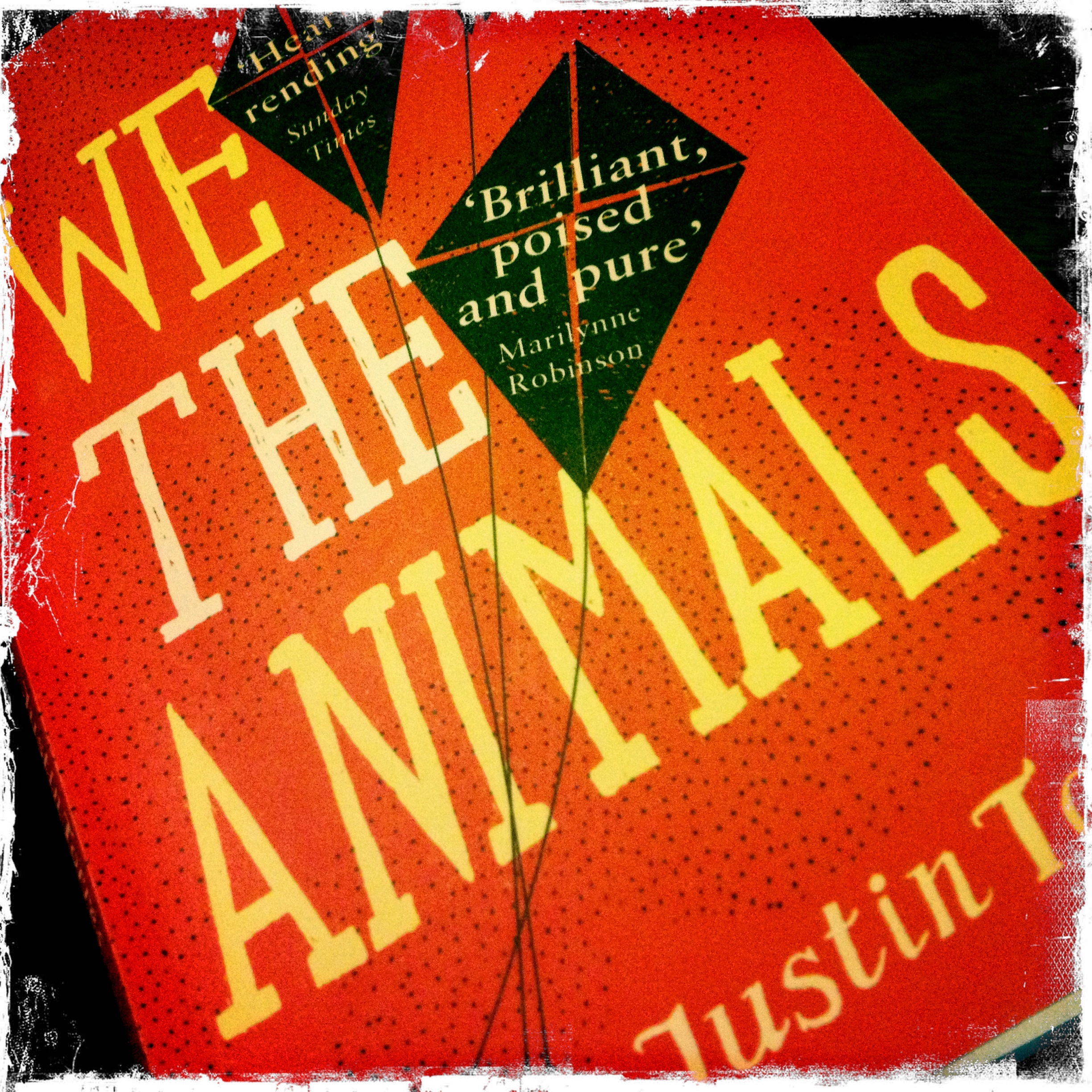
from “We The Animals” by Justin Torres

we the animals

“We The Animals” is a slim book – almost thin enough not to be a novel at all, but a novella.

But it is so very rich in its thinness.

It is taut. Every word has its place and only that place will do. Like a perfectly tuned musical instrument.

I loved this book from the moment I picked it up – its sentences spoke to me instantly. I was there, in the grubby house with the Puerto Rican father and the white mother, locked into some struggle that children can’t name. All the while you have a sense of dread, stretching the skin of the balloon – bursting is inevitable.

It opens:

“We wanted more. We knocked the butt ends of our forks against the table, tapped our spoons against our empty bowls: we were hungry. We wanted more volume, more riots. We turned up the knob on the TV until our ears ached with the shouts of angry men. We wanted more music on the radio; we wanted beats; we wanted rock. We wanted muscles on our skinny arms. We had bird bones, hollow and light, and we wanted more density, more weight. We were six snatching hands, six stomping feet: we were brothers, boys, three little kings locked in a feud for more.”

Then later in this excerpt the boys attempt escape from the chaos of their home life;

“We reached an empty field, tossed our backpacks onto the grass, and set up camp. Wind whipped the tips of our ears and stole a plastic bag right out of Manny’s hand. He thought it was a sign and fished though our supplies until he pulled out a tight, fat roll of twine and three black plastic bags. We made kites: trash bags on strings. We ran, slipped, the knees of our dungarees all grass stained, we got up, ran, choked ourselves half to death with laughter, but we found speed, and our trash kites soared. We flew for an hour or so, until daylight fully buried itself into night and the light sank back, except for the stars and a toenail clipping of moon, and the kites disappeared, black on blackness. That’s when we let go,and our trash kites really soared – up and away, heavenward, like prayers, our hearts chasing after.”

It’s the kind of literature that delivers you bellyside to the narrator. We never even learn his name. But there we are  – in someone else’s skin. At times you want out, it is just too grim. But then that’s good writing. If this is the kind of writing you like then “We The Animals” is for you.


On Attenborough…

Attenborough

He is eighty-seven years old.

Just beneath his skin, by his collar-bone, sits a pace maker  – good for another twenty-five years.

He would, if he could.

Pale blue chambray shirt, camel trousers. His uniform. His left leg is especially bowed, like that of an old cowboy. I suspect arthritis chews away at his hips. Exiting off the raised central stage at intermission he wobbles and almost falls. From the audience a collective intaking of breath. Ray takes his elbow, he steadies. Please don’t fall you precious man.

He tells us stories from the start of television. He was there in the very beginning. He was in the small studio when television was live and a nature program meant standing an armadillo, brought in a box from the London zoo, on a doormat placed upon a table and filming it, or else having the local rat-catcher tell a story to camera. From these very basics to seeing flight as if we were birds ourselves, as if we were insects caught on a spider’s web or killer whales hoisting a seal pup through the air. He has been witness to so much that is beautiful and frightening and awe-inspiring in nature. He loves it all. Almost too much for one man. How incredibly fortunate. And he knows it too. He does not take it for granted.

We listen to his stories like children camped at the feet of their exploring grandfather. We, the armchair travellers, who have watched him through the small screen since our own childhoods when we first watched Life on Earth. Then, it inspired my sister to follow a career in nature. His voice so familiar that to think of blue whales and elephant seals is to play the soundtrack of his commentary in our mind.

When asked about the planet he is not optimistic for its future. He worries about global warming. But he is not a political heavy weight. He does not stir up protest and dissent. He asks that people do what they can to reduce carbon pollution. He eats meat – his dentition, his stomach structure, his evolution – they all suggest to him that it is okay to do so.

The drive home is quick. Passing Kings Park bushland on our left – an infinity of blackness. I tell Jasper the thought of the parkland at night scares me – so black. Of course, he answers, like it is the only sensible emotion to feel. It is late and the roads are empty. It has been raining and the bitumen is slick ink. Street lights making shiny pools of silver.

We are the only car on the road in either direction. We have a string of green lights. Green pools on black road.

We are on the highway above the railway and the ocean is to our right. The tracks are empty. Standing on the road ahead is a fox. I can tell from the shape of its bushy tail, held horizontally to the road, as long and wide as the fox itself. It turns its head towards us and we see its orange eyes and its sharply pointed ears. I know there are foxes in the cities, even the very biggest and busiest, but still. In my head I thank David Attenborough. As if he has brought this creature out of the dark and shown it to us tonight as we race home.

I slow the car and the fox darts across the road ahead of us and is gone. Into the gardens of the big houses. Looking for chickens.


Dirty Laundry – Epilogue

coroner's report

Again feeling like a pariah.

We all know who she is, but she does not know who we are. It is an unequal relationship. One where perhaps we hold more power. But then again there is always the truth and really only she knows that, or as much of it as can be known. No one knows more about what when on at 17 Harwood Street, Hilton, but her. Perhaps also she knows more than she can say to anyone, even to herself. If some how she were responsible for the boy’s entrapment – then who can she tell. Not a single soul. Not ever.

I suspect she guesses the ones with the notebooks are the reporters – with work to do. They can justify their prying, nursing an A5 spirax on their laps. I have no justification.

When she arrives she is surrounded by her family, once again. Grandma in pale green slacks and top. What an outing. Who I think of as her father has more white than grey hair. A comb’s made furrows through it. A big nose. He appears to have stepped from the set of East Enders. There are other blondes that could be sisters, cousins. She has run the gauntlet of the camera men. Now they simply wait outside the entrance for all this to be over with.

She greets her family with pecks on cheeks. There are smiles.

Even out here, in the foyer, I write down everything. A supporter watched Fast and Furious Six and loved it. Left work early to watch it.

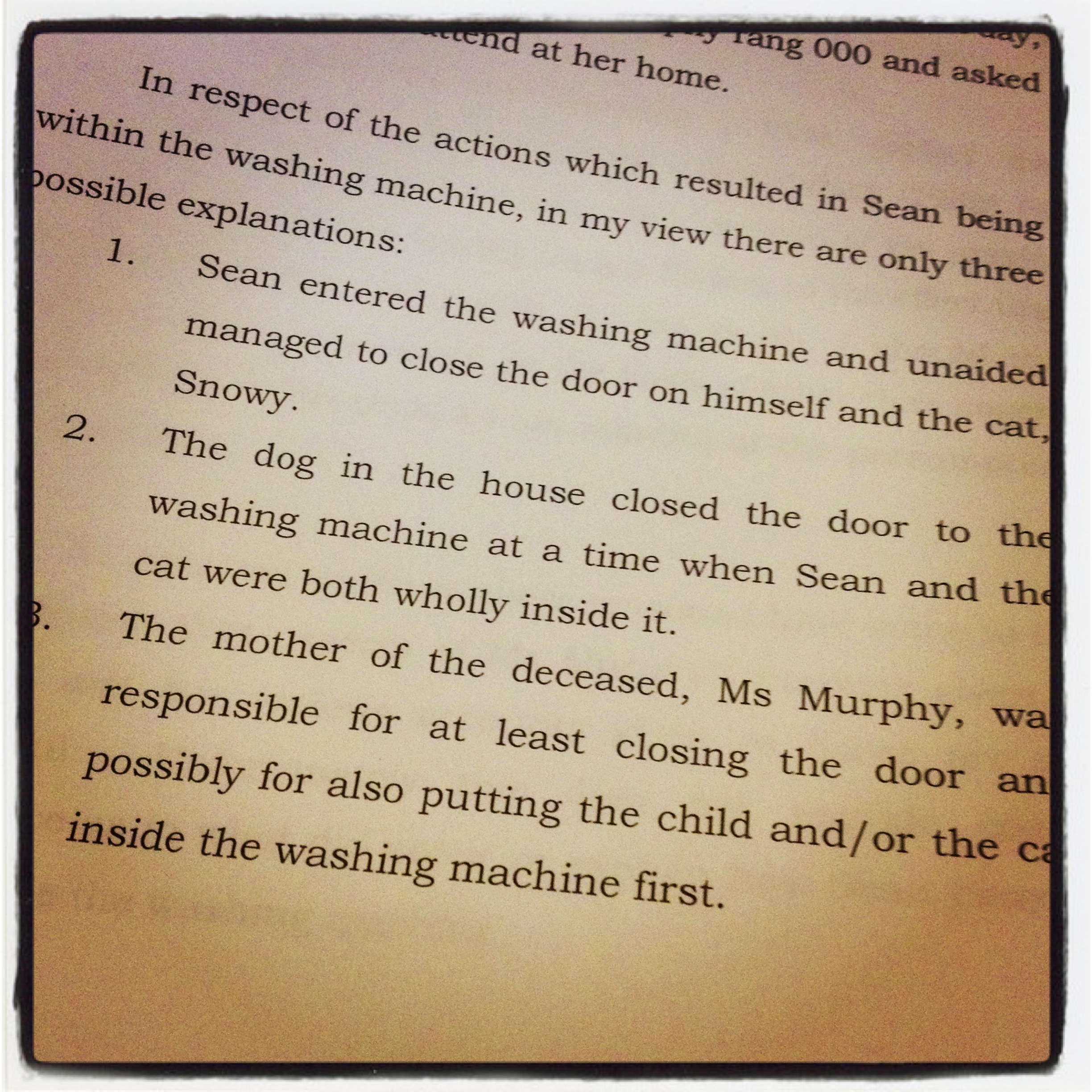
As soon as the doors to the court are open, we all file in. Most of the lawyers are different to the ones that were in the court before. The washing machine that sat ominously in the court room during the proceedings has gone. Ten minutes till the coroner is expected to appear. The reporters next to me talk about the night before. Too many red wines have left her feeling tired. It’s just another day in the office for them. Kerry Murphy sits between her two major supporters – a woman and the white-haired man, who could be her adopted parents.

We stand on Mr Hope’s arrival into the court and bow.

He lets us know that he will read from his findings and that they will be available in hard copy at the end. Exhibits will be returned to the police, including the washing machine.

He is straight into it. Occasionally he looks up and seems to connect his gaze directly at the mother. He is brusque and unemotional. He is straightforward and logical. There is no other way to view the material he has dissected through. He makes his points clearly and forcefully. He declares the mother to be untruthful, but despite some of the ways the child and cat may have come to find themselves inside the washing machine being unlikely, they were not impossible. Unlikely things do happen, he said. He said that he needed to be absolutely sure that the mother was involved in the child’s death to make such a finding. He needed to have cogent and reliable evidence to make such a conclusion and, in the absence of such evidence, he could not do so.

He said of the mother; “she is a person who is prepared to lie whenever she considers the truth is unfavourable to her.”

But being a liar did not necessarily make her anymore than that.

In the end, as he delivered his open finding, and it settled on her that she was not going to be found responsible for the death of her son, her bottom jaw began to quiver and she fell onto the woman beside and wept silently.

Was she crying from relief? No doubt. Did she cry too for the loss of her son? Maybe.

Other family wiped tears from their eyes.

Mr Hope rose from his desk, as did the entire court room to acknowledge him, and then he turned and left. It was over. There was no lingering around. No one would be asking him any questions. I want to ask: Ok I get that you made an open finding, but what do you really think? Do you feel she was responsible? In your gut. But he does not make a personal judgement. He just looks at evidence and finds accordingly. There is no room here for sentiment, for feelings, for intuition. His sitting up high really does reflect some higher thinking. He does not cloud logic, like the rest of us might. Because you get the feeling that everyone, besides her supporters, thinks she was, in some way, responsible.

The journalists rushed to the assistant’s desk to get their hands on a copy of the report. The assistant rose and walked slowly around her desk, taking a copy of the report to give to the mother, still seated with her family crowded about her. Then she came back to her desk to hand out the remainder. Some people would not receive one, but at least the mother had been given a copy. The assistant had done her job.

Outside the building the reporters were in position. Two camera men could see through the glass and give a heads up to the others when the family were on their way towards the exit. Most of the reporters were at the bottom of the steps enjoying a moment in the sun. In a cold city street in winter any warmth is welcomed. Two camera men wait at the base of the ramp in case she chooses that rather than the stairs. She does. Despite being flanked by family, she is immediately surrounded. I feel sorry for her. They do not. She is like meat thrown to a pack of piranhas. I guess they can claim to be doing their jobs. I can’t hear their questions, but later, on the TV news, I hear them. Are you relieved? How do you feel? She says nothing. She keeps walking, close to the wall of the building. They are in her face, incredibly close. But they don’t pursue her for long. They give up by the end of the block. I am on the other side of the street. Just watching. Still feeling ashamed.

If she came across me and asked, “What are you doing here?” what would I say? I want to say, I am sorry for your loss. Can you tell me what happened to Sean?

I wonder how it is that the reporters think she is ever going to tell them anything with the camera and microphone rammed in her face.

The truth has shrivelled to a kernel locked inside her. It disappeared the moment Sean took his last breath.

They keep filming till she turns the corner and then they stop, as if a single city block is their limit. Perhaps they only need 30 seconds of footage. Outside Miss Maud’s the family stand in a huddle smoking cigarettes. I am fifty feet from them and all the reporters have gone. They can have their lives back now. Can they? How do you go on after this?

At home I read my copy of the report. Nothing tells me why the cat did not scratch the boy to pieces. Nothing explains how the toddler hung on to a struggling animal. The cat appeared to have died in the same way as Sean – entrapment and suffocation – but may have died slightly sooner. The only really clear thing to be decided was that the boy was dead or dying within the confines of the washing machine during one of the phone calls made that day. As Ms Murphy spoke to her then defacto at 1.36pm, supposedly about placing $5 down on a layby purchase, Sean would have been in the machine. They spoke for 326 seconds. Ten minutes later she rang triple zero to say, “My three-year-old climbed into the washing machine and he – I think he’s dead.”