Waiting for the Miracle – Revisited

Today I spoke to 150 or so veterinary science and biology students as part of their professional life series. I have an interesting story to tell and they sat and listened. At the end of a lecture, that talked of my history and about how I still work as a veterinarian, I read them this story, “Waiting for The Miracle”. We looked at slides and they asked questions. One student asked me how was it that I knew I could still be a vet. I answered I didn’t know. And perhaps not knowing how hard it might be, and sometimes was, was a good thing. Another asked my advice on how to overcome grief. I said find some way to express what is inside you. Write it, draw it, paint it. Another asked what had I learnt after all these years. What had it taught me? I said acceptance. Another student revealed at the conclusion of the talk, as people were coming up to say goodbye and thank you, that her partner had committed suicide only a month ago and she was thankful, at this time, to have someone come to talk to them about grief.

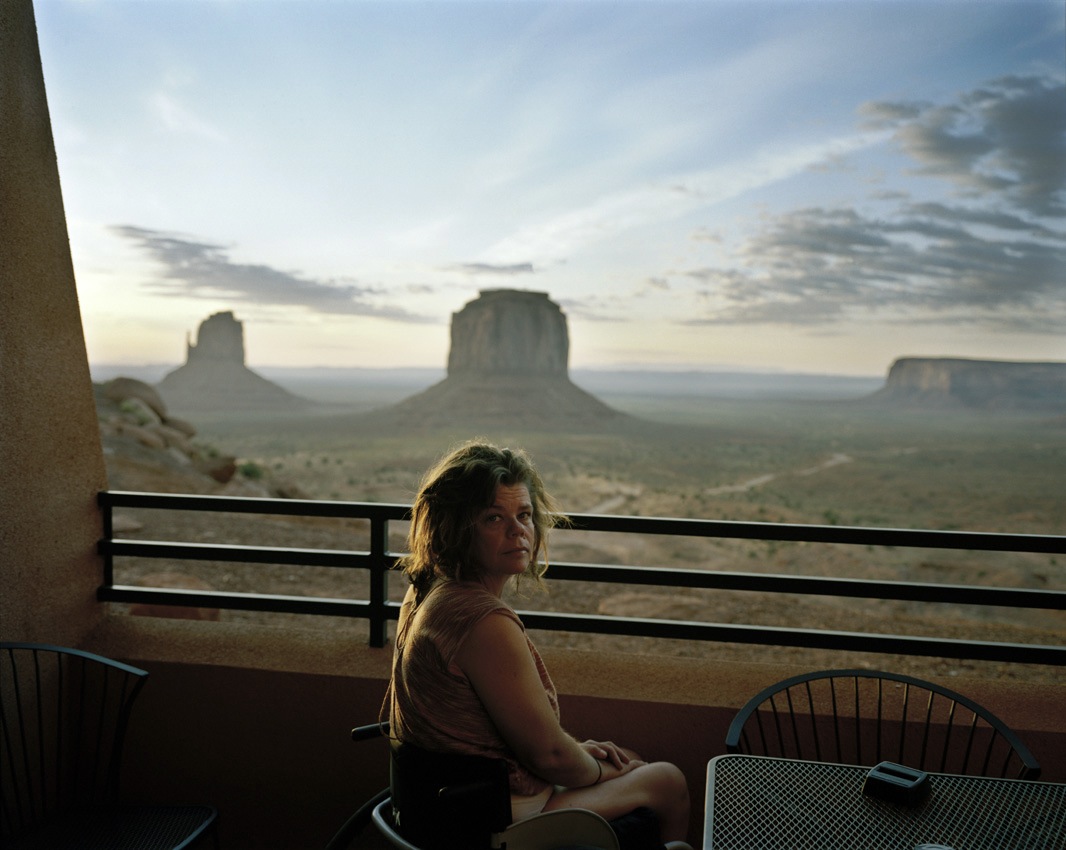
Nicole Monument Valley

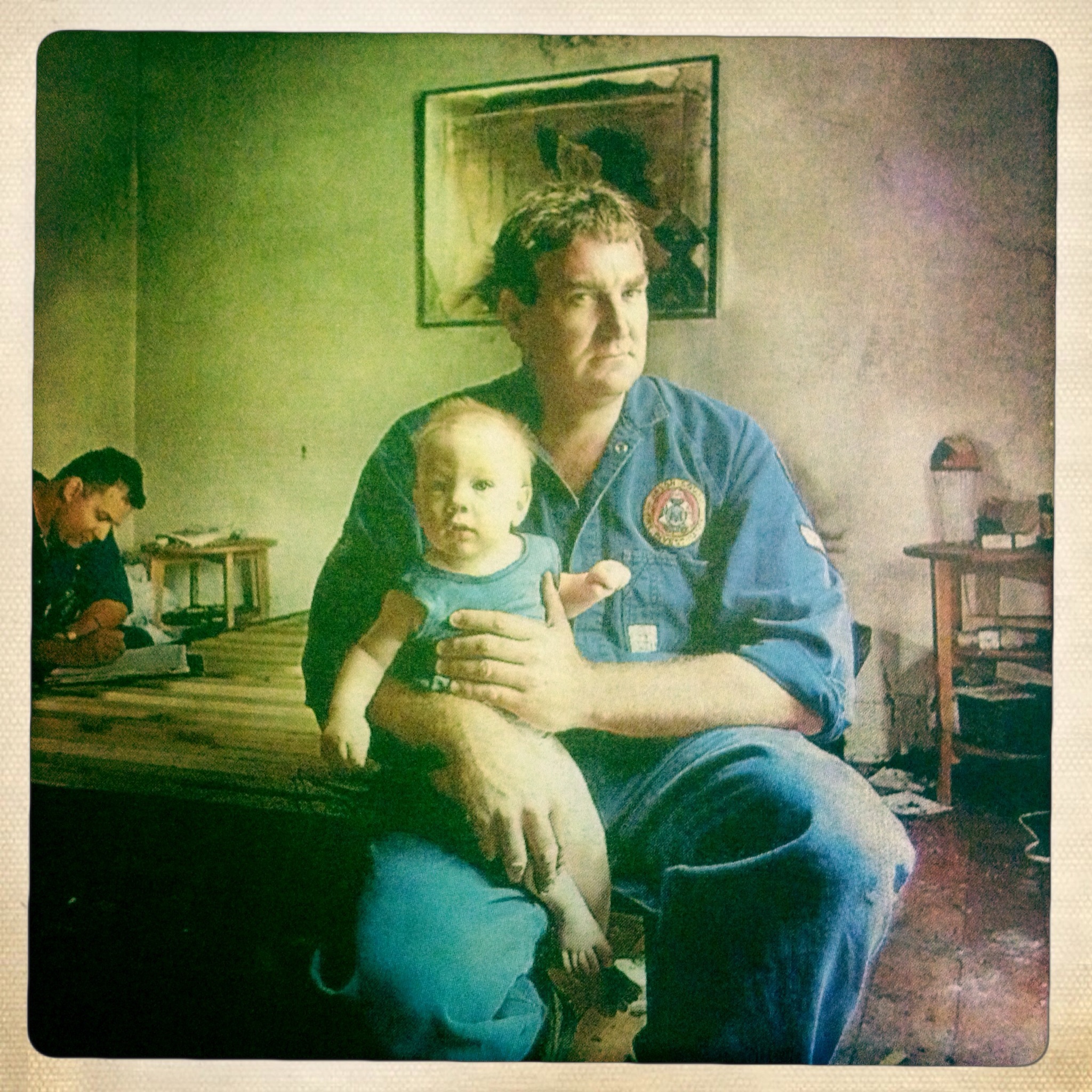
The image, taken by Graham Miller, inspired the writing of this story;


WAITING FOR THE MIRACLE

In the foyer of the hotel I meet a man. After drinks he is braver and asks what he has wanted to know from the moment he saw me in a wheelchair. Always the story of how. But really the story of after, the story of before, or the story of why goes unsaid, unpicked. It is there in the picture if you know how to look.


A car hits a tree. Fast hits hard. Wood is unforgiving. Aged carbon is as solid as stone. Bone is weak. Honeycomb really. The things I tell him are; that I was not the driver. I don’t want him to think it was my fault. Somehow that makes it better for me. Yes I was wearing a seatbelt. The driver fell asleep. Nothing more sinister than that. We were all tired.  She was just doing what the rest of us had already succumbed to. The sleep that comes after surf and sun.


He goes to his room. I go to mine. I suspect he wears a toupee. These are the kind I attract. He walks soundlessly on carpet to the stairs in shoes that have never seen the dirt. I point to the lift. I remember climbing stairs, barely.


****


The things I don’t tell him.


Through the car windows the sun streams in slats made by trees and branches. Like interlaced fingers across your face. Ribbing the road. There is the hum of tyres. A melody of sleeping notes. The sand is still between my toes and in the dip of my belly button. Salt has dried in my hair, so it is like tendrils of thin stripy seaweed. I suck a strand of it like a baby does a finger.


I wear a second hand dress from an op shop from a country town run by old biddies and not gone through like the second hand shops in the city. It is synthetic and sweaty but beautifully cut. It makes my armpits moist and saltier still. It is cream with black flowers. Who would have thought of black flowers? As they slice it from my body in the hospital it is binned in a disposable bag. It is just a $2 frock but I miss it still.


My boyfriend comes to see me in the hospital. All brown and surfy. His hair stiff with sea. It is a cruelty he can’t imagine. I can smell the salt on him, worse than any perfume. He is more than a boyfriend. We live together. We’ve left other people so as to entwine ourselves more completely than vine and post.


She comes too, the girl who seems beside him a lot these days. She was in our lives before all this happened. Before the tree and the car collided as if they were magnetised to each other.


******


The Story of Before;


She is blonde, but so am I, so that is not the reason. She is young, but so am I, so that is not the reason. She is bright, but so am I, so that is not the reason. She wants him and so do I, so that is not the reason. She is her, and I am I, so that is the reason.


When I enter the uni social club, where I meet him after lectures, he is there and so is she. Always these days their schedules are the same. And they are doing this or that project together. This assignment is due tomorrow; they will need to work late. I can see their faces are too close together to be talking of study. Is his skin touching hers? They are magnified to me. I analyse every movement she and he makes. This is Anita, he introduces her.


What kind of man is he? Sinewy but stooped. He needs Yoga. I already know the bends, the postures. He copies me but never learns. His body won’t soften, his spine stays curved.


After an argument, heated and passionate, there is no making up. A touch from me is rejected. Don’t. Our bodies, like shop dummies, lie apart in the bed wishing it could cleave itself in two.  I lie on my side looking out to the wardrobe, seeing my reflection in the grey-spotted glass. Then I am pushed from the bed by his feet in the middle of my back. Boof. On the floor. Like a child who has rolled out in their sleep. But no one is there to cradle and soothe and place me back under the covers. So on hands and knees I make my way to another room and curl asleep on a chair.


He is so clever with words. Was that the reason? He writes reams and reams. He fills yellow pads with scrawling epic poems. He wants me to read it. To praise him. Always about love, he writes, and God.  If I take too long to read it, because I have my own study to do, he is offended. It means more than I am busy too. It means I do not care about him. It means I do not care for the things that are important to him. Of course it means I do not love him.


I must convince him of my love.


But his need for love is fathomless. Like the open cut mine it is deep and ugly and scarred. I fill it time and time again but it is a piddling attempt to pack the gaping hole. It is turning into something else between him and me. He is making me compete with her and I am losing.


She is more capable.


We are living together in a student house. We eat eggplant and beans. We heat the house with a fire. We collect wood from vacant blocks. We can’t afford a trailer of mallee roots. The landlord has many cats that he comes daily to feed. Like bats they appear at dusk when his car pulls up outside. He leaves the diesel motor running and it beckons the strays. From under old car bodies and out from under limestone foundations cats pour like liquid fur. He stands beside the boot, dishing out the entrails and carcasses he has brought. There is the odd hiss and claw as they saunter back to their hideaways with their bounty.


Inside the house we are two people at war over scraps. Scraps of love that are torn at like rags. He wants to go to her. She is a fresh thing, he has yet to tread on and make soiled with sadness.


******


The Story of After;


Now I am injured he has remorse. But it is also an escape for him. He can be injured too. How dreadful to have a girlfriend so handicapped, such a burden. He must make daily trips into hospital and sit by my bedside. He must drive past the surf.  He must leave his trail of sand on the lino for someone to sweep.


Sometimes she is with him and she is sweet and kind. I cannot believe that I like her. I want to be her friend. She starts to come without him. We both wear no makeup. Her skin burns in the sun. Mine tans. But in hospital there is no sun, just harsh buzzing fluorescence. Our skins have the same milkiness. I am fading into the sheets. When I wake up from another surgery her hand holds mine.


She unburdens herself and tells me she was with him, entangled, coiled beneath cotton, as the car hit the tree. She was warm and wrapped in flesh while my bones bent and broke like twigs.


Her confessions are tearful. We both weep. She is crying for her own self and me for mine. Again we are the same. She doesn’t want him anymore. I can have him. I can.


He talks about garden paths and pushing me in my wheelchair through the forest. He can make this and that. He can convert, he can carry up stairs. Beside the hospital bed beneath the cotton of his boxers I give him a hand job.


Back in the house of cats we have ramps and an open bathroom. Men friends with tools have converted the kitchen and bathroom so that a wheelchair can manoeuvre and a hand control is put in the car, and it all sounds so easy to just convert and rearrange, but inside the house the house is different. I see it from the height of a seven year old. There is a clunking to movement, a sound of wheels and squeaky rubber tyres on floorboards. No one says you will miss the sound of bare feet.


I can get into an armchair and remember my legs. I can close my eyes and when the phone rings go to get out of the chair to answer it before my mind registers there is a new way to do this that involves no legs. Getting up without legs. All arms. Hauling around legs that are weighty in their uselessness but as good as amputated.


Burn me and cut me and still they do nothing. I wish them gone for all the good they are. Separated by him, so he can still call what we do love making.


More girls. This time they are different from me. They walk. They can feel their vaginas. I can’t compete. I don’t want to compete. He has made me a non competitor.

It is not enough to love someone with all your might. To squeeze every ounce of love you have into it, so that you are a husk after all the wringing is done.


******


The Story of Why;


I will go from him. To my own place. I will worship things like monumental rocks that the indigenous people prefer you don’t climb. In their magnificence I will seem small. I will wake up at dawn so I can look out to the sunrise and watch it slowly make its way upward and in its rising feel my own self soar. I know I look sad, but it is not sadness you see in my face. It is the face of someone who knows loss, and knows that in losing there are great gifts.


Leunig in the Kitchen

Michael Leunig

Leunig asks himself, “What is this?”

It is his way in to everything.

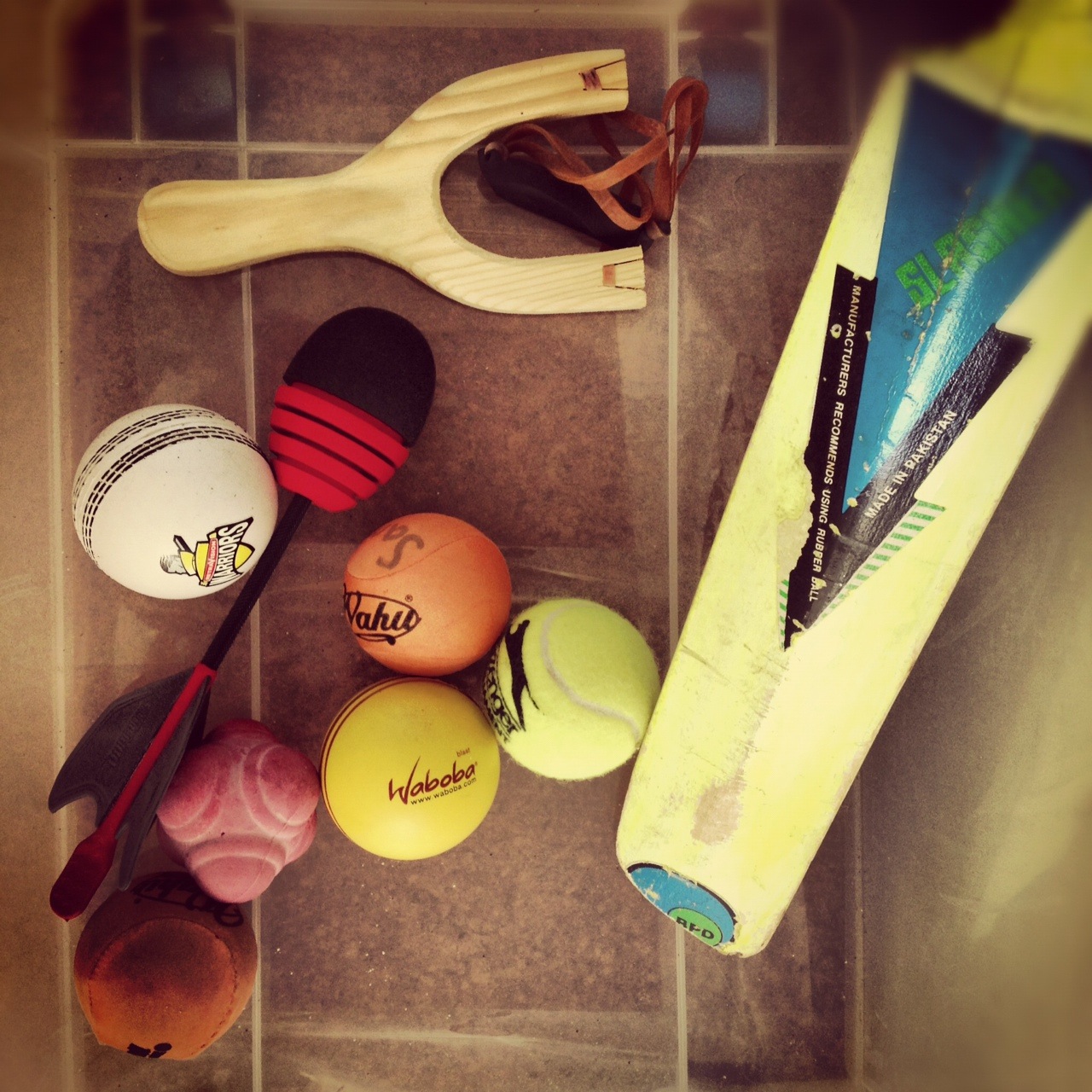
He describes his childhood as one of benign neglect. He grew up in a working class family with four other siblings. He played in paddocks on the suburban fringe. His playground was the rubbish tip. As a child he started a fire and burnt himself severely enough that it took him six months to recover and learn to walk again. He nearly lost some toes. His playthings were a dog and shanghai. He pinged at tin cans. He says it taught him much; trajectory, velocity…I can imagine him. A mop of wavy hair, poking a stick at rubbish, asking himself, “What is this?”

He had a duck, bought as a fluffy yellow duckling. It imprinted on him. It followed him. He likes ducks. He likes their rounded beak. He likes that it is does not peck but rather dabbles. Non-threatening. To him ducks provide the way forward.

He doesn’t look for meaning. He admires the musician, who, in making music is not asked to explain its meaning. They are free from that kind of scrutiny. To the musician mystery is allowed.

He has been able to stay in a childhood state of wonder, asking, as he looks at the world, “What is this?”

People in the audience are hanging on every word. They lean forward on their lecture theatre seats, tipping towards him, craning. The man in the row in front lifts his glasses and wipes his eyes. People are hungry for his simple wisdoms, given like small morsels. We are the ducks and he throws us satisfying crumbs. He tells us “hang on to your childhoods.” All the aged people in the audience murmur in agreement. But their childhoods may already be lost to them. How to get them back? He talks of wonder, dreaming, mindfulness. It is what a child does without thought. He needs no courses on how to do it. No meditation retreats. A rubbish tip, a duck, a pencil and a piece of paper will do.

Leunig sees the pathos in things. This is what attracts him. As a child he saw two men engaged in a fistfight. A drunken brawl. It filled him with shock and sadness. Again he asked, “What is this?”

“Love your enemy,” he tells the audience. War doesn’t end on the battlefield. Deaf in one ear, he could not be conscripted to go to the Vietnam War. He had been prepared to go to gaol as a conscientious objector, but in the end his disability prevented him from having to make a stand. “They took the wind from my sails,” he says.

He failed Year 12 twice, he tells us. The second time he did worse than the first time. Someone asks him why he continued at school if it was so hard for him. Wouldn’t he rather have stayed home? He says he wanted to be with his friends and that he had some worthwhile teachers along the way. He liked being there. It didn’t matter to him that in the end he hadn’t passed the exams.

It is a hot sticky day before the crossing of Cyclone Rusty. I have returned from Kitchen Garden where eggs were marbled in a pot of black goo – star anise, soy, cassia bark, black tea and more. The hard-boiled eggs were cracked and peeled and inside the egg white had turned beige and brown filament veins mapped the ovoid. Like wonderfully cracked porcelain. Like terrazzo. I felt like Leunig might on viewing the beautiful eggs. What is this?

marbled eggs

And how much Leunig would have loved the sago pudding?  The minature white balls are like miniature stuffing for a bean bag. The kids can’t help but let them run through their fingers, over and over again. They are white and hard, but cooked they turn into translucent beads. They are sticky and gooey and have no flavour – not until mulberry syrup and coconut milk are added. The mulberry syrup is a deep dark purple liquid. Viscous. As it gets added to the sago it turns it mauve. It is the colour of the storm cloud, the one that is heading our way. It still isn’t flavoursome, but it is delicate and strange in the mouth and everyone has an opinion. It is a bead. The tapioca is more about texture than taste. It awakens another sense. To the children who made it it is magical. The artist-child holds one between a finger and thumb and says to the little glasslike ball – I call you Nemo.

Imagine

Jasper


Imagine you are ten years old and deciding what to do with your life. Butcher, baker, candlestick maker. You have an unimaginable future ahead of you. You cannot perceive of an illness or accident that would prevent you from doing anything. You haven’t been on this planet a long time and yet you feel you know a helluva lot. You know you like pastry. You know it’s not wise to live off it. You know you like the rain. You know you aren’t quite brave enough to do anything crazy on your skateboard. Your parents tell you loads of stuff in the wizened way of old folks. Follow your dreams. But your dreams are of running. Someone chasing. Selecting for your future has somehow become the thing to think about, all of the time. How is it that they can suck the excitement out of anything with their calculated predictions, their carefully put forward analysis? They don’t want you to make the same mistakes as them.


You wonder if you are some kind of mistake they made.


Sometimes you feel like a piece of play dough. The parents are big-fisted toddlers who are pawing at you. They make you this way. Then they make you another. A thumb to the side of the face. They don’t like what they see. They roll you into a ball and try all over again. You are getting sandy and dried out. But despite their attempts at sculpture, you are already made. Back in your plastic tub you are bursting forth with your own decisions, little arms bud from the body, thin athletic legs spring out.


The lid pops off and the little play dough boy is off and running. Think; the Ginger Bread Man.


They can’t stop where you go now or what you do. You might get flattened. You might dry out. Run, run as fast as you can. You can’t stop me I’m the Ginger Bread Man.


I used to buy him a Ginger Bread Man every Friday from Annie’s bread stall in the market. In a white paper bag I delivered it to school at pick up time. Smartie eyes. He ate his head off first. I called the woman Annie every week for years. I felt as if I knew her. Then one day I heard her called Janice by another customer. I was mortified. How had I been calling her Annie all these years and she had never corrected me? I asked her. Is your name really Janice? Yes, she said. But to you, I am Annie. I like being Annie. Despite this I started to call her Janice. Every time I said it, we smiled. When the shop finally closed she came out behind her counter and we hugged like old friends; a moment between floury, bountiful baker and loyal customer. I had tears in my eyes. No more weekly Ginger Breads for my boy.


On the radio I hear an interview with the man who is the designer of the Academy Award Envelope. As a child he imagined being the man to design the folded paper encasing the name of and the Oscar goes to. What kind of child dreams that dream?


A visit to a high school makes the play dough boy look small and squeaky. Large boys with hairy legs and deep voices, men really, lope around the courtyards. What has happened to teenagers? So large. The girls, too. Shorty shorts with giraffe-long legs. Hairless, naturally. Lipstick disguised as lip-gloss. Can the ten year old see himself here? Will he get lost between the science room and the art department? Something about my own high school experience bubbles near the surface. It’s scary not knowing people. It’s scary being small. What if no one likes you? What if when you speak, you say something that other people laugh at?


But there are many differences between this high school and mine. We were nearly all white. Girls. Here there are Sikhs with turbans, African, Asians, Indians, Indigenous and us. It is the United Nations. A small blonde white kid popping his way out of his plastic tub. Stretching his legs, rolling over his bowling arm, finding a friend to talk to over lunch. Now I have a place to imagine him when he is away from home at high school. Sitting on a limestone wall around a chess court in the quadrangle engulfed in difference, all made to feel equal.

Ginger Bread Man


Back In the Kitchen…

parsnips

It is the second week of a new school year and we are back in the kitchen garden. The kids shirts are still stunningly white.

It is February weather in Perth. That means hot. Heat wave hot. Four days over forty in a row. No breeze at night. Withering gardens, brown lawns, windscreens that shimmer with heat. Hot bitumen basketball courts. So hot that recess sees kids choose to sit under the shade of an ancient gum rather than run about.

For this first week back in the kitchen there is a review of how to safely use a sharp knife. Claw grip, making a bridge across a vegetable. I must get Lee to show me first before I can instruct the children. I realise I am not a good example. How have I kept all my fingers? That mastered, we push on to halving and de-stoning the nectarines for our tomato and nectarine salad. The nectarines hang onto their hearts like drowning sailors to a life buoy. In the end we macerate a few and think of various creative ways to get the flesh from the sticky stones, all the while remembering to use our knives safely. Some nectarine flesh is consumed in the process. I warn too much stone fruit will find you on the toilet.

We need basil;  two students are sent to collect the herb from the blisteringly hot garden. There, cherry tomatoes are soaking in the sun, turning sweet. Salad leaves are wishing for some respite. I imagine the girls returning with their aprons, used like a basket, carrying the pungent leaves. Instead they come back with the prescribed twenty-four leaves, each individually plucked from the stem, in the palm of their hot hands.

Another child, sent to get a herb, comes back with a thumb pinch of the stuff. Yes I think we need more. Lots more. Go again. Yes I know it’s hot.

What is it with the kids and the picking of herbs? Like they are bringing back gold. Sometimes they are sent back three or four times.

Today every dish is about the fresh produce we have in season. We have tarts – puff pastry base topped with sliced figs, caramelised onions and grated cheese. Fig trees grow like weeds around Fremantle. Their gnarly tree trunks burst from limestone walls and rubble cliffs. This is their time – the beginning of the school year, as if designed to give sustenance to a tired child on a hot walk to and from school. The branches arch earthwards, making their fruit accessible to even the shortest of fruit-pickers. The purple, green fruit drop from the trees and are splattered on local footpaths. Soles are sticky with their juice. The white sap from the picked fruit stains your hands brown. If you have a fig nearby you know to break them open and check for bugs before you pop it in your mouth. Broken open, a fig’s flesh quivers like it is a nest of squirming larvae. Its warm, sticky flesh dissolves into sweetness. Figs; fruit of the Gods. But remember Lorikeets and rats feast on them too.

We have a salad of green with the added crunch of parsnip chips grown from our garden. Planted too close together, the roots grew deformed and twisted, and yet they still add a yummy texture and flavour to the salad. And besides, not many kids are partial to parsnips before they’ve tried them this way. In a purple plastic bucket, like the sacrificed tails of piglets, they wait to be sliced and then shallow fried. The humble parsnip turns into something especially delicious.

We eat our lunch under the shade of gum trees. The garden workers have been allowed to spray themselves with the hose since it has been that hot. A bee dying for a sip of water gets the table all riled up. Ravens wait for the food that will surely drop beneath the chairs. The table has been set with its checkered red and white cloth. After a year of kitchen garden there is already tradition and knowing. The children have collected flowers to decorate the table. The parent helpers and head cook are thanked and then we begin. Bon appetito.

Newbie parents are baptised in the ways of the kitchen. The cleaning group students have disappeared at the crucial moment when there are dishes to stack in the dishwasher and mountains of plastic glasses to stack away.

But success in the kitchen garden is measured not by how well we tidy away. ( Although it is appreciated and noticed.) It is about tasting, trying new flavours and making magical discoveries such as fig and feta, tomato and nectarine.

figs


Learning…

from John WS Bradshaw

So I am three days into the reading of Module 1.

I am freaked out by the mention of the Drosophila fly in a paper on Behavioural Genetics. I had hoped to go to my grave never seeing that word in print once more. I am taken right back to those Genetics lectures given by Professor Bradley. You know; the steep lecture theatre beside Bush Court, where half closing your eyes and navigating the steps gives you vertigo. Where swivelling desks are the bane of the left-handed. He, like a swollen bumble bee, buzzing behind the lectern, us, up the back behind our hands, giggling, not paying attention, as usual. Mesmerised and dulled by the tone of his voice, we drift off. What is it about lecture theatres that makes sleep so inevitable? We are studying vet science. We are in third year, trying our best to scrape by. Third year – where study becomes mud that must be waded through. We are eager to get our hands on scalpels. Search out ovaries through a cow’s rectal wall. What do we want to know about fruit flies?

There are words here that are vaguely familiar.

Alleles, genotype, heterozygous, homozygous, hybridisation, phenotype, pleiotropy… Who are you kidding? Did you ever know their definitions? Not knowing their precise meaning gives them even more power to alarm. If it were poetry perhaps they could be beautiful. Instead they vibrate with science. I need to look them up and add them to the glossary. To the dictionary then. The maroon-covered Merck Veterinary Dictionary. These words are now taking up space inside my brain. They jostle for position. I ache for more diagrams, more visuals, even the words could be prettier. The stories. Where are the stories? Surely genetics is the best narrative of all. And then comes the story of the cat. During medieval times she is considered cursed and the companion of witches. Seen in the street at night it was best to kill her or maim her, knowing she was likely to be a witch in disguise.

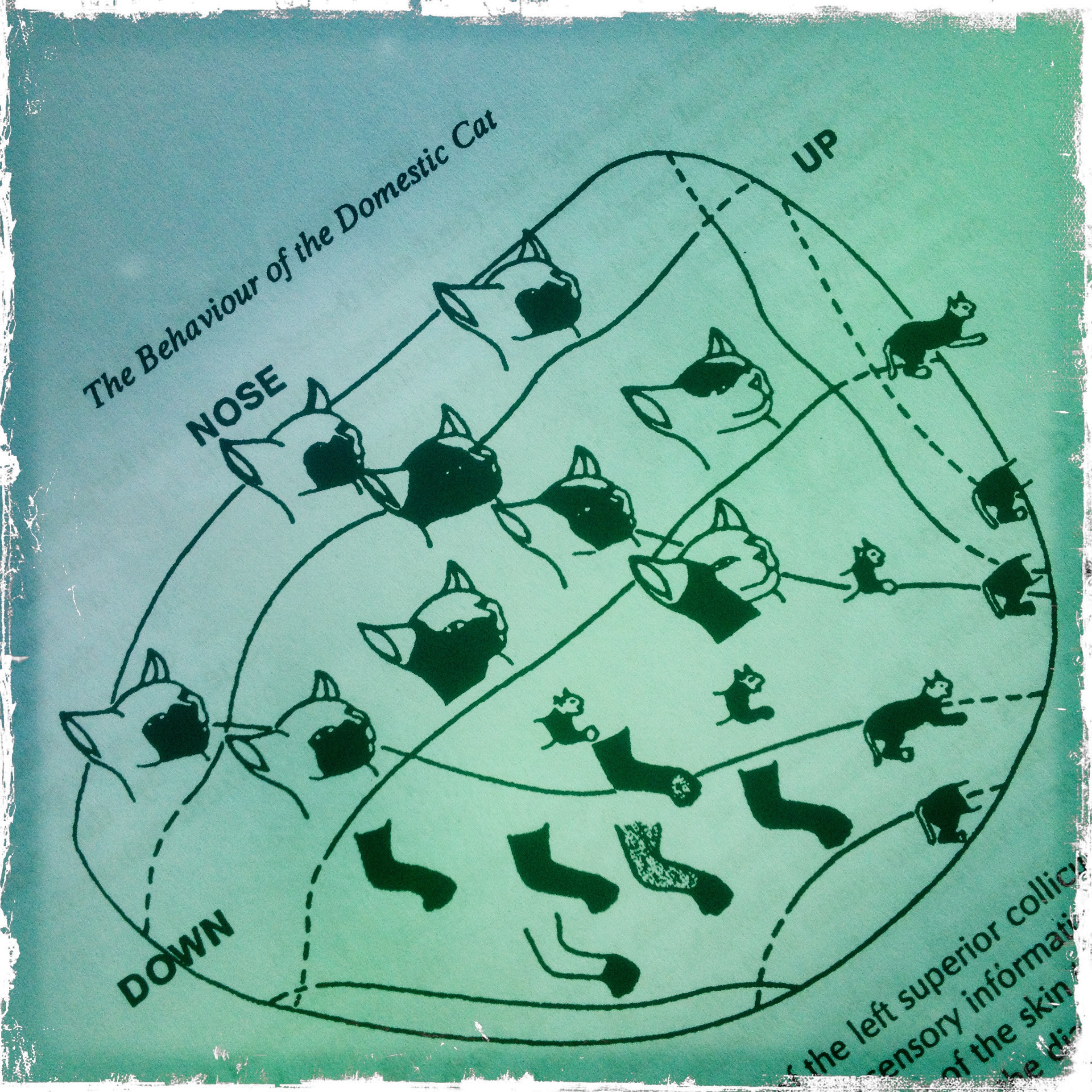
What I learn; the cat is genetically more resistant than the dog to large variations in shape and size. Its manipulation has been less malleable. They have been domesticated for a shorter period, but even with more time, they seem unlikely to become as varied a species as Canis familiaris. It is as if they have kept a bit of themselves secret from us. Always a little bit wild. When the pupil of a cat is fully open she has nocturnal vision equal to that of a bat or a badger. To think that Chinese peasants used the size of a cat’s pupil to tell the time. I look at a diagram of the cat’s superior collicus in its mid brain – an area that processes and integrates sensory information. It is all about its face and fore paws. The fact that you’ve known since childhood that a cat uses her whiskers like eyes and that her paws are stealth weapons. Some things are easy to learn. You see them.

Some things; like the fact that sled dogs always keep one foot on the ground and that that foot happens to be a sweat-free foot, selected for through breeding the best sled dogs, since it is less likely to collect ice as the dog runs, just stay with me. And that dogs who have single or double flights in their gaits, like greyhounds, would be unable to pull a sled, and instead would be struck off-balance, as all four feet leave the ground when they run. And to be a good sled dog you need to be able to poop and pee and run all at the same time. These things stick in my brain.

Some things; like the fact that in domesticating the dog we have designed a creature that needs us and depends on us and wants our company. Like a plasticine model we have pushed it into whatever shape we have desired. We have selected it for tameness (a reduction in flight distance) and in doing so we have reduced its brain size, changed the shape of its face and ears and tail, increased its vocalisation, made its sexual cycles shorter and kept it in a permanent juvenile state. Even the skulls of the largest dogs are no bigger than that of a four-month-old wolf. When we have issues with our dogs it is often a misinterpretation of the qualities we have designed them for. For instance the Border Collie who chases cars, the Blue Heeler who bites the ankles of children, the terrier who digs up the rose beds and the dog who pines for his master while he is away from home. We have asked Lassie for loyalty and boy have we got it.

New Beginnings

study file

It is a hot day near the end of the school summer holidays. It has been the usual. So much swimming. Chlorine is the smell of summer. Stretchy bathers that are wearing away. Rashies that sag to the knees.

A pile of notes has arrived for me from the Uni.

I am going to study.

I am in wet bathers at my desk. I open the package. Jasper thinks it is a present. It is of a kind.

It has modules in it. Wrapped in plastic and prepunched ready for a lever arch file. I can make a trip to Office Works. Legitimately.

I begin to read what they call Module Zero on the internet. It has taken me an age to get this far. For some reason (but no doubt something I was to blame for) I had created two logins and the one I am using has no material in its downloadable files. They needed to give me a new password and chose elephant. Why elephant I wonder? I access it. Module Zero. It is a pre module. It is something to think about before you even begin to study. Reading it makes my heart race. It is about learning and memory and what are the best ways to motivate you and how to remember and how to study. Left brain. Right brain. What about No brain? What I am remembering is the terror of University. The fear of failure. Yes like Pavlov’s dog the bundle of notes have triggered a learned response. Panic.

I tell myself to breath. As if from heaven, I am interrupted by ten year olds who must go to the pool or else they will die.

Here they spend time devising a plan to get ice cream.

Eating a proper lunch first might just be the only way.

It is too hot to be a spectator. I get in to do laps. But it is half hearted; since I have done all the laps I had planned to do this week. I can just get in the water and flop about. But habit kicks in and so I mosey on up and down. In the lane next door a man is swimming in his khaki knee length shorts complete with belt.

Mmm I think. He must be desperate to swim. Overwhelmed by the heat perhaps. Some kind of foreign tourist unaccustomed to bathing suits…

At the end of the fifty metres I am about to turn when I look across and see him sitting on the edge of the pool smiling broadly at me. Excuse me, he says. I lift my goggles to eye him. What length is the pool?

Clearly he is pleased with the completion of his one lap.

It is an Olympic pool, I say. Fifty metres long.

Everyone is so happy here, he says. So many laughing children.

Yes, I suppose so.

I have not thought about who is happy and who is not.

I hang on the lane rope looking at him and his smile. Something about him invites questions. Perhaps the way he smiles. He tells me he hasn’t swum in a pool before. Just the ocean. What do you think? I ask. Do you like it?

It is good for my legs because I am a refugee and I have been tortured, he says, still smiling.

Oh, I see, I say not seeing at all. I don’t know what to say next after this. I guess I am unused to having a conversation with someone after they have mentioned their torture.

I prattle on about the pool, about how it is heated and he can come here every day if he wants and it is always the same temperature. He tells me he couldn’t afford to come every day. Someone has paid for him today.

Well…

I wish him well. Have a nice swim, I say. I swim off and see him out of the corner of my eye keeping pace with me, a lap across. Sometimes he does a kind of dog paddle and other times an attempt at freestyle. His legs are all over the place but he makes it up and down and up again. Swimming like he has fallen off a boat and is swimming for his life. Saving himself.

As I swim more laps I wonder about his loved ones. Are they in Sri Lanka still? Does he pine for someone? What can he think of the pool, with its inflated crocodile?

Missing Jasper

from John Muir book
from John Muir book

Jasper is away.

A long way away.

He is across a very big continent. He is in a different time zone. He is not with either of his parents. It feels weird. He rings and his voice is so young. He is inquiring when he speaks to us. He wants to know whether we have seen movies and gone to out to dinner. We have instructions not to see Jack Reacher without him, but it is okay to see foreign films. He wants us to have a good time without him. Like he is worrying about us. The same way we are worrying about him. Mutual vexation. We try to be as descriptive as we can about the very ordinary things we are doing while he is away. There is a niggle knowing child-free time is precious and we should be doing more. We should be going out later than late. What drugs could we still take and fully recover from? But that need is gone, it seems. We should be doing more than seeing the early evening session of The Life Of Pi followed by Indian food. Home in time to catch the end of the tennis.

We have bought a new Kombi (new to us, but still forty years old) and after taking down the inside cupboards a line of rust in the roof is revealed. For a long time water has pooled here and eaten away at the metal. It is a rusty, gaping hole where there should be solid, comforting metal. Instead there is unsupportive air. She was supposed to be rust-free. We are disappointed because we liked the guy. After all he is going to live in Bali and teach Yoga and surfing. We trusted him when he said he had cut all the rust out. Why did we trust him? We chastise ourselves for being gullible. There was no way of seeing the rust. But.

It will cost a lot to fix. More than we imagined. And first we need to find someone capable and willing to do the job without ripping us off.

When Jasper saw the Kombi he fell in love with it immediately. Because it has a pop top. It is a place for him to sleep. It is up high, above his parents and a long way from creepy-crawlies when you are camping. It is the ultimate cubby. We were infected by his enthusiasm. Suddenly I am dreaming of travelling around Australia and home-schooling. I am thinking of abandoning the house, researching the dog-friendly camping sites and high-tailing it.

There is something about a Kombi that turns children into urchins. Suddenly they love the dirt and sticks and simple things. They no longer need ipads or game boys. The possibility of adventure, the thought of no showers, the snuggling under a fleece-lined sleeping bag on top of a still warm engine. What’s not to like…

Jasper as a three year old urchin in our first Kombi

It would solve our high school issues. No need to decide on a school even. School of Kombi.

But it doesn’t stop me pouring over all the web sites for all the schools. I am researching scholarships and GATE testing. I am finding out the difference between academic extension programs and Independent Public schools. I am wondering whether Catholic education is suitable for heathens. I am looking up school boundaries and contemplating renting in Shenton Park just to get into Shenton College. I am trying to recall the name of relatives that have attended elite boys schools. Would their name help? I have a brick on my chest.

I go to the pool and swim. It is something I haven’t done in a long time. It got lost when my parents got ill. It was the first thing to fall by the way side. Even though it is only half an hour, it was a half hour I couldn’t seem to get back. It hid itself from me. Then it had began to take sneaky peeks at me from behind a sofa.Today I found it. Cornered it and held fast. Graham suggested coffee in town, but I stuck with the swim. I had trouble locating my bathers. Would the lycra have bubbled away? Would they still fit? Just. I couldn’t remember how much money I needed to locate in coins for the entrance fee. I know there will be new girls at the counter. Maybe they will want to see my concession. I feel more blind without my glasses than I use to. I will never recognise anyone who chooses to say Hi.

I feel my body, heavy and sluggish, over the first one hundred metres. The rhythm needs to be found. Muscle memory recovers itself. I don’t push it. I just roll the arms over. I am trying to rock my upper body more in an attempt to not hurt my shoulder. It is the kind of thing the over-forty swimmers need to do. I breathe deep and slow. With each lap serenity returns. Ah yes. The water. Giving back. Like the life source it is. A swimmer passes me and leaves a trail of silver bubbles sparkling like sequins flowing from a ball-gown. They are saying follow me into a space. Come with me hither. The ladies are doing their deep-water aquarobics beside my lane. Their bodies are round, festive baubles, reminding me of Christmas and maraschino cherries. They have yellow floats around their waists, making them buoyant. I think of The Life of Pi and the turbulent ocean. Of his swimming to the life raft. Of the tiger. So fierce, so beautiful. The cherries’ legs are working hard, like they are peddling an invisible bike. Above the water their heads model hats and sunglasses and their air is fogged by the cloying scent of their makeup and perfume. Even at eight in the morning. But it is good exercise and who knows when you may need to swim that little bit harder to reach the shore or the life raft. I just mosey along. Given the need to reach the raft I may just go down with the boat. My laps = No rush. Not going anywhere. Up and down and back again. Losing myself in the monotonous stroke and the motion. Not counting the laps, because it is too taxing and means I can’t day dream. Mesmerised by the blueness of the sky.


from the short story “The Lost Order” by Rivka Galchen

from the NewYorker

What I love about this story in a recent New Yorker is the narrator’s anxiety, so wonderfully revealed. It has a Miranda July weirdness about it…

“I was at home, not making spaghetti. I was trying to eat a little less often, it’s true. A yoghurt in the morning, a yogurt at lunchtime, ginger candies in between, and a normal dinner. I don’t think of myself as someone with a “weight issue,” but I had somehow put on a number of pounds just four months into my unemployment, and when I realised that this had happened – I never weigh myself; my brother just said to me on a visit, “I don’t recognise your legs” – I wasn’t happy about it. Although maybe I was happy about it. Because at least I had something that I knew it wouldn’t be a mistake to really dedicate myself to. I could be like those people who by trying to quit smoking or drinking manage to fit in an accomplishment, or at least an attempt of an accomplishment, into every day. Just by aiming to not do something.”

and what about this for great description of two female delivery persons;

“I feel somewhat bad because I find I am staring at these women’s asses (I think of that word as the most gentle and affectionate of the options) and I feel somewhat good because both of the asses are so attractive, though they are quite different: one is juvenile and undemanding, and the other is unembarrassedly space-occupying and reminiscent somehow of gardening – of bending over and doing things. The pants are tight-fitting. I do know that I – and really everyone – am not supposed to think this way about women, or for that matter men, because, I guess the argument goes, it reduces people to containers of sexual possibility. But I’m not sure that’s quite what is going on. Maybe I just think these women have solved the getting-dressed problem.”


Rottnest 2012


Every year we go to Rottnest in November. It is our family tradition. We have done it since Jasper was in utero and before he was even thought of. In those days we had an imaginary child called Pee Wee. Somehow she skipped childhood and we never envisioned her at Rottnest. She was a gamine who grew up to be a singer in a jazz band and who lived a groovy loft on Manhattan. In our musings we were aging grey-headed parents who visited her there. But that’s another story. Instead we got a blue-eyed boy, who, like the real boy he is, comes with us on holiday, a forty minute ferry ride from home.

Arriving at Rottnest is like going home. You have stepped out of your Fremantle cottage to shortly enter your more primitive but better abode. This home has no messy desk, no laundry, no bills and, most of the time, no telephone coverage.

So much of every part of the holiday is soaked in familiarity. Do you remember the year I nearly fell off my chair onto the Dugite? What about the time Vinnie cracked his helmet smashing into the wall as he stacked his bike? And when Jasper caught his finger in the flywire door? Each year melds with the former so it can no longer be recalled what year it was and who was there. That time we stayed in the back row, with Troy and Jo and the boys were babies. Remember when we showed the Nordic Anja the flickering of the orbiting satellites. She had never seen a sky so black, so unaffected by city light. There is the routine of arriving at the ferry terminal early enough for someone to unload the plastic containers full of belongings and beach gear and still have time enough to drive home again and return riding their push bike, into the head wind, with the semis roaring by. This year Jasper is old enough to do the bike run too.

There must be enough time to sweet talk the ferry men into the delivery of the-above-allowable-safe-lifting-weight beach wheelchair in its bag. They have not denied me thus far.

Once arrived at the island there is the picking up of the key from the accommodation office. Invariably the unit is not ready, but they have taken to texting you when it is, and so we just go to the bakery to wait. Here donuts are bought. Not because they are especially good. It’s just what we do. Energy for the hill. Is the peacock that frightened Jasper as a baby still alive doing its dance? The seagulls that live around the settlement are the most brazen and will snatch a chip right out of your hand just as you are about to put it in your mouth. But this year I have learnt that seagulls mate for life, and some how knowing this makes me feel kinder towards them. Somehow I notice that they are in pairs when I have never seen this before. Before I thought of them as flying rats. Me; older, softer.

There is the ascent to climb on the way to the Longreach. The kids race off, well ahead on their geared bikes. No one is pushing a pram, or hauling a trolley with little ones. The way is known to the boys. Past the Police station, the nursing post, the oval, the Basin. This year I am walking alone to the chalet. I have a heavy load of extras under the chair and a bag on my lap. But it is not super hot and who is in a hurry anyway. The odd moth-balled quokka is about attracting the odd tourist who squats in front with a camera. To the boys the sight of a quokka is no more interesting than that of a seagull. The new attraction is freedom. Ahead of the parents. Gone.

The oval is dry, the grass cracking, and the sign still says the water used to reticulate the grass is unsuitable for drinking. The potholes in the bitumen remain.

The hill to Longreach is my test. One day I will falter here. One day I will not have the steam to make it up unaided. For now it is doable. Tough if it is hot and the chair is loaded. But still. Flies make a nuisance of themselves when my hands are too busy pushing to shoo them away. At least the glasses keep them from the corners of my eyes. I am slow enough to look up and see the windmill and marvel that its spinning is providing the island with its energy. A large black skink, like an expensive sunglass case, slithers through the scrub. I love the whoosh whoosh of the giant windmill blades as they rotate. They give the wind muscle. Cyclists whizz past going down hill, wind-smiles on their faces. I look at the bitumen as they pass, think about how sweet it might be to stroll up the hill, taking step after step in soft leather sandals, then put my head down and keep pushing.

Then the familiar Longreach Bay comes into view. It has a large section of light blue water where there is no weed. We call it the Big Blue. Yachts are anchored to moorings around the edge of the blue, but it is mid-week and there are only a few. The moorings are familiar too. There are ones that we swim out to as a test. There are ones that we have swum to and then whilst treading water in the deep we have gasped as beneath us the dark shadow of a stingray swims by. There is a descent now to the front row of Longreach chalets. I can get some speed up. I get my own wind-grin. Still the others will have been there a good fifteen minutes already. They will have brought the luggage inside. They will have chosen their beds, checked the fridge is filled with the groceries delivered by the shop and rearranged the kitchen table. Graham will have disconnected the tv and faced it, like a naughty child, into the corner. Single-handedly he will have manoeuvred the couch out onto the verandah and faced it towards the Big Blue. We always strung a hammock, but since a child died when a pillar collapsed, the authority that runs the island has banned this. On this holiday a worker erects a sign on the balcony saying maximum capacity of nine persons. Graham will have set up the sound system and might even be flopped on the couch with his feet up.

When I arrive the boys will have their shoes off. They will be jumping on the bed, climbing the door jambs Spiderman-style and exiting through the windows of the front bedroom. They will have scattered the cork tile floor with their belongings. Already Hot Wheels will be lost in the far reaches under the beds. It will have taken only a moment for them to turn feral. From now on they will sleep in beds full of sand, with black feet and salt-encrusted hair. They will wear the same boardies and t-shirts for days. They will reluctantly put on sun-screen and a hat. They will joyously travel to the shop several times a day for whatever it is the adults need, just in case they can wing an ice-cream or a sweet lolly.

Sometimes there will be a surprise in the chalet like a new coat of paint. This year there is a photograph of a sunset at The Basin adorning the wall.

Otherwise it is like returning to your own home. Few things are different. They have decided to give you more dishwashing liquid, but anyway I bring my own. The scrubber is still crap. Don’t worry I bring that too. The single tea towel is still inadequate. I have several. They have dispensed with the enormous stainless steel pot big enough to boil a whole crayfish. Shame. They still only give you one roll of toilet paper. Tight. Over the years the beds and pillows have improved but we still bring our own foam eggshell and our latex pillows. Because that’s the thing about Rottnest. It is a little bit of home. For the people who go there regularly, it is just an extension of chez-moi. We have friends who take their own elaborate coffee makers and their Thermomix. They make sure everything is just so. Someone might have the ritual of tying a red ribbon to their gate latch for the littlies to know which is their chalet. Someone else might set up a table for cards or scrabble or jigsaw puzzles. Someone might set up a sun shade on the beach and leave it flapping there all week, like they own a bit of Longreach.

You know it so well that you recognise the sound of the closing of the yard gate. It has made a groove in the sound memory of your mind. You know that at night the bathroom door will bang softly, but loudly and consistently enough to keep you awake if you don’t stopper it with folded cardboard. You know the sound of the metal latch on the front door, designed to stop it slamming shut in the afternoon gusts. You know which bay will be most sheltered for the direction the wind is blowing. You know one day one kid will be sunburnt and another will fall off his bike. You know that ice cream will make it better and it will come from the freezer so cold that you can’t scoop it out with a spoon unless you boil the kettle and warm the spoon first. Note to self – next year bring the Zyliss ice cream scoop. When one boy has forgotten a toothbrush and he is sent to the shop to buy one he returns with a toothbrush so old-fashioned that it reminds you of your own childhood. It has a handle of a single colour. It has no grip for your thumb. No knobs to scrape your tongue. It has no fancy bristles of different lengths or fading colours to massage your gums. It reminds you of when the Colgate toothpaste tubes were metal and to squeeze them in the centre got your Dad riled. It reminds you of communal bathrooms in caravan parks where your mother made you wear your thongs in the shower incase you caught something off the concrete. It is the simplest of brushes. He tells you that that is all the shop had in the way of tooth brushes. Nothing fancy.


The Fire

This story was first published in 2003, in issue 95 of Island Magazine. It is a decade since a fire burnt our house. At the time my sister was dumping my dad. A baby was learning to sleep. It seemed the fire and the family implosion happened simultaneously. Ten years on the baby is a tween. He sleeps restfully. My sister recovered her relationship with both of our parents before they passed away. The family healed. The house was repaired. The fire is still a powerful image and the story (I hope) is worth revisiting….
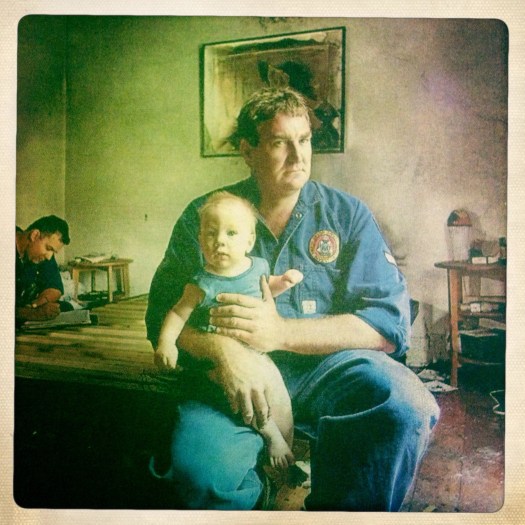
My baby boy gets his hair from me. It sticks up straight off his head. The hair is soft and blond; the colour of spinifex, or a wheat field before harvest.

He isn’t used to sleeping alone. He isn’t used to being in a room where we’re not. Up until this point we have taken him with us everywhere, it seems. While he sleeps in the kitchen we speak in hushed voices and leave the washing up. We bring him, still sleeping, into the lounge. We don’t watch war movies or ones with car chases and gun shots. We mute the television during the ads.

To get him to sleep on his own has been painful. I have felt it in my chest and my head. I have felt more conflicted over this than anything, ever. Before I had a baby I thought it was possible to never let a baby cry. Before I had a baby I thought I knew much more than I know now. Teaching to sleep; what a crazy idea.

If you are teaching to sleep the books recommend consistency, confidence, calmness. All these things abandoned me when he was crying like someone was ripping his arms off.

But time helped and we and he got better. Eventually, but more than the three days predicted by all, he was sleeping longer and I was feeding only once in the night after midnight. Then we had the fire.

We had been to a party and Jasper had been baby sat for the first time by my friend Sandy. It was three in the morning and we were all asleep when someone lit the curtains of his bedroom. Have you read this sentence and not believed it? I wanted it to come upon you more slowly, but a fire is a fire. It happens quickly. In an instant. Quicker than a sentence a fire takes hold of the muslin curtain that is soft and light and moving in the breeze by the open window. Does the person stay to watch it burn the fabric, stay to make sure it will really get going, or do they flee, up the park steps to watch from the safety of the oval?

Once the muslin is on fire then does the calico catch next? How high are the flames now? How much light do they throw on the room? If the arsonist still stood outside by the window would he see the cot? Would he see its white-painted wood glistening and the teddy bear slumped on the floor? Is the skin of his face warmed by the blaze?

From across the continent my sister writes my father a letter and tells him she wishes to break off their relationship. Like some kind of annulment. The fact that she is forty and that they have had conflict for most of her life doesn’t mean she wants it to continue. The fact that our father is eighty, an old man, does not make my sister sympathetic. She is sick of all the shit she gets from him. She writes it out in a big long list – the humiliation, the abuse, the anger. She thinks, I find out later, that she can call off the relationship like she could with a lover, a boyfriend or husband and that eventually she’ll feel better about it. Over it. She doesn’t seem to know that you can never really be rid of your parents or their influence on you, even if you never see them or speak to them. They are in your cells.

As I hold Jasper while I wait on the footpath for the fire brigade I think about this. I press my lips into his soft cheek. My nose smells his skin. Fresh and sleepy. He doesn’t know why he is taken out of his bed at three in the morning. He doesn’t, of course, know the time at all. But I think he recognises that things are different. The sky is black, solid. His father, Graham, is moving quickly in shorts and no shirt with a hose. He is energetic, whereas I am numb. Useless. I hold the baby. It is all I am required to do, thankfully. I am the mother. I do not have to try to put out the fire. I am holding the baby. Keeping him safe.

My mother and father want me to read Lisa’s letter, as if i will be able to sort it out. They are perplexed like old people. They are old people. They could never have expected their daughter to call it off. My mother whimpers on the phone and I am reminded of a puppy pawing at a pet shop window. But what can I do? When we were teenagers I did the counselling. Our rooms were separated by wardrobes, one facing one way and the other in reverse, so between them was a gap of a few inches. Our heads were close by as we lay in our beds. Till late into the might we discussed the problems we had with our parents. We plotted our route to independence. We rode away on our bikes to the cemetery near our house and played in the bushland. I tell them I do not want to be in the middle telling her they said this and she said that. I tell them it is between Dad and Lisa. Mum should keep out of it too. My sister thought my mother might not even see the letter. How little she knows them. Of course my mother opened the letter addressed to Dad as she walked down the red cement path from the letterbox. She’s read it before she even got to the front door. I have decided to stop trying to have a relationship with you, it opens…

The hose doesn’t reach. Graham has to get another from the backyard and join it to the one at the front. It all takes time. I see his fingers as if they are magnified working hurriedly with the connectors. Like the way I watched his hand grapple for the key we keep hidden in the architrave of the bedroom door before we burst out the front and down the garden path. He stands in the garden bed and points the hose into the window. Water arches out like an ornamental spray. Immediately he sees the pointlessness of this attempt. I watch and feel aware that the scene is vaguely amusing. It is also beautiful. The bright orange flames leap out of the window. They flick into the night. Their brightness makes everything around them darker. The night becomes thinker, blacker. There is sound too. It is the warm sound of crackling, burning, a campside fire. A sound I have never before thought of as sinister, or scary. Then there are loud cracks as glass inside shatters. The pictures are being blasted. Their paper is burning, turning coffee brown. Think treasure maps made in primary school. The light fittings are breaking apart, exploding with heat. Black smoke is billowing out of the window. It is really burning now, I think.


I remember being on the farm as a girl. We’d knock down blackboy stumps with our feet and break up bits to light a small fire so as to boil the billy for a cup of tea. They worked well. My sister and I grinned at the burning vegetation. We had no thought for the blackboy. We saw no justification in exempting it from our need or pleasure. Just like we called it black boy, without a thought.

We can hear the fire sirens. The trucks swing into our street and I see their flashing lights. The diesel engine is loud, thudding, as it makes its way towards us. I raise my arms in the air. Over here. We are over here. My outstretched arms beckon. Graham stands beside me. He rests a hand on my shoulder, like we are an outback couple standing beside an airstrip watching a small plane land.

My father wants my help. I suggest he see a counsellor who might be able to assist him in reaching out to my sister, in bringing her back. He is eager to do this and I guess I am a little surprised. I imagine him at the therapist’s trying to summarise his dilemma. He would be tongue-tied, more foreign than usual, more Dutch. I see his socks neatly pulled to under his knees, held there by elastic, his hands nervously clasping each other. He wears too much aftershave, pulls his shorts too high on his waist. He asks me if I think it could be genetic, after all it’s in his family – his brother broke from his mother and he hasn’t seen him either for forty years. Maybe he thinks that if it’s in her genes it excuses him. I tell him I don’t think so.

The therapist has suggested he start with letter writing. He is to write once a month, enclosing old photographs.

When my sister receives the first of these letters she tells me she sees the attempt at reconciliation as trying to make her feel guilty. She thinks the old photos reek of emotional blackmail. She says that she does not question that we had good times growing up. What is he trying to prove sending her these old photographs?

The firemen are enormous. Yellow suits, hard hats, heavy boots. They come towards us shouting. Anyone inside? Where’s the fire? Show Us! Graham leads them to the window and points, although it is obvious now. They can see it too. They unravel the large water hose and blast a thick jet into the room. The fire is out. Firemen, twelve of them, are everywhere. They walk with their arms held out from their bodies as if their heavy suits stop them from bending. They run too, but in slow motion, like spacemen on the moon.They come up to me and ask us if we are okay. Any coughing? Is the baby’s breathing normal? They tell Graham he did an amazing job, treat him as a hero. We will get the chaplain to speak to you, one of the yellow men says. I think this is unnecessary. Aren’t chaplains for the dead?

I ask when we can go back in. I imagine we will be able to sleep in the front room. I imagine something like a small campfire at the window of the burnt room. I have no idea. The fireman bends down towards me; we’ll get the chaplain out, he says again. Best you stay with your neighbours for now.

In our neighbour’s house we have a makeshift bed on the floor of the lounge room. Liz has listened to Jasper’s chest with her stethoscope. Michael has made tea. We are waiting for the chaplain. I still hold Jasper close. Now I can smell his hair. It is impregnated with the smell of burnt rubber. It overtakes the smell of cleanliness, of breast milk. I smell the sleeve of my own top. It is there too. In the days following the fire the smell follows me everywhere. A tip from the chaplain: wash clothes in a loosely loaded washing machine, with a capful of eucalyptus oil.

The chaplain arrived near four in the morning. He didn’t look like someone who had got out of their bed in the middle of the night. His hair was combed; deep furrows lined his forehead like a freshly ploughed field. He was in uniform. He didn’t mention God, or prayers. He was practical, informative, well rehearsed. He gave the impression he knew what he has talking about. The aftermath of fire was his business. We, on the other hand, knew nothing.

I didn’t think my family was as fucked up as it is. My sister needed to do what she did. In a way I’m glad for her. Glad she had the courage to say what she had wanted to say for years. But also, for my own sake, wish she could just go with the flow. Just switch off to our father’s insensitive comments, his silly teasing. Or perhaps she should have had it out in a huge expansive row. Maybe she could have thrown things; smashed plates, cursed and then after all the mayhem they could have cried and made up. Sadly, only in the movies is it quite that easy.  


I didn’t get to see inside the house till the following day. I crunched over glass down the hallway to the room where the arson squad squatted on their haunches by the burnt window. I said Oh My God more times than I could count. Nothing else could come out of my mouth. I was aware of repeating myself but unable to stop the inane phrase. The detective had to grab my attention. We need to ask you some questions, he said. Together we went back through the night about what I had seen and where different items in the room were. What had the curtain be made of? What had been on the bed?

The once white room was now black. The closer to the ceiling the blacker it got. Sticky soot hung on the walls and large strands of cobwebs covered in smoke hung from the ceiling. The wooden floors were littered with cracked glass and burnt material. One picture had fallen from its hanger but it’s frame was still intact. The burnt paper of the picture made a piece of abstract art. It was beautiful somehow. A streak of melted latex mattress ran from the bedroom down the hall and out the front door from where it had been dragged outside by firemen. A toxic smell filled the air. A childhood memory surfaces; melting the plastic casing of a Bic pen by holding it against the coil of the radiator.

Even the rooms not burnt were black. The hallway was black. In the study a fine film of soot covered the computers, the shelves of books, everything. I picked a book of the desk and my hands were instantly black. I began to feel overwhelmed by the dirt, by the blackness, by the thought of the damage, the loss, the need to clean stuff. So much stuff. So much dirty, black stuff. I guessed now that this was what the chaplain had been talking about. This was what he warned people of. Because before people saw the damage they didn’t know the first thing about a little fire.

The arson squad, their blue overalls amazingly clean and bright, talked about the language of fire. They poked around in the room for hours, scribbling on clipboards. They could tell exactly where the fire had started. It hadn’t been electrical or the baby monitor or anything innocent. It had been someone outside lighting the curtains of the room. They were certain. If they were to see a fire in a hundred petrol drums they could pin point the one that had ignited first. They had ways of telling.

The decline in the relationship between my sister and father has none of the characteristics of a fire. No one can track where it started. What was the spark that set the whole thing aflame? The science of relationships is less precise. If only there was an equivalent to Detective Tilley in the psychology department, who could get hold of my father and sister and, with pen in hand and clipboard on knee, nut it out. Yes, it is dirty work, he said. You had no choice but to get down and dirty. He said it like it was one of his favourite lines.

Graham is on the phone to the shock jock who has tracked us down at the hotel. Some lunatic set fire to Graham Miller’s eight month old baby’s room…Can you tell us what happened Graham? Graham has agreed to go on the radio and the television news to help get the smoke detector message across. It saved our baby’s life, he reiterates, even when they try to get him to say something irrational, angry, vengeful towards the arsonist. Instead Graham says that he thinks the person has a problem and needs to be helped.

We are staying at the Mosman Beach Apartments while they fix up our house. Mosman Park is a strange suburb. There is a mixture of the extremely rich and the down and out. Closer to the river are mansions and expensive girls’ schools, while nearing the highway there are old weatherboard cottages, renovator’s dreams and high-rises. A large salmon brick block of flats with a reputation for housing junkies overlooks our apartments.

It could be a month before we are home again. A company which specialises in fire and flood damage removes everything from the three front rooms and the hallway. They will clean it all and return it. This is the thing about insurance.

In the small two bedroom flat there is a sense of relief at not having all our stuff. We have only a couple of bags of gear with us – clothes that were on the washing line and unaffected by the fire. Like the times when I have been travelling or camping, I again realise the burden of belongings. Not having any of it frees my time. All there is to do is play with Jasper.

It is summer and hot. The apartment is on the ground floor, so is insulated by two levels above. Still I have the overhead fans on. Their dusty blades move the air and keep us cool. There is carpet for Jasper to crawl on. He can sit unaided. I attach his high chair to the breakfast bench and feed him canned fruit blended with rice cereal. The resident golden labrador stands at the screen door and wags his tail. His name is Ronnie and he is training to be a guide dog someday. Every afternoon his trainer comes and puts on his harness. He becomes sedate and she takes him out. When they return she talks to Barry, the landlord, about him, like he is a child having piano lessons. She updates Barry on Ronnie’s progress. Graham had nicknamed him Ronnie Irani after the touring English cricketer.

I spend a lot of time on the brown fake leather couch. I watch endless amounts of tennis. Hewitt. Agassi. The Williams sisters. The cricket is less interesting. Australia thrashes England. Lehmann is suspended for a racist comment on the pitch. There are bush fires in Canberra. For once I feel I can relate. Before I thought people on the news talking about their damaged homes were being melodramatic – so overly attached to their belongings. Four hundred homes are destroyed and some people are found dead. A lot of people have no insurance. The news reports how people had to be ordered from their homes and how a man saved himself by running water over himself from a hose as he huddled in the corner and watched as his house burned down. Tears well up in my eyes. I see there is no smoke detector is the flat.

I think Lisa’s decision to have nothing to do with my father is selfish. I talk to Sandy about it. She is, after all, a psychologist. She is often able to say something that makes the incomprehensible understood. Perhaps she is close to Detective Tilley in this way. She says people become selfish in a response to having to look after themselves. Perhaps, as a child, my sister couldn’t trust them to care for her in the way she needed. Selfishness was a response to a lack of love. If she didn’t look after herself who would?

Graham is ironing a work shirt. I move back and knock my arm into the point of the iron and burn the skin. In response to my “ouch” Graham tells me to move away. He is curt. I burst into tears. He goes to work.

Later I see a dead mouse on the floor. Half of its body is under the fridge. I see its back legs splayed out. I can’t bring myself to scoop it up with the pan and broom. I skirt around it and out the flywire door to get the landlord. He is talking to another guest and I say excuse me, can I show you something. I take him to my apartment and point out the mouse. He admits to being frightened of them too, but manages to get it into the dustpan while I avert my eyes.

Jasper wakes in the middle of the night. I go in to him briefly and settle him, then leave the room. I have been taught this by Ngala. As I leave his cry becomes louder, more insistent, more angry. Do not respond to the angry cry., the child health nurse has told me. I resist the temptation to go in. I stand outside and listen. It kills me. I watch the clock. Every ten minutes I go in any way and tell him it is okay. But it is not okay. He is beside himself now. He is so angry. I am no longer confident and calm. I retreat to the bedroom where of course Graham is awake. No one could sleep through this crying. I imagine the entire block of flats is awake. Perhaps the neighbourhood. Will someone ring the police? Will they think I am sticking him with burning cigarette butts? The crying goes on. And on. It gets louder and then softer and then louder again, but it never stops for long. A few times I think he is going, fading off to sleep, but then he starts up. Graham and I lie in the dark. We hold one another’s hand. We plead with the air for him to sleep. We see that it has been over an hour. It’s not working. Perhaps he has a rash. Have you checked him for a rash? asks Graham, as if it is something a mother should know to do. I think you should turn on the light and check his skin? Suddenly that seems possible. Perhaps it is meningococcal disease. I switch on the light. It is fluorescent and insanely bright. He screams louder than is humanly possible. No rash detected. In the end I take him to bed.

Once my father felt the way I feel about Jasper about my sister. He would have felt the same pull, the same yearning for her. I know it. How could he not? Where has it gone? The sadness of this loss is bigger than most things for me at this time. I cannot imagine what it might be to not have my child with me anymore. Perhaps it is wrong, or at least not the best thing for him, to try to teach him to sleep by himself. How can it be good for him to learn that his mother does not answer his cries? That instead, in a room lit with a strange slanting, fractured light, she stands behind the door and fearfully watches the clock.

In the morning when I wake, and he is asleep beside me, it is hard to recall the distress of the night before. In the early hours the light-switch in the bathroom had seemed penetratingly loud, some creaking outside, annoyingly close. Now there is the workmen’s radio from the housing units next door, the bells of the railway crossing and the hum of the electric train. Ronnie Irani is running by the pool fence and destroying the garden. Barry is about in his Speedos and no shirt.

We inspect our house daily and watch the slow progress of the cleanup. Gradually the stink begins to fade. Everything is repainted. The workers litter the front garden with cigarette stubs and wash out their brushes on the plants. Cleaners prise soot from the floorboards. Our clothes are returned smelling of almonds. People whose houses have never been burnt say it’ll be as good as new. We buy more smoke detectors than we need and place one in every room. We no longer leave the windows open and curtains will never again flap in the breeze. Eventually books go back on the shelves. I turn them over in my hands and smell them. The slightest whiff of smoke remains. We inspect security mesh but decide on plantation shutters. For awhile I go back to breastfeeding Jasper in the night. I listen for footsteps on the path outside. I write cards to the fire brigade, the chaplain and the arson detectives, that can’t help but seem inadequate in thanking them. We have credit at a linen shop in the city and I can buy the mohair blanket I have always wished for. Later when I lie reading on the bed with the rug drawn up around me, I think how it will always be a reminder for me of our time away from our house, of the fire, of the rift between my father and sister, of Jasper’s babyhood and his sleepless nights. I instil in the inanimate object more emotion than I should. What if it was ever to be lost to fire or moths? I press it to my face, feel its wonderful warmth, smell its animal tang, its earthiness and delight in it.